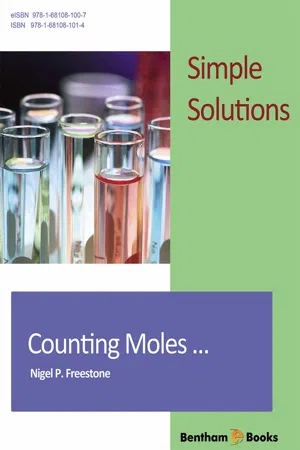
Students studying chemistry often struggle with the mole. Counting Moles provides an effective aid to learning by giving clear and confident presentation of the essentials of the mole concept needed by those starting chemistry courses. This user-friendly self-teach e-book is split into six chapters which sequentially introduce the 'mole calculating frame' to help solve problems. Over 200 fully worked examples are given along with several hundred questions.
The mole concept is applied to topics such as relative atomic mass and relative formula mass, percentage composition, empirical and molecular formula. The book also covers concentration, its units, volumetric analysis and the relationship between volume, mass and moles of gases. Counting Moles culminates in you taking a Mole Driving Test. On passing this test, you are issued with a Counting Moles Driving License that will give you all the confidence required to correctly answer all mole calculations.
- English
- ePUB (mobile friendly)
- Available on iOS & Android
eBook - ePub
Simple Solutions – Counting Moles...
About this book
Information
Mole Driving Test Answers
Nigel P. Freestone

To Pass the Mole Driving Test and Throw Away Your M-plates You Will Need To Achieve a Score of Greater than 70%. Each Question is Equally Weighted (5%).
| Relative Atomic Masses: |
| Hydrogen (H) = 1, Carbon (C) = 12, Nitrogen (N) = 14, Oxygen (O) = 16, Sodium (Na) = 23, Sulfur (S) = 32, Chlorine (Cl) = 35.5, Potassium (39), Calcium (Ca) = 40, Copper (Cu) = 63.5, Barium (Ba) = 137, Mercury(Hg) 200.5, Lead (Pb) = 207. |
| Molar Volume: 22.4 L or 22,4000 cm3 at STP (273.15 K and 1 atm) |
| Avogadro’s Number: 6.02 x 10²³ |
- 1. Rubidium has two naturally occurring two isotopes. 72.2% of all rubidium atoms have a relative atomic mass of 85 and the rest have a relative atomic mass of 87. What is the average relative atomic mass of rubidium?
- Answer:
Average Atomic Mass=(72.2/100 x 85) + (27.8/100 x 87)
=61.37 + 24.186
=85.56
- Answer:
- 2. Compound A was found to have the following composition: 47.0 % potassium, 14.5 % carbon, and 38.5 % oxygen and a relative molecular molar mass of 166.22. Determine the empirical and the molecular formula of compound A.
Answer:
| Potassium | Carbon | Oxygen | |
|---|---|---|---|
| % composition | 47.0 | 14.5 | 38.5 |
| Ar | 39 | 12 | 16 |
| % composition/Ar | 47/39 = 1.2 | 14.5/12 = 1.2 | 38.5/16 = 2.4 |
| Ratio | 1 | 1 | 2 |
- Empirical formula: KCO2
Relative...
Table of contents
- Welcome
- Table of Contents
- Title Page
- BENTHAM SCIENCE PUBLISHERS LTD.
- FOREWORD
- PREFACE
- Relative Atomic & Formula Mass, Percentage Composition, Empirical & Molecular Formulae
- The Mole
- Moles & Balanced Chemical Equations
- Molarity & Concentration
- Volumetric Analysis
- Molar Volumes & Reacting Volumes
- Mole Driving Test No. I
- Mole Driving Test No. II
- Mole Driving Test No. III
- Mole Driving Test Answers
- PERIODIC TABLE
- License
Trusted by 375,005 students
Access to over 1.5 million titles for a fair monthly price.
Study more efficiently using our study tools.
Frequently asked questions
Yes, you can cancel anytime from the Subscription tab in your account settings on the Perlego website. Your subscription will stay active until the end of your current billing period. Learn how to cancel your subscription
No, books cannot be downloaded as external files, such as PDFs, for use outside of Perlego. However, you can download books within the Perlego app for offline reading on mobile or tablet. Learn how to download books offline
Perlego offers two plans: Essential and Complete
- Essential is ideal for learners and professionals who enjoy exploring a wide range of subjects. Access the Essential Library with 800,000+ trusted titles and best-sellers across business, personal growth, and the humanities. Includes unlimited reading time and Standard Read Aloud voice.
- Complete: Perfect for advanced learners and researchers needing full, unrestricted access. Unlock 1.5M+ books across hundreds of subjects, including academic and specialized titles. The Complete Plan also includes advanced features like Premium Read Aloud and Research Assistant.
We are an online textbook subscription service, where you can get access to an entire online library for less than the price of a single book per month. With over 1.5 million books across 990+ topics, we’ve got you covered! Learn about our mission
Look out for the read-aloud symbol on your next book to see if you can listen to it. The read-aloud tool reads text aloud for you, highlighting the text as it is being read. You can pause it, speed it up and slow it down. Learn more about Read Aloud
Yes! You can use the Perlego app on both iOS and Android devices to read anytime, anywhere — even offline. Perfect for commutes or when you’re on the go.
Please note we cannot support devices running on iOS 13 and Android 7 or earlier. Learn more about using the app
Please note we cannot support devices running on iOS 13 and Android 7 or earlier. Learn more about using the app
Yes, you can access Simple Solutions – Counting Moles... by Nigel P. Freestone in PDF and/or ePUB format, as well as other popular books in Physical Sciences & Chemistry. We have over 1.5 million books available in our catalogue for you to explore.