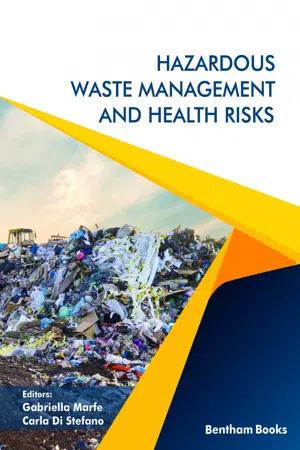
Hazardous Waste Management and Health Risks presents a systematic overview of evaluating solid and hazardous waste management practices. The book introduces readers to the basic principles of hazardous waste management and progresses into related topics that allow managers to assess environmental quality. These topics include heavy metal pollution, reproductive biomarkers as signals of environmental pressure and health risks, and environmental contamination in an international perspective. With an emphasis on sustainable development throughout the text, a zero-waste strategy as an alternative way to manage hazardous waste is suggested in a dedicated chapter. This reference book is intended as an introductory guide for managers taking waste management training courses and students involved in degree courses related to environmental engineering and management.
eBook - ePub
Hazardous Waste Management and Health Risks
- English
- ePUB (mobile friendly)
- Available on iOS & Android
eBook - ePub
Hazardous Waste Management and Health Risks
About this book
Information
Reproductive Biomarkers as Early Indicators for Assessing Environmental Health Risk
Luigi Montano*
Chief of Andrology Unit and Lifestyle Medicine, Local Health Authority (ASL) Salerno, EcoFoodFertility Project Coordination Unit, Oliveto Citra (SA), Italy
Abstract
The evaluation of exposure in association with information on the inherent toxicity of the chemical (that is, the expected response to a given level of exposure) plays a critical role to predict the probability, nature, and magnitude of the adverse health effects. The epidemiological findings, the results on cancers and other chronic diseases with a long latency are a weak tool to reduce the risk for the current and next generation. An important issue is the exposure time into health risk assessment/management, especially in highly polluted areas, where health problems increase. In this regard, the environment and health aspects must become, as a matter of urgency, an international priority, both in terms of policy and resource allocation. The use of reproductive biomarkers for early risk detection is introduced by the EcoFoodFertility research project in one of the areas with the highest environmental impact in Europe, “Land of Fires” in Southern Italy. This area, a symbol of the ecological crisis, represents a possible new methodological approach in public health. This chapter aims to explain how biomarkers of reproductive health could be exploited as early flags of environmental pressure and enhanced risk of chronic adverse effects on health. In particular, human semen seems to be a sensitive source of biomarkers, giving information on biologically active exposures, and it can be very useful for preventive health surveillance programs, especially in environmental risk areas. This approach appears very promising, above all, in young people (maximum fertile age:18-35 years), considering the possibility to reduce the chronic-degenerative diseases in future adults. In this context, many scientific findings are increasingly about the association between pollution and fertility problems and therefore, the safeguard of germ cells is a new challenge to reduce the burden of epigenetically transmitted diseases.
Keywords: DOHaD, Ecofoodfertility, Environmental Marker, Endocrine Disruptors, Environmental Health, Epigenetic, Health Marker, Human Semen, Land of Fires, POHaD, Public Health, Pollution, Reproductive Health, Semen Quality, Sperm Epigenome.
* Corresponding author Luigi Montano: UroAndrologist, Chief of Andrology Unit and Lifestyle Medicine, Local Health Authority (ASL) Salerno,EcoFoodFertility Project Coordination Unit, Oliveto Citra (SA), Italy;
Tel: 00393339433861; E-mails: [email protected] and [email protected]
Introduction
The World Health Organization (WHO) and the Organisation for Economic Co-operation and Development OECD, (https://www.oecd.org/china/air-pollution- to-cause-6-9-million-premature-deaths-and-cost-1-gdp-by-2060.htm) calculated about 600,000 premature deaths and diseases caused by indoor and outdoor air pollution in the European Union [1]. Furthermore, many findings point out the responsibility of human activities on climate change which is becoming very dramatic. Naturally, human lifestyle plays a central role in the onset of many chronic diseases, as reported in the European Code against Cancer, although the effects of chemical and physical pollutants actually represent the most important threat to public health whose transgenerational effects should cause considerable concern to policymakers. In fact, most of the outdoor and indoor contaminants exert their action as endocrine disruptors by altering cellular signals and also, inducing oxidative stress (excess of free radicals of oxygen not balanced by the presence of reductive activity). The oxidative stress is able to damage at biomolecular level DNA, proteins, lipids, which, if not properly repaired, trigger a significant inflammatory response and, in turn, induces neoplastic transformation. In this regard, the imbalance between antioxidant defenses and detoxification processes produces the onset of oxidative stress diseases in humans, due to increased susceptibility of the organism to pollutants. The pro-oxidant activity of particulate matter (PM) [2] polycyclic aromatic hydrocarbons (PAH) [3] on human health has been demonstrated in clinical data, while the harmful effects, induced by toxic heavy metals or organophosphate pesticides, has been demonstrated in animal studies [4]. Exposure to environmental toxicants contributes to the increase in the production of free oxygen radicals, while the nuclear factor erythroid 2, like 2 (Nrf2), is able to modulate the antioxidant response through the cellular antioxidant system, the reduced glutathione (GSH), and the activity of the Glutathione reductase (GSR) [5, 6]. Its reduced activity has been associated with the onset of pathologies, elevated susceptibility to negative effects due to pollutants and, additionally, with overexpression of p53 [7]. Other biomarkers for pollution are metallothionein proteins, which are used as a contaminant-specific indicator of metal exposure [8]. They are inducible proteins and the accumulation of heavy metal cations within the cells enhances metallothionein gene transcription by stimulating their synthesis. The metall- othionein messenger RNA is translated by the cytosolic free ribosome; it leads to an increase in apo-metallothionein that rapidly reacts with the free metal cations that are present in the cytosol [8]. These proteins can protect cell structures from non-specific interactions with heavy metal cations and to detoxify the metal excess penetrating into the cell. In this regard, metallothionein proteins are usually considered to be important specific biomarkers that detect an organism's response to inorganic pollutants such as cadmium (Cd), mercury (Hg), copper (Cu), and zinc (Zn) that are present in the environment. The toxicity of heavy metals may be attributed to the binding of metals to sulfhydryl groups in proteins such as glutathione (GSH), resulting in an inhibition of activity, interference with structure, or displacement of an essential metal element leading to deficiency effects [9]. Repairing stress-damaged proteins and chelation of metals involving heat shock proteins and metallothionein is thus recognized as a potential mechanism of metal detoxification. Although mechanisms by which heavy metals interact have not been clearly elucidated, a number of biomolecules, including GSH metallothionein, and heat shock proteins have been predominantly recognized as major interactive mediators when evaluating interactions based on metal mixture exposure [9]. The striking feature of metallothionein is the inducibility of MT-1 and MT-2 genes by different agents and conditions. The regulation of metallothionein biosynthesis happens primarily at the level of transcription. The MT-1 and MT-2 genes in higher species are rapidly induced in vitro and in vivo by a variety of stimuli including metals, hormones, cytokines, oxidants, stress and irradiation [10]. Owing to their induction by a variety of stimuli, metallothionein proteins are considered to be valid biomarkers in the medical and environmental fields [11]. Numerous studies have demonstrated that changes in MT expression are associated with the process of carcinogenesis and cancer progression. However, the expression of MTs is not universal in all human cancers. Previous studies have shown that MT expression is upregulated in breast cancer, nasopharyngeal cancer, ovarian cancer, urinary bladder cancer, and melanoma [12-16], while in other cancers, such as hepatocellular carcinoma, prostate cancer, and papillary thyroid carcinoma, MT expression is downregulated [17-21]. Moreover, tumors arise from the interaction between intrinsic factors (constitutional variants and genetic and/or molecular alterations) and extrinsic factors (levels of environmental carcinogens and pro-carcinogens with which one comes into contact during life). In particular, the sequential acquisition and the relative accumulation of molecular alterations involved in tumor development and progression seem to be influenced by the presence of different genetic susceptibility factors (mutations and ...
Table of contents
- Welcome
- Table of Content
- Title
- BENTHAM SCIENCE PUBLISHERS LTD.
- FOREWORD
- PREFACE
- List of Contributors
- Introduction
- Hazardous Waste and its Management
- Hazardous Waste And its Associated Health Risks
- Biological Effects of Hazardous Waste: Threshold Limits of Anomalies and Protective Approaches
- Heavy Metal Pollution: Sources, Effects, and Control Methods
- Reproductive Biomarkers as Early Indicators for Assessing Environmental Health Risk
- Hazardous Waste, Health Problems, and Personal Well-being: An International Perspective
- Zero Waste Management as Key Factor for Sustainable Development
Trusted by 375,005 students
Access to over 1.5 million titles for a fair monthly price.
Study more efficiently using our study tools.
Frequently asked questions
Yes, you can cancel anytime from the Subscription tab in your account settings on the Perlego website. Your subscription will stay active until the end of your current billing period. Learn how to cancel your subscription
No, books cannot be downloaded as external files, such as PDFs, for use outside of Perlego. However, you can download books within the Perlego app for offline reading on mobile or tablet. Learn how to download books offline
Perlego offers two plans: Essential and Complete
- Essential is ideal for learners and professionals who enjoy exploring a wide range of subjects. Access the Essential Library with 800,000+ trusted titles and best-sellers across business, personal growth, and the humanities. Includes unlimited reading time and Standard Read Aloud voice.
- Complete: Perfect for advanced learners and researchers needing full, unrestricted access. Unlock 1.5M+ books across hundreds of subjects, including academic and specialized titles. The Complete Plan also includes advanced features like Premium Read Aloud and Research Assistant.
We are an online textbook subscription service, where you can get access to an entire online library for less than the price of a single book per month. With over 1.5 million books across 990+ topics, we’ve got you covered! Learn about our mission
Look out for the read-aloud symbol on your next book to see if you can listen to it. The read-aloud tool reads text aloud for you, highlighting the text as it is being read. You can pause it, speed it up and slow it down. Learn more about Read Aloud
Yes! You can use the Perlego app on both iOS and Android devices to read anytime, anywhere — even offline. Perfect for commutes or when you’re on the go.
Please note we cannot support devices running on iOS 13 and Android 7 or earlier. Learn more about using the app
Please note we cannot support devices running on iOS 13 and Android 7 or earlier. Learn more about using the app
Yes, you can access Hazardous Waste Management and Health Risks by Gabriella Marfe,Carla Di Stefano, Gabriella Marfe, Carla Di Stefano in PDF and/or ePUB format, as well as other popular books in Biological Sciences & Environmental Science. We have over 1.5 million books available in our catalogue for you to explore.