Individuals with Angelman Syndrome (AS) present many unique challenges to professionals, parents and others who are committed to maximizing individuals' competence while ensuring them the best possible quality of life. Angelman Syndrome: Communication, Educational, and Related Considerations is a unique, exhaustive compilation of existing material related to understanding the nature of AS and how individuals' communication and related skills can be fostered most effectively. It provides readers with a comprehensive understanding of the background of Angelman Syndrome along with an in-depth exploration of communication (with a focus on augmentative and alternative communication), educational, and related issues that should be addressed when attempting to meet the needs of individuals with AS at home, school, work, and elsewhere in the community.
Key features of the book include:
· Extensive background information about medical and related factors behind AS and how they influence individuals' learning
· A series of prologues written by the parents of individuals with AS
· Contributions from internationally recognized experts on AS, communication disorders, psychology and education
· Numerous practical, evidence-based strategies for conducting assessments and carrying out interventions among AS affected individuals Speech-language pathologists, allied healthcare providers and educators providing support to affected individuals should benefit from the information provided in the book by being able to identify appropriate communication, behavioral and educational goals. Laypersons, particularly parents, will also find the information highly useful in advocating for best practices for their children (which is partly fostered by the series of parental prologues).
Angelman Syndrome: Communication, Educational, and Related Considerations will not only serve as a valuable reference for improving the learning experience for AS affected individuals but will also embolden both professionals and parents to maintain higher expectations for them.
eBook - ePub
Angelman Syndrome: Communication, Educational, and Related Considerations
- English
- ePUB (mobile friendly)
- Available on iOS & Android
eBook - ePub
Angelman Syndrome: Communication, Educational, and Related Considerations
About this book
Information
Topic
EducationSubtopic
Inclusive EducationLearning Characteristics of Students with Angelman Syndrome and Related Instructional Strategies
Erin S. Sheldon*
Angelman Literacy Project Kingston, Ontario, Canada
Abstract
Angelman Syndrome (AS) is associated with a constellation of disabilities. Students with AS present in the classroom with complex communication needs, cognitive disabilities, and differences in how information received through the senses is perceived and integrated. These students also have significant strengths: strong social motivation, a desire to communicate and interact, a positive affect, and strong attention when instruction is socially interactive and personally meaningful. Understanding the nature of the learning differences in AS is essential to planning how to meet these student’s educational needs and successfully include them in academic instruction.
Keywords: Accommodation, Aided language modeling, Alternative assessment, Augmentative and alternative communication (AAC), Angelman syndrome, Apraxia, Assistive technology, Attention, Autism, Complex communication needs, Dyspraxia, Education, Emergent literacy, Engagement, Epilepsy, Fine motor, Gross motor, Sensory integration, Video modeling.
* Corresponding author Erin S. Sheldon: 37 Inverness Crescent, Kingston, ON, K7M 6P2, Canada; Tel: (613) 328-7632; E-mail: [email protected].
Introduction
This chapter is a description of the learning characteristics that are often observed in students with Angelman Syndrome (AS). Angelman Syndrome is associated with specific differences and disabilities that require accommodations in the classroom. Strategies to support and accommodate these differences to maximize learning opportunities are discussed. This material serves as a precursor to Chapter 9, Comprehensive Literacy Instruction for Students with Angelman Syndrome, where the issue of literacy instruction is examined in depth.
My daughter Maggie is in the 6th grade. When Maggie was first diagnosed with AS as a toddler, we turned to the research literature to discover best practices and guide us to meet her educational needs. The research detailed the extent of developmental delays we should expect but offered minimal direction to support us to plan her education. We were left with unanswered questions: What did her AS mean for how she should be educated? What should we do differently as a result of her diagnosis? What educational strategies could help her access the instruction and learning in her classroom? How could we maximize her participation? How could we assess her learning and use that assessment to direct our interventions? I returned to graduate school and studied the learning characteristics of students with AS. This chapter is a summary of these characteristics, drawn from the literature and analyzed for the purpose of planning for how to meet the educational needs of our students.
Learning CHARACTERISTICS
Students with disabilities may differ from their peers who are developing typically in six broad areas: communication, cognition, physical abilities, senses, attention, and affect (Erickson & Koppenhaver, 2007). Students with AS are complex because they tend to have observable differences in all six of these areas. In addition, students with AS often have medical needs that impact their learning in the classroom. This section describes the differences that school teams might observe in these students as well as broad strategies to accommodate these differences.
Communication
Angelman Syndrome is associated with complex communication needs and minimal speech. The expressive communication disability is disproportionately more severe than the student’s overall developmental delay, cognitive disability, and receptive understanding (Gentile et al., 2010). These students require intensive support in school for communication skill development. What students with AS can express is the least of what they understand. Given the pervasive nature of their profound communication disability, what students with AS can express must be recognized as the floor, not the ceiling, of their comprehension.
Dyspraxia And Apraxia
Oral speech is rare in students with AS. Families often report spontaneous words and even sentences, yet these utterances can rarely be performed on demand and may never be repeated. This inability to produce or imitate speech on command is consistent with the nature of apraxia (difficulty initiating a motor response) and dyspraxia (difficulty planning and executing a motor response). Penner et al. (1993) documented significant motor planning deficits in adults with AS and characterized these deficits as a global developmental dyspraxia with particularly severe oral motor impacts.
Many students with AS develop some manual sign language, but their signs tend to be recognizable only to familiar people within familiar contexts (Calculator, 2013). Manual sign language development is complicated in students with AS for several reasons: apraxia inhibits the initiation of motor movements, dyspraxia causes difficulty planning and coordinating motor movements, ataxia results in tremulous movements and low muscle tone, and a generalized delay in fine motor skills contributes to poor accuracy in signing. The manual signing abilities of students with AS are unlikely to meet the student’s needs enough to be understood by unfamiliar people, relate thoughts on abstract concepts, share personal stories, or report on their learning and comprehension. Educators need to plan for multimodal strategies to support communication. These multimodal strategies include manual signing, natural gestures, Enhanced Natural Gestures, vocalizations, graphic symbol displays, speech generating devices (SGDs) and other forms of alternative and augmentative communication (AAC). Fig. (2.1) shows students with AS using both light-tech paper-based AAC systems and high-tech speech generating devices.
Dyspraxia inhibits the ability to implement and enact what would normally be volitional or voluntary movements (Donnellan, Hill, & Leary, 2013). Dyspraxia is observed when students accidentally activate the wrong limb to move, seem to struggle with how to position their body in space, appear to freeze in space and then suddenly engage in a poorly targeted movement, or appear to ignore prompts to respond with a motor movement. Students who struggle with these kinesthetic dilemmas (Bauman & Kemper, 1994) may be good candidates for special education strategies such as backward chaining and the system of least to most prompts (Collins, 2012). Some students are more successful with naturalistic, predictable sequenced activities, such that the final step that requires initiation is part of a predictable flow of activity rather than a sudden demand for performance (Donnellan et al., 2013; Kliewer, 2008).
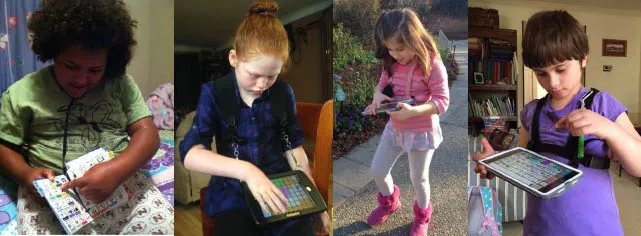
Students with AS using AAC.
Co-morbid Autism and Angelman Syndrome
Some students with AS have traits commonly associated with autism. These traits include a lack of imitation skills, reduced eye contact, ceaseless or uncontrolled movements, and difficulty with manual sign language. Compared to their peers who have AS but no symptoms of autism, students who appear to have both autism and AS demonstrate less communicative intent, such as not establishing joint attention before gesturing or vocalizing, and not escalating communicative signals to achieve a goal (Peters, Horowitz, Barbieri-Welge, Taylor, & Hundley, 2012). Students with both autism and AS initiate fewer social overtures and less social interaction than their peers with AS only. These differences are consistent with what Mirenda (2008) described as an expression of apraxia and dyspraxia in children with autism, suggesting that some students with AS who appear autistic may simply have more significant dyspraxia. Mirenda encouraged practitioners to perceive these symptoms as the reflection of a motor disorder that may be more effectively treated with “back-door” approaches that emphasize communication partners modeling the motor patterns involved in using AAC to engage in spontaneous communication, rather than performance-focused massed trials.
Aided Language Modeling As An Instructional Strategy
Mirenda (2008) argued that the research to date on various forms of aided language modeling in natural contexts (e.g., Drager, Postal, Carrolus, Castellano, Gagliano, & Glynn, 2006; Goossens', Crain, & Elder, 1992; Romski & Sevcik, 1996; Romski, Sevcik, Adamson, Cheslock, Smith, Barker, & Bakeman, 2010) demonstrates it is a viable and effective intervention for students with the greatest language deficits. Aided language input involves supplementing oral speech with visual symbols when communicating with children who do not speak. It is a strategy based on language acquisition in typically developing children. Children without disabilities acquire language through immersion in language-rich contexts and environments, surrounded by fluent models of language used for a variety of authentic purposes. Children who are developing typically learn to speak through immersion in a complete language, not direct instruction one word at a time. Children in average working class homes are exposed to 1,250 words spoken per hour, or 6 million words per year (Hart & Risley, 1995). Children without disabilities are thus immersed in models of the same oral language they are expected to master over the course of early childhood. This verbal modeling lays the foundation for language development as babies begin to experiment with babbling (producing the sounds they hear) and participating in oral exchanges. Infants who are developing typically hear thousands of words spoken in meaningful natural contexts for approximately one year before they produce their first word, but can speak about 1,500 words by age three. Thus, children without disabilities learn expressive language through rich immersion in models of language they can observe, comprehend, imitate, and finally express. Aided language input strategies presume that children who cannot produce oral speech have the same need for deep immersion in an accessible language to become fluent communicators. Aided language input is an intervention that attempts to create access to a visual, symbol-based model of communication.
Children with disabilities receive less spoken language input than their peers without disabilities. These students rarely have the opportunity to observe visual symbols used in an alternative communication system in ordinary contexts to achieve communication goals. Children who are developing typically are exposed to thousands of words from which they select the first words they attempt to express, but children who cannot speak may have access to only a handful of photographs or visual symbols. Children who cannot speak are reliant on adults to provide access to their first words. Children who cannot produce speech are rarely immersed in modes of communication they can observe, comprehend, imitate, and finally express (Drager et al., 2006; Goossens’ & Kraat, 1985). Visual symbols are used sparingly and inconsistently with these students, often only in direct instruction environments for the narrowest range of communicative purpo...
Table of contents
- Welcome
- Table of Contents
- Title
- BENTHAM SCIENCE PUBLISHERS LTD.
- FOREWORD
- PREFACE
- DEDICATION
- PROLOGUE
- List of Contributors
- Clinical Features, Medical Issues, and Diagnostic Testing in Angelman Syndrome
- Learning Characteristics of Students with Angelman Syndrome and Related Instructional Strategies
- Broad Considerations Driving AAC and Related Instruction for Individuals With Angelman Syndrome
- Overview of Augmentative and Alternative Communication and Special Considerations for Individuals With Angelman Syndrome
- Fostering Communication Skills in Beginning Communicators
- Fostering Effective Communication in Individuals With Angelman Syndrome Who Rely on Symbolic Methods of Communication
- Enhanced Natural Gestures: A Self-Administered Program for Teaching Communicative Behaviors to Individuals with Angelman Syndrome
- Application of Principles of Applied Behavior Analysis in Addressing Challenging Behaviors of Individuals with Angelman Syndrome
- Comprehensive Literacy Instruction for Students with Angelman Syndrome
- The Role of AAC In Fostering Inclusion of Adults with Angelman Syndrome in Post-School, Home and Community Settings
- EPILOGUE
Trusted by 375,005 students
Access to over 1.5 million titles for a fair monthly price.
Study more efficiently using our study tools.
Frequently asked questions
Yes, you can cancel anytime from the Subscription tab in your account settings on the Perlego website. Your subscription will stay active until the end of your current billing period. Learn how to cancel your subscription
No, books cannot be downloaded as external files, such as PDFs, for use outside of Perlego. However, you can download books within the Perlego app for offline reading on mobile or tablet. Learn how to download books offline
Perlego offers two plans: Essential and Complete
- Essential is ideal for learners and professionals who enjoy exploring a wide range of subjects. Access the Essential Library with 800,000+ trusted titles and best-sellers across business, personal growth, and the humanities. Includes unlimited reading time and Standard Read Aloud voice.
- Complete: Perfect for advanced learners and researchers needing full, unrestricted access. Unlock 1.5M+ books across hundreds of subjects, including academic and specialized titles. The Complete Plan also includes advanced features like Premium Read Aloud and Research Assistant.
We are an online textbook subscription service, where you can get access to an entire online library for less than the price of a single book per month. With over 1.5 million books across 990+ topics, we’ve got you covered! Learn about our mission
Look out for the read-aloud symbol on your next book to see if you can listen to it. The read-aloud tool reads text aloud for you, highlighting the text as it is being read. You can pause it, speed it up and slow it down. Learn more about Read Aloud
Yes! You can use the Perlego app on both iOS and Android devices to read anytime, anywhere — even offline. Perfect for commutes or when you’re on the go.
Please note we cannot support devices running on iOS 13 and Android 7 or earlier. Learn more about using the app
Please note we cannot support devices running on iOS 13 and Android 7 or earlier. Learn more about using the app
Yes, you can access Angelman Syndrome: Communication, Educational, and Related Considerations by Stephen N. Calculator in PDF and/or ePUB format, as well as other popular books in Education & Inclusive Education. We have over 1.5 million books available in our catalogue for you to explore.