Self Discovery is a translation into English of the first part of Svatmanirupanam, a work attributed tb the great spiritual teacher Sankara. The text teaches how veils may be removed to discover one's own true Self as unlimited bliss.
eBook - ePub
Self Discovery
- English
- ePUB (mobile friendly)
- Available on iOS & Android
eBook - ePub
Self Discovery
About this book
Information
Topic
PhilosophieSubtopic
Philosophies orientalesSELF DISCOVERY
KNOWING ‘I AM’
1
I bow to the feet of the divine teacher, which pulverise the unbearable world of duality1, subduing the demon of false2 perception.
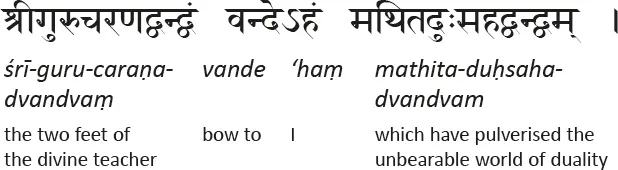
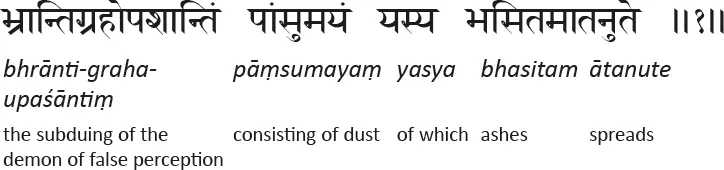
śrī divine, guru teacher, caraṇa foot, dvandva pair, √vand to venerate, bow to, aham (asmad) I, mathita pulverised, duḥsaha unbearable, dvandva duality;
bhrānti false perception, graha demon, upaśānti cessation, pāṃsumaya consisting of dust, yasya (yad) of which, bhasita ashes, ā√tan to spread.
1 The Sanskrit word for ‘duality’ here is ‘dvandva’ oſten referring to pairs of opposites such as pleasure and pain. ‘Dvandva’ is also used in this line in the sense of ‘the two feet’ of the teacher which are venerated. This image indicates the humility needed on the spiritual path.
2 The Sanskrit word here is ‘bhrānti’, literally ‘wandering’, and coming to mean ‘perplexity, confusion, doubt, error, false opinion’, referring to false perception, here the perception of duality, particularly the duality of subject and object.
2
I bow to that best of teachers, who is compassionate and destroys all doubts, whose feet point out the non-dual experience3 known as ‘That’4.
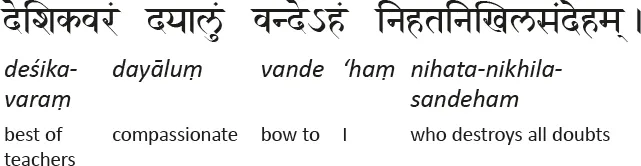
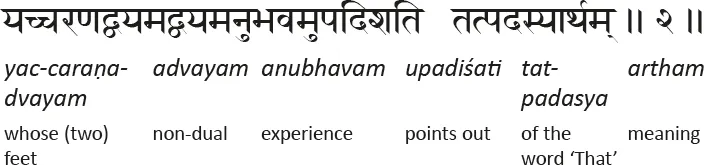
deśika teacher, vara best, dayālu compassionate, √vand to bow to, aham (asmad) I, nihata destroyed, nikhila all, sandeha doubt;
yat (yad) that, caraṇa foot, dvaya pair, advaya non-dual, anubhava experience, upa√diś to point out, tat (tad) That, pada word, artha meaning.
3 This is ‘advaya anubhava’ in Sanskrit. Experience of the non-dual may seem self- contradictory, but the word for experience ‘anubhava’ literally means ‘being along with’. Hence this type of experience is not experience of something separate.
4 This is a reference to such expressions in the Upaniṣads as ‘You are That’ (Chāndogya Upaniṣad 6.8.7) in which ‘That’ means the ultimate reality.
3
Scorched by the blaze of worldly illusion, the disciplined aspirant is enlightened by the teacher through words enabling discovery of one’s own Self 5.
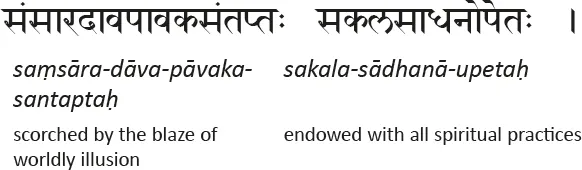
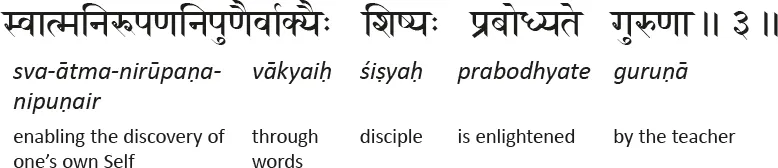
saṃsāra worldly illusion, dāva conflagration, pāvaka fire, santapta scorched, sakala all, sādhanā spiritual practice, upeta endowed;
sva own, ātman Self, nirūpaṇa discovery, nipuṇa capable, vākya sentence, words, śiṣya disciple, pra√budh to enlighten, guru teacher.
5 The Sanskrit expression here gives the whole work its title ‘Svātmanirūpaṇam’. ‘Nirūpaṇa’ means ‘discovering, stating, determining, defining’, from the root ‘rūp’ with the prefix ‘ni’. ‘Rūp’ means ‘to form, figure, represent (especially on stage)’ and ‘ni-rūp’ to perform, indicate by gesture; to find out, discover, ascertain; to investigate, examine, search, consider, reflect upon.’
4
Who can doubt their own existence? 6 Even if you have such a doubt the doubter is really your Self.


asti there is, exists, svayam oneself, iti thus, asmin (idam) in this, artha matter,
kasya (ka) of which, asti, saṃśaya doubt, puṃs person;
atra here, api even, saṃśaya, cet if, saṃśayitṛ doubter,
yaḥ (yad) who, saḥ (tad) he, eva really, bhavasi you are, tvam You.
6 Śaṅkara here clearly distinguishes his teaching from doctrines which maintain that the Self does not exist. For Śaṅkara, the Self (ātman) and the Absolute (brahman), which are identical, are positive, and by nature being, consciousness and bliss (sat-citānanda). This topic is also discussed in Taittirīya Upaniṣad 2.6.1.
5...
Table of contents
- Cover Page
- Title Page
- Copyright
- Dedication
- Contents
- Acknowledgements
- Introduction
- Note on Page Design
- Self Discovery
- Back Cover
Trusted by 375,005 students
Access to over 1.5 million titles for a fair monthly price.
Study more efficiently using our study tools.
Frequently asked questions
Yes, you can cancel anytime from the Subscription tab in your account settings on the Perlego website. Your subscription will stay active until the end of your current billing period. Learn how to cancel your subscription
No, books cannot be downloaded as external files, such as PDFs, for use outside of Perlego. However, you can download books within the Perlego app for offline reading on mobile or tablet. Learn how to download books offline
Perlego offers two plans: Essential and Complete
- Essential is ideal for learners and professionals who enjoy exploring a wide range of subjects. Access the Essential Library with 800,000+ trusted titles and best-sellers across business, personal growth, and the humanities. Includes unlimited reading time and Standard Read Aloud voice.
- Complete: Perfect for advanced learners and researchers needing full, unrestricted access. Unlock 1.5M+ books across hundreds of subjects, including academic and specialized titles. The Complete Plan also includes advanced features like Premium Read Aloud and Research Assistant.
We are an online textbook subscription service, where you can get access to an entire online library for less than the price of a single book per month. With over 1.5 million books across 990+ topics, we’ve got you covered! Learn about our mission
Look out for the read-aloud symbol on your next book to see if you can listen to it. The read-aloud tool reads text aloud for you, highlighting the text as it is being read. You can pause it, speed it up and slow it down. Learn more about Read Aloud
Yes! You can use the Perlego app on both iOS and Android devices to read anytime, anywhere — even offline. Perfect for commutes or when you’re on the go.
Please note we cannot support devices running on iOS 13 and Android 7 or earlier. Learn more about using the app
Please note we cannot support devices running on iOS 13 and Android 7 or earlier. Learn more about using the app
Yes, you can access Self Discovery by Śrī Śaṅkara Ācārya, Warwick Jessup, Elena Jessup, Warwick Jessup,Elena Jessup in PDF and/or ePUB format, as well as other popular books in Philosophie & Philosophies orientales. We have over 1.5 million books available in our catalogue for you to explore.