![]()
The first foundation:
1.0 Revenues1
Approaching revenues with the right attitude is important if you want to be able to optimise revenues well. You must understand that you have the right to charge enough, and that you sometimes have an obligation to charge a lot.
Early in my business career, like many others, I had a hard time charging enough. It felt dishonest to accept payments of more than what I felt was necessary. The problem, as I will explain further in this book, was simply that determining what a reasonable payment is can be very difficult. Nearly all companies have a mix of good, average, and bad deals. If you are overly concerned with accepting only what you find reasonable, chances are that you make only a mix of average and bad deals, which we can see in the examples presented below.
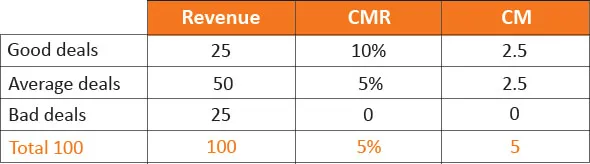
Let us start by looking at a more positive example of how a company’s profitability can be supported by a mix of different deals. Assume an average profitability for 50 percent of your deals, a good profitability for 25 percent of it, and a bad profitability for the remaining 25 percent of the deals – with a turnover of 100. Also assume that an average profit margin (CM) is five percent, and a bad deal gets zero percent profitability. Furthermore, assume the good ones earn ten percent, which is shown in the table below:
This table arrangement is naturally highly simplified, and somewhat misleading. In practice, many companies are in much worse situations simply because they are either too nice, honest, fair, or however else you describe it. They simply do not dare help themselves when the chance arises. Even though they are likely aware that certain deals are worse than expected, they do not see this as reason to charge more. Same in other situations even when customers are likely more than willing to pay a higher price under certain circumstances. I came across an example of this at Yu Garden in Shanghai. This is a popular area filled with many visitors, both tourists and locals. On my visit, the skies suddenly opened to a tropical downpour much more extreme than I am used to in Sweden. All unoccupied taxis disappeared as quickly as umbrella sellers appeared, in just a minute or two. As an entrepreneur, I am always stimulated by how quickly people in certain localities across the world react to a business opportunity, just like these umbrella sellers. Even more interesting though, was trying to hail a taxi, and then how when I finally did so. The streets were filled with thousands of people who were looking to find an unoccupied taxi. As quickly as one showed up, crowds of people would run up to it trying to get a seat, just to get out of the rain. The cheap umbrellas, which I also bought one of, unfortunately proved unable to keep the rain away for more than a few minutes, after which they seemed in some miraculous way to let through more water than fell from the skies. They were likely primarily intended as sunscreens and were not made for rain. Then I suddenly caught sight of a taxi with its occupied sign turned off, and where the driver waved away a local woman as she approached. Instead, the driver was totally occupied with a phone call in his mobile. Since it was the only taxi nearby, I decided to give it a try, despite the driver refusing that elderly woman. As I approached, I was surprised when the driver rolled down the passenger door window to ask in Mandarin, where I wanted to go. I gave him the name of my hotel, and he says it will cost 100 yuan. I reply OK and jump into the back seat. He then clarifies that he wants 100 yuan for the ride, and I nod once again. As this ride would normally cost only 20 yuan, he did not seem to think I was actually prepared to pay five times the normal fare. So, he entered the figures into his mobile and held this up to show me.
I accept the price a third time and he mumbled something I really do not think was meant as a compliment to my intelligence or deal-making capabilities. On the other hand, I was pleased with the entire episode, which some may question. However, as a businessman I get more of a kick from someone trying to make a good deal, than not. In my situation, it did not matter at all whether the ride cost 20 or 100 yuan, I was out of the rain, and I got back to my hotel early enough in the afternoon for when their business lounge served free cocktails (not bad!). So practically, this was also a good deal for me (I came out ahead at my second free drink). Why, then, be upset at a taxi driver making a good deal?
Customers most often have the opportunity to say no thanks to any offer, and that was something I slowly came to realise in my youth – or rather came to accept. A few years after that experience in China, I was under pressure trying to turn around a lossmaking unit to profitability. There I realised, you could not afford haggling with yourself to be nice to customers all the time (they were adults after all). They had their own responsibility to decide what a reasonable price was. If I kept on working both sides of the negotiating table, I would be letting down everyone relying on me to do my job to help them keep theirs. So, I started charging more for our products. Then I insisted on charging even more, and then some more until I concluded there was a limit to how much was reasonable even when you could get away with charging more for the moment. You could call that maturity. After a while, when the pendulum had swung fully from being poor at charging enough to being good and getting paid well for a few years, the pendulum settled somewhere in between. This meant we showed profitability that approximated what I described in the table above, but with somewhat better figures.
However, as I mentioned, many companies I have studied were not able to consider this totality. For various reasons they were always only interested in charging what they felt was reasonable, which inevitably meant poor profitability, since they could only make average or bad deals. You never make a good deal when you limit yourself to a reasonable markup. Any good deals then, are only based on incorrect costing, which likely happens only rarely. Depending on how the average and good deals fall out, you can have any of the following scenarios.
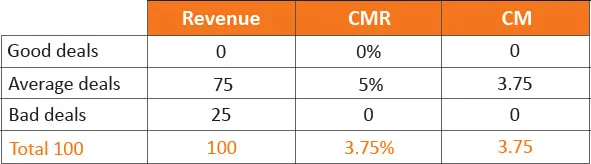
Assume that the majority, say 75 percent, of your deals have average profitability, and the rest are bad.
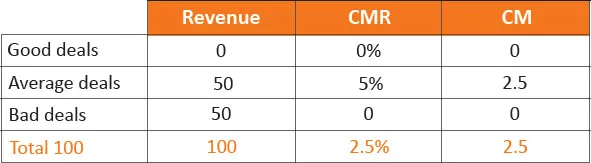
Or that half are average, and half are bad:
In both cases profitability is often worse than you think or understand. When you use, say, 5 percent margin in your costing, you most likely feel your total profitability should be 5 percent but, that is not what happens. Certainly, actual outcomes are never as oversimplified as these figures. Still, you are guaranteed to have poor profitability if your philosophy is based on charging only reasonable or normal mark ups, since you will always have some less profitable products or services. This has various causes; competition, incorrect costing, higher purchasing costs, and similar.
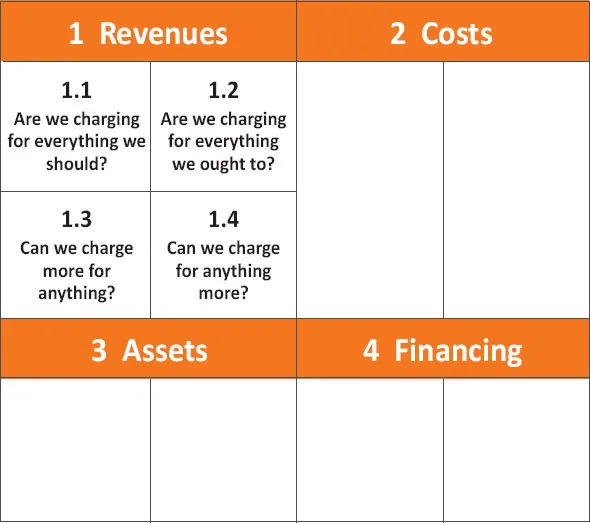
In addition to charging more to improve profitability, you also have to work on other factors using the four foundations of profitability, for which we provide more examples below.
Talking about charging more or cutting costs will surely bring many to think of the extreme aberrations involving this behaviour. The greedy business that charges unreasonably high prices for their products or services simply because they can, or the ruthless buyer who squeezes the life out of their suppliers. This is certainly not what is meant when using these terms here. Following all the advice presented in this book would likely bring exceptionally high profitability. Optimisation also means you have to use your common sense to ensure long-term, sustainable profitability levels. Which is why you must always use the tools described in this book while applying good sense and instincts. Doing so will enable you to create high profitability over a longer period. Or you can consider the thought: “In limitation, he first revels himself the master.”
When your company makes money, your customer is not necessarily losing money. In my own work as consultant, I have always tried to ensure my customer gains more from my efforts than I do. When a taxi ride in Shanghai costs 100 yuan that should normally cost only 20, this does not have to be a bad deal if it is a small sum compared to what you make. Especially if it is significantly cheaper than at home and also gets you out of a tropical downpour.
Let us move on to look at how you can change the amount of your revenues. It would seem obvious that the best way to increase revenues is to sell more. This is certainly not a bad idea, but many times you can increase revenues on what you already sell, which is what we will concentrate on here; the steps you can take that often have faster impact on profitability than anything revenue gains from entirely new sources.
The first question is whether your company actually charges for everything it should (reasonably) charge for. That is, for everything you actually do for the customer. The second question is whether your company charges for everything it ought to charge for. The difference here is that you ought to charge for everything that brings added value to the customer, but that does not necessarily mean a cost to your company. For this, you have to weigh whether charging is appropriate or not and how this will affect your customer relationship. For the first question, what you should reasonably charge for involves, in my judgement, whether the company charges for all the time you spend on the customer. After considering both these methods to increase revenues, you can ask whether this involves something you can charge
more for – that is, something you deliver that the customer may be prepared to pay more for than they do already. Then you can ask if there is something more you can charge for.
Thus, you start by asking yourself if you charge for everything you should; then if you charge for everything you ought to ; and then if there is anything more you can charge for; and finally, if there is something more you can charge for. Each one of these (ought to, should, more, something more) is treated in separate chapters of this book, each with a few subsections.
1.1 Are we charging for everything we should?
One phenomenon I have encountered at many companies (and been guilty of myself) is not charging for everything you do for the customer. Often, this is simply a desire to deliver a good product or service. This, in itself, is not really a problem – if you charge for it, but all too often, you do not. There are endless examples of this.
As when I took responsibility for that factory under threat of closure and found several production processing operations performed on the manufactured products, but which we did not charge for.
This involved things like manually removing sharp edges (deburring) on the products by grinding, which was very time consuming (that is, costly). When I asked why we did this, the answer was it could possibly be because once, many years previously, the customer had complained about sharp edges on the products. Another consideration was that you can remove these sharp edges by machine – by tumble finishing or shot peening. The latter was most cost- efficient. We brought this up for discussion with our customers, asking whether they could accept this instead, very few chose to continue with the manual deburring after comparing the two results. Their choice was made easier, of course, when we explained the huge price difference between the two methods, and especially, how much this involved the charge we were forced to add for the manual work.
A common reason for getting stuck in these situations where you do not charge for what you should is that people have a hard time discussing negative price changes with their customers. It is easier to give a little more of yourself and call it service than to open a discussion where you ask for the other person to give a little. Generally, this is not really a problem to discuss, as long as you explain why you have to reset your prices, and that (where possible) you offer your customer alternative solutions. For example, you can offer option 1 at a price X, or option 2 at a price Y. By offering different alternatives to choose from, you move the discussion from whether they will choose at all to what the customer wants to choose. A trick that most sellers are well acquainted with. Not working with this type of pricing also means you take the risk of spending time on things the customer does not need, while you run your operations at lower profitability. You simply have to dare bring up pricing with your customer. This is a natural part of making a deal however uncomfortable you may feel about it. If this feels particularly unpleasant, you might consider whether this is due to the kind of customer you have, that is, your product or service is not what they want or need. Otherwise this might involve you not feeling strongly enough that the product or service you are selling is actually worth the price for these customers. That is when you should think about changing jobs. You should not be selling things you are not comfortable with selling and feel strongly about. Otherwise you are not being true to your customers or yourself.
1.1.1 Adding 5% to the bottom line
Here is an example from a smaller service provider of how just a little more discipline regarding what you should charge for can add fifty thousand to your bottom line.
This was an IT service provider who, like so many other small service providers, were not very careful with charging for what they did for their customers, including telephone support. This may sound slightly tight-fisted, but it is all about unreasonable proportions. In a company with ten employees in all, three spent several hours daily providing telephone support to their customers. These three were hired as system developers, and naturally their support work had obvious value for them in getting firsthand information to learn what further development their solution needed. Still, this was entirely unreasonable, having three people give away several hours daily just to be nice. We agreed to set a target that each of them would try to bill one hour for support work every day.
Everyone in the company agreed this should not be a problem at all, since they had not really billed anything for this type of support until then. This would not in any way threaten their customer relationships or make these customers think they were being overcharged. For this tiny company, the difference was measurable. They charged €70 per hour, which meant revenues of €210 every day if all three made their target. This is certainly not a lot of money, but for a company that had less than €1,000,000 in annual turnover, this brought an accumulated effect adding nearly €50,000 to their bottom line yearly. Anyone can see how valuable this small daily contribution...