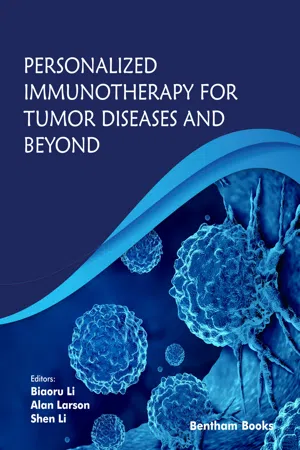
This book introduces personalized immunotherapy with multi-dimensional models of analysis to determine the best plan for immunotherapy of patients. The book introduces readers to some basic concepts which lay the foundation for personalized immunotherapy: the development of a major histocompatibility complex (MHC), the genome profile of T cells and tumor cells, and genome-wide association studies. Chapters also cover special topics such as new immunoassay methods related to personalized immunotherapy and targeted immunotherapy which are geared towards familiarizing readers with current research practices. Focusing on the central theme of personalized immunotherapy, the authors provide a wealth of information about T-cell screening, tumor neoantigen cloning, primary tumor cell culture for T-cell cloning, bioinformatics strategies for understanding T-cell and primary tumor cell biology and function, and new developments in research on adoptive T-cell immunotherapy. These developments include T-cell gene therapy and T-cell gene editing, transgenic T-cells for increasing affinity to tumor cells such as CAR T-cells and TCR T-cells, and the systematic modeling of polyclonal specific T-cells and biobank technology. Key Features: - Introduces readers to basic concepts in personalized medicine and immunotherapy- Presents current information about immunological assays used in research- Presents an overview of T cell immunotherapy and cloning techniques- Presents an overview of tumor cell bioinformatics and its role in immunotherapy- Includes new developments and references for personalized immunotherapy techniques (T-cell gene therapy and T-cell gene editing, transgenic T-cells which target CAR T-cells and TCR T-cells, and polyclonal T-cell modeling) - Includes a section on biobanking- Presents information in an easy-to-read format for a wide range of readers- Brings contributions from experts with over 30 years of experience in personalized immunotherapy Personalized Immunotherapy for Tumor Diseases and Beyond is an ideal handbook for medical professionals and students involved in personalized medicine, immunology and oncology. General readers interested in the new developments in these fields will also benefit from the information provided.
eBook - ePub
Personalized Immunotherapy for Tumor Diseases and Beyond
- English
- ePUB (mobile friendly)
- Available on iOS & Android
eBook - ePub
Personalized Immunotherapy for Tumor Diseases and Beyond
About this book
Information
Topic
MedicinaSubtopic
InmunologíaBiobank for Personalized Immunotherapy
Biaoru Li1, *
Georgia Cancer Center and Department of Pediatrics, Medical College at GA, Augusta, GA 30912, USA
Abstract
A biobank is a resource for keeping blood and tissue samples, which is going to play an increasing role for personalized immunotherapy, called precision immunotherapy. Moreover, large profits from biobanks are their futures of patients' personalized immunotherapy. A new generation of immunotherapy often relies on a person's tissues/cells/molecules/data so that personalized immunotherapy starts to deposit the patient's specimens and clinical information with genomics data. If tumor patients can save their specimens such as tumor tissues or blood before treatment, furthermore, if patients can achieve some genomic data for future treatment, the specimens saved in biobanks and the genomics data observed from their tissues can contribute clinical physicians and clinical scientists to develop a new generation of treatment, for example, patients respond to immunotherapy predicted by individualized measurement and undergoing personalized T-cell immunotherapy. This chapter introduces biobank, one of the most up-to-date personalized immunotherapies, which enable conducting research and development (R&D) for professional collection of clinical specimens and clinical data. The chapter aims at describing the concept of biobank and future potential to treat patients. It also includes sample preservation protocols and data management as well as online service of samples and clinical data. Thus, some standard operating procedures apply for personalized immunotherapy of diagnostic and treatment procedures. Finally, ethics for sampling, clinical information, and genomics data are mentioned to support the biobank chapter.
Keywords: Biobank, Data-banking, Personalized immunotherapy, Precision medicine.
* Corresponding author Biaoru Li: Georgia Cancer Center and Department of Pediatrics, Medical College at GA, Augusta, GA 30912, USA; Tel: 440-317-1443; E-mail: [email protected]
INTRODUCTION
T-cell adoptive immunotherapy and cytokine treatment of tumor diseases have come out several decades [1, 2]. For example, Steven Rosenberg had applied for lymphokine-activated killer cell (LAK) and tumor-infiltrating lymphocyte (TIL)
to treat renal cancer and melanoma of patients during early 1980s [3, 4], and we had also used TIL to treat solid tumors for several hundred of tumor patients within the 1980s-the 1990s [5, 6]. Immunotherapy has developed so quickly that a few new methods have emerged during the 30 years [7, 8]. On the other hand, personalized medicine is also going to be quickly developed [9, 10]. Precision medicine is a new medical model that relied on individual characteristics of each patient rather than “one size fits all” treatment.
Since the 1980s, LAK, TIL, natural killer cells (NK cell), cytokine-induced killer cells (CIK), dendritic cells, and cytokine-induced killer cells (DC-CIK) have been increasingly developed as adoptive T-cell immunotherapy in translational medicine and different stages of clinical trials [11-16]. However, the cells only achieved 11-30% partial and complete responses (PR and CR) in clinics [17]. In order to increase immunotherapy effect, two subspecialties have developed during the last thirty years: (1) genetically engineering some particular substances, such as TNF-α, TGF-β, IL2, IL12, and IFN-γ, have mainly been introduced into T-cells [18-20]; (2) recently, genetically engineering some higher affinity substances between tumor cells and T-cell such as modified TCR (T-cell receptor) and chimeric antigen receptors T-cell (CAR-T cells) have been also successfully reported to treat B-cell leukemia/lymphomas as well as other tumor diseases [21-24].
When the human genome sequence was decoded in 2004 [25], scientists and physicians have primarily studied workflows from biobank and genomic profile/system modeling in silico to functional inducing T-cells ex vivo and genetically-engineering cell in intro/ex vivo related to the new techniques [26-28]. We have been studying the fields from tumor-tissue biobank such as T-cells’ and primary tumor cells’ isolation, storage, and culture into single T-cell/single tumor cell genomics and system biology for more than 30 years [29-31]. Fortunately, Rosenberg first reported the efficacy of T-cell personalized immunotherapy of different patients related to individual GWAS (genome-wide association study) in 2015 [32]. Now, personalized immunotherapy has been increasingly reported in the new generation of immunotherapy.
All in all, optimal immunotherapy requires excellent support of biobank so that personalized immunotherapy begins to save patient’s specimens such as tumor tissue biobanking with their T-cells and tumor cells storage, including their molecules and genomics data. Once the system established, clinical scientists and medical doctors can readily use their biobanks for clinical administration of their tumor diseases at a hospital and undergoing immune therapy. Furthermore, the goal of this biorepository is to collect tumor tissue, blood, and data from patients undergoing immune-based therapy, so that they can use for correlative evaluations in optional protocols [33]. The specimens and data are linked to the patient, thus allowing for personalized immunotherapy. Furthermost, they provide continuous treatment such as those that evaluate the correlation of tumor biomarkers with patient variables to treat cancer, as well as those that identify interactions between biomarkers and immunotherapy [34].
Along with the R&D of new techniques in tumor tissue storage, T-cells/tumor cells storage, thawing, and cultures, the methodology significantly improves specimen biorepository to patient treatment and clinical care [35, 36]. If a patient can store his/her tumor and blood specimens, the vast choice of patient treatment can resolve the challenge of the patient himself with tumor disease, for example, patient specimens can be used by next-generation sequence (NGS) for personalized therapy once the patients have their tumor recurrence. Finally, the following knowledge explosion in this era, the possibility of applying for new treatment and new compounds should increasingly depend on the possibility of storage of tumor specimens.
BIOBANKS FOR PERSONALIZED IMMUNOTHERAPY
Concept of Biobanks
Because extensive diversity relied on purpose and role on biobanks, it is not easy to give an optimal concept for biobank [37]. Generally, biobanks are professional biorepositories of clinical samples regarding storing specimens at a harvested time, including clinical, epidemiological, and general source data. Also, processed samples are analyzed and optimally preserved for clinical patients with sharing to hospitals for the patients and clinical/scientific community for their clinical and translational researches [38]. An ideal biobank consists of the acquisition, delivery, preservation method under the regulation of Standard Operating Procedures (SOPs) to ensure correct performance of all components (such as specimens anonymization, patients’ acquisition, delivery, preparation, analysis, proper storage conditions and specimens’ sharing in hospitals under ethics). In short, the concept of the biobank is to set up an SOP tissue storing system for patients with a wide variety of data for the R&D requirements, translational medicine, and clinical application.
Concept of Biobank for Immunotherapy
- T-cells of immunotherapy involve LAK, TIL, CIK, DC-CIK [39]. Moreover, these cells have significantly been developed into a new generation of immunotherapy, such as genetically engineering a type of the patient’s own disease-fighting T-cells to killing own tumor cells so that the T-cells isolated from the patient’s blood are altered by inserting a gene, which is reprogramed to recognize and kill tumor cells as TCR-T-cells or CAR-T cells [40-42]. The altered cells are then reinfused into the patient’s body in which the modified T-cells spread and further expand to identify and...
Table of contents
- Welcome
- Table of Content
- Title
- BENTHAM SCIENCE PUBLISHERS LTD.
- PREFACE
- INTRODUCTION
- List of Contributors
- MHC and Cancer Immunotherapy
- Immune Cells Signaling-Pathway and Genomic Profiles for Personalized Immunotherapy
- Immunoassay of Personalized Immunotherapy
- Tumor Microenvironment, ADO/IDO Pathway-Foundation of Personalized Immunotherapy
- Molecular Targeting Checkpoint in Cancer-Foundation of Personalized Immunotherapy
- Molecular Screening and Neoantigen Cloning-Fundamental of Adoptive T-cell Immunotherapy
- Primary Cell Culture and T-cell Cloning -Fundamental of Adoptive T-cell Immunotherapy
- Bioinformatics of T-cell and Primary Tumor Cells-Fundamental of Adoptive T-cell Immunotherapy
- Development of Adoptive T-cell Immunotherapy-Future of Personalized Immunotherapy
- Gene Therapy and Genomic Editing-Development of Adoptive T-cell Immunotherapy
- Genetically Modified T-cells Affinity to Tumor Cells-Development of Adoptive T-cell Immunotherapy
- System Modeling of T-cell Function-Development of Adoptive T-cell Immunotherapy
- Biobank for Personalized Immunotherapy
Trusted by 375,005 students
Access to over 1.5 million titles for a fair monthly price.
Study more efficiently using our study tools.
Frequently asked questions
Yes, you can cancel anytime from the Subscription tab in your account settings on the Perlego website. Your subscription will stay active until the end of your current billing period. Learn how to cancel your subscription
No, books cannot be downloaded as external files, such as PDFs, for use outside of Perlego. However, you can download books within the Perlego app for offline reading on mobile or tablet. Learn how to download books offline
Perlego offers two plans: Essential and Complete
- Essential is ideal for learners and professionals who enjoy exploring a wide range of subjects. Access the Essential Library with 800,000+ trusted titles and best-sellers across business, personal growth, and the humanities. Includes unlimited reading time and Standard Read Aloud voice.
- Complete: Perfect for advanced learners and researchers needing full, unrestricted access. Unlock 1.5M+ books across hundreds of subjects, including academic and specialized titles. The Complete Plan also includes advanced features like Premium Read Aloud and Research Assistant.
We are an online textbook subscription service, where you can get access to an entire online library for less than the price of a single book per month. With over 1.5 million books across 990+ topics, we’ve got you covered! Learn about our mission
Look out for the read-aloud symbol on your next book to see if you can listen to it. The read-aloud tool reads text aloud for you, highlighting the text as it is being read. You can pause it, speed it up and slow it down. Learn more about Read Aloud
Yes! You can use the Perlego app on both iOS and Android devices to read anytime, anywhere — even offline. Perfect for commutes or when you’re on the go.
Please note we cannot support devices running on iOS 13 and Android 7 or earlier. Learn more about using the app
Please note we cannot support devices running on iOS 13 and Android 7 or earlier. Learn more about using the app
Yes, you can access Personalized Immunotherapy for Tumor Diseases and Beyond by Biaoru Li,Alan Larson,Shen Li, Biaoru Li, Alan Larson, Shen Li in PDF and/or ePUB format, as well as other popular books in Medicina & Inmunología. We have over 1.5 million books available in our catalogue for you to explore.