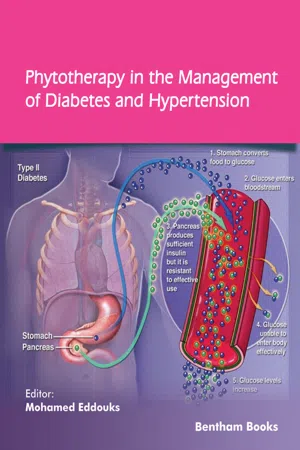
Medicinal plants are a source of potential therapeutic compounds. Phytotherapycan give patients long term benefits with less or no side effects. Phytotherapy in the Management of Diabetes and Hypertension is a book series which emphasizes the biochemistry behind diabetes mellitus and hypertension, along with the control or remediation of these conditions through cost effective, safe and easily-adaptable methods validated by scientific research.This is the fourthvolume of the series which features reviews on selected natural productsused to treat diabetes and hypertension. This volume brings 6 chapterscontributed by 14 researchers that cover general updates on diabetic phytotherapy, circumin, and the medicinal use of olive leaves, passion fruit and spiral gingers in the treatment of diabetes and hypertension.Each review covers different plant species or medicinal agents whereapplicable, providing readers essential information about their role in thetreatment of diabetes and hypertension.Both academic and professional pharmacologists as well as clinicianswill find comprehensive information on a variety of therapeutic agents in thisvolume.
- English
- ePUB (mobile friendly)
- Available on iOS & Android
eBook - ePub
Phytotherapy in the Management of Diabetes and Hypertension: Volume 4
About this book
Information
Topic
MedicineSubtopic
Endocrinology & MetabolismUpdates on Clinical Study Reports of Phytotherapy in the Management of Type 2 Diabetes Mellitus
Md. Moklesur Rahman Sarker1, 2, *, Mahfuza Afroz Soma1
1 Department of Pharmacy, State University of Bangladesh, 77 Satmasjid Road, Dhaka 1205, Bangladesh
2 Health Med Science Research Limited, 3/1 Block F, Lalmatia, Dhaka 1207, Bangladesh
Abstract
Type 2 diabetes mellitus (T2DM) is a metabolic disorder caused by the insufficient production of insulin and/or the development of resistance to insulin. The long-term management of T2DM with conventional oral hypoglycaemic drugs is a challenge as these drugs may worsen certain underlying comorbidities and complications, such as chronic kidney and cardiovascular diseases. Besides, because of the development of resistance to those drugs, it is difficult to control hyperglycemia for long term treatment of type 2 diabetes mellitus patients. This drawback of conventional medicines necessitates phytotherapy, herbal medicines, functional foods, nutraceuticals, and other forms of alternative medicines or the invention of new medicines for the effective and long term treatment of type 2 diabetes mellitus avoiding the major adverse-effects or minimising them. Plant-derived bioactive compounds are a great resource for the discovery of new medicines. Besides, phytomedicines in the forms of extracts, isolated compounds, combined herbal preparations or other forms can be used for the prevention and treatment of type 2 diabetes mellitus. This chapter contains updated panorama based on the evidences from clinical study reports on different forms of phytotherapy, including plant extracts, its fractions, isolated bioactive compounds, functional foods, nutraceuticals, herbal medicines formulations and other forms of plant-derived phytotherapy reported for the treatment of type 2 diabetes mellitus. The findings from clinical study reports were discussed with proper citations as well as presented in summarized form in a table. A total of 52 different types and forms of prospective phytomedicines, bioactive compounds, or formulation or extracts or fractions or decoctions or functional foods formulations having clinical study reports associated with type 2 diabetes mellitus were presented in this chapter. The molecular mechanisms involved along with the primary and secondary outcomes with phytotherapy on type 2 diabetes patients were also presented. Multiple clinical studies demonstrated very prospective and potential antidiabetic activities of Berberine, Bitter gourd, Cinnamon, Curcumin, Dia-BestTM, Fenugreek, Gegen Qinlian decoction, GlucoSupreme herbal,Gymnema sylvestre, Magnesium, Nigella sativa, Resveratrol,
Tibetan medicine herb combination, TCM multiple herbal combination, Xiaoke pill, and vitamin C. Hence, at least, these phytoremedies are recommended for the management of type 2 diabetes mellitus which may have additional benefits in diabetes management compared to conventional Allopathic medicines considering the long-term safety and effectivity of the products. The updated clinical study reports on phytotherapy presented in this chapter will be helpful for the medical, biological and pharmaceutical researchers and complementary and alternative medicine users to use these plants extracts, its fractions, isolated biomolecules, herbal preparations, functional foods, nutraceuticals and other forms of phytomedicines for the prevention and treatment of diseases as well as for the discovery of modern medicines.
Keywords: Bioactive Compounds, Clinical studies, Complementay and alternative medicine, Herbal medicine, Phytomedicine, Phytotherapy, Type 2 diabetes mellitus.
* Corresponding author Prof. Md. Moklesur Rahman Sarker: Professor and Head of Academic & Research, Department of Pharmacy, State University of Bangladesh, 77 Satmasjid Road, Dhaka 1205, Bangladesh; Chief Researcher, Health Med Science Research Limited, 3/1 Block F, Lalmatia, Dhaka 1207, Bangladesh; Tel: +8801776758882; E-mail: [email protected] & [email protected]
INTRODUCTION
Diabetes mellitus is a group of metabolic disorders characterized by high blood glucose levels. Diabetes mellitus is caused by insufficient or absence of insulin production or impairment of insulin action or both, which results with the disturbances of the metabolism of carbohydrate, protein, and fat [1]. Diabetes is classified into the following categories:
- Type 1 diabetes mellitus (also called insulin-dependent diabetes): This occurs due to the destruction of pancreatic β-cells by autoimmunity, which leads to the complete deficiency of insulin production.
- Type 2 diabetes mellitus (also known as non-insulin dependent diabetes): This occurs because of the progressive loss of insulin production or secretion from pancreatic β-cells or the development of resistance to insulin or because of both reasons.
- Gestational diabetes mellitus (GDM): GDM occurs because of the hormonal and metabolic changes of pregnant women, and is diagnosed in the second or third trimester of pregnancy.
- Specific types of diabetes: Diabetes may also be developed due to other specific reasons, such as i) monogenic diabetes syndromes: neonatal diabetes and maturity-onset diabetes of the young, ii) diseases of the exocrine pancreas: cystic fibrosis and pancreatitis, iii) drug- or chemical-induced diabetes: glucocorticoid use in the treatment of HIV/AIDS or after organ transplantation [1, 2].
Diabetes can be diagnosed by measuring fasting plasma glucose (FPG) or post-prandial plasma glucose two hours after meal (2-h PG) level or glycated hemoglobin A1C (HbA1c) criteria [2]. People with FPG ≥ 7.0 mmol/L, 2-h PG ≥ 11.1 mmol/L, HbA1c ≥ 6.5%, or random blood glucose ≥ 11.1 mmol/L in the presence of signs and symptoms are diagnosed to have diabetes [1, 3].
The prevalence and incidence of diabetes is increasing all over the world irrespective of lower-income, middle-income and developed countries. According to WHO 2018 report, the number of diabetic patients has increased from 108 million in 1980 to 422 million in 2014 [4].The global prevalence of diabetes in adults over 18 years of age has increased from 4.7% in 1980 to 8.5% in 2014 [4]. According to the report of the International Diabetic Association in 2017, approximately 425 million adults (20-79 years) were reported to live with diabetes, which is estimated to be raised to 629 million by 2045 [5]. It was found that the highest number of diabetes patients was between the age of 40-59 years, and 50% (212 million) of the people with diabetes were undiagnosed [5]. In the year 2017, more than 1.1065 million children were found to live with type 1 diabetes melli...
Table of contents
- Welcome
- Table of Content
- Title
- BENTHAM SCIENCE PUBLISHERS LTD.
- PREFACE
- List of Contributors
- Updates on Clinical Study Reports of Phytotherapy in the Management of Type 2 Diabetes Mellitus
- Curcumin: A Drug of Choice for the Treatment of Diabetes and Hypertension
- Olive Leaf: A Traditional Phytomedicine for Diabetes and Hypertension
- Medicinal Plants from Genus Costus in the Management of Diabetes
- Antidiabetic and Antihypertensive Potential of Passiflora spp. (Passion Fruit) - An Updated Review
- Monograph on Anvillea radiata Coss. & Durieu
Trusted by 375,005 students
Access to over 1.5 million titles for a fair monthly price.
Study more efficiently using our study tools.
Frequently asked questions
Yes, you can cancel anytime from the Subscription tab in your account settings on the Perlego website. Your subscription will stay active until the end of your current billing period. Learn how to cancel your subscription
No, books cannot be downloaded as external files, such as PDFs, for use outside of Perlego. However, you can download books within the Perlego app for offline reading on mobile or tablet. Learn how to download books offline
Perlego offers two plans: Essential and Complete
- Essential is ideal for learners and professionals who enjoy exploring a wide range of subjects. Access the Essential Library with 800,000+ trusted titles and best-sellers across business, personal growth, and the humanities. Includes unlimited reading time and Standard Read Aloud voice.
- Complete: Perfect for advanced learners and researchers needing full, unrestricted access. Unlock 1.5M+ books across hundreds of subjects, including academic and specialized titles. The Complete Plan also includes advanced features like Premium Read Aloud and Research Assistant.
We are an online textbook subscription service, where you can get access to an entire online library for less than the price of a single book per month. With over 1.5 million books across 990+ topics, we’ve got you covered! Learn about our mission
Look out for the read-aloud symbol on your next book to see if you can listen to it. The read-aloud tool reads text aloud for you, highlighting the text as it is being read. You can pause it, speed it up and slow it down. Learn more about Read Aloud
Yes! You can use the Perlego app on both iOS and Android devices to read anytime, anywhere — even offline. Perfect for commutes or when you’re on the go.
Please note we cannot support devices running on iOS 13 and Android 7 or earlier. Learn more about using the app
Please note we cannot support devices running on iOS 13 and Android 7 or earlier. Learn more about using the app
Yes, you can access Phytotherapy in the Management of Diabetes and Hypertension: Volume 4 by Mohamed Edouks in PDF and/or ePUB format, as well as other popular books in Medicine & Endocrinology & Metabolism. We have over 1.5 million books available in our catalogue for you to explore.