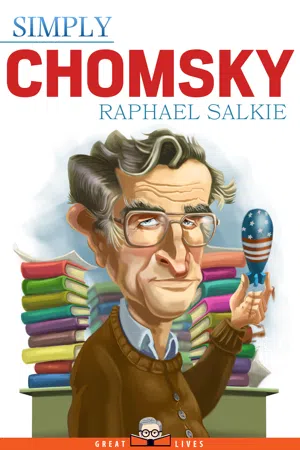
"Noam Chomsky's work has challenged and changed our understanding of the world from his pioneering work in linguistics to his unceasing critique of the world around us. Raphael Salkie's book, Simply Chomsky, succeeds in bringing these critical issues to the attention of readers in a work at once succinct and illuminating."
—Irene Gendzier, Professor Emeritus, Dept. of Political Science, Boston University
Avram Noam Chomsky was born in Philadelphia in 1928 to Jewish immigrant parents who were both educators. His parents were mainstream liberals, but through relatives, Chomsky was exposed at an early age to socialism and other progressive ideas that shaped his politics. After earning his Ph.D. in theoretical linguistics at the University of Pennsylvania in 1955 and a fellowship at Harvard University, Chomsky became a professor at the Massachusetts Institute of Technology. His first book, Syntactic Structures, published in 1957 and now considered a classic, not only shook up the study of linguistics, but also had a profound effect on philosophy and psychology, and laid the groundwork for the field of cognitive science. In the 1960s, Chomsky took part in protests against the Vietnam War and began writing the articles that initiated his other career as a public dissident and political thinker. Over the course of the next 60 years, Chomsky would continue to be a major voice in both areas, embodying a lifelong commitment to intellectual exploration, freedom of thought, and human rights.
In Simply Chomsky, Professor Raphael Salkie provides a compact, user-friendly introduction to Noam Chomsky's political activism and his groundbreaking work in linguistics. Unlike most Chomsky studies, Prof. Salkie not only covers the essentials of Chomsky's thought and accomplishments, but also explores his most recent concerns—including the climate crisis, the threat of nuclear holocaust, and current geopolitical hotspots—which are often very different from the topics that preoccupied him decades ago.
For students of linguistics, for those interested in U.S. foreign policy, and for anyone concerned about the enormous problems facing the world, Simply Chomsky will be exhilarating and thought-provoking reading. Noam Chomsky has spent his life challenging widely accepted assumptions and beliefs and has made an indelible mark on world affairs and human thought. Simply Chomsky offers a special opportunity to find out more about this remarkable and always engaging contrarian thinker.
eBook - ePub
Simply Chomsky
About this book
Information
Topic
PhilosophySubtopic
Philosopher Biographies2
Sources
Aitchison, J. 2012. Linguistics made easy. London, Hodder Education.
Allott, N., C. Knight and N. Smith. 2019 (eds.). The Responsibility of Intellectuals: Reflections by Noam Chomsky and others after 50 years. London, UCL Press. Free to download from https://www.uclpress.co.uk/products/123963.
Amnesty International. 2018. The Hooded Men: torture, lies and a quest for justice. https://www.amnesty.org.uk/hooded-men-torture-uk-ireland.
Bartlett, N. 2018. Jeremy Corbyn strengthens his hold on Labour as the party appoints Unite veteran Jennie Formby as general secretary. Daily Mirror, 20 March 2018. https://www.mirror.co.uk/news/politics/corbyn-strengthens-hold-labour-party-12221476.
BBC News. 2002. Chomsky publisher cleared in Turkey. http://news.bbc.co.uk/1/hi/world/europe/1817598.stm.
BDS (Boycott, Divestment, Sanctions) 2017. Chomsky clarifies position on the cultural boycott of Israel. https://bdsmovement.net/news/chomsky-clarifies-position-cultural-boycott-israel.
Boeckx, C. & M. Grohman (eds.). 2013. The Cambridge Handbook of Biolinguistics. Cambridge, CUP.
Booker-Lewis, S. 2020. Help for disabled people to use Brighton beach on the way. The Argus, 4 March 2020. Online: https://www.theargus.co.uk/news/18279485.help-disabled-people-use-brighton-beach-way/.
Bornkessel-Schlesewsky, I. & M. Schlesewsky. 2009. Processing Syntax and Morphology: A Neurocognitive Perspective. Oxford, OUP.
Brockes, E. 2005. The Greatest Intellectual? Noam Chomsky interviewed by Emma Brockes. The Guardian, 31 October 2005. Online (with comments by Chomsky) at: https://chomsky.info/20051031/
Brown, A. 2003. A way with words – an interview with Larry Trask. The Guardian, 26 June 2003. Online at: https://www.theguardian.com/science/2003/jun/26/scienceinterviews.artsandhumanities
Bulletin of the Atomic Scientists. 2019. The Doomsday Clock. https://thebulletin.org/doomsday-clock/
Cammaerts, M.-C. 2014. Performance of the Species-Typical Alarm Response in Young Workers of the Ant Myrmica sabuleti (Hymenoptera: Formicidae) Is Induced by Interactions with Mature Workers. Journal of Insect Science 14 (234), 1-6. https://academic.oup.com/jinsectscience/article-pdf/doi/10.1093/jisesa/ieu096/25454022/ieu096.pdf.
Chandler, D. 2009. Climate change odds much worse than thought. New analysis shows warming could be double previous estimates. MIT News Office, May 19, 2009. http://news.mit.edu/2009/roulette-0519
Chomsky, N. 1957. Syntactic Structures. The Hague, Mouton.
Chomsky, N. 1959. Review of B. F. Skinner, Verbal Behaviour. Language, 35:1, 26-58. Online at: http://pds21.egloos.com/pds/201407/08/38/Review_of_Verbal_BF_Skinners_Verbal_Behavior.pdf. Reprinted in J. Fodor & J Katz (eds.), The structure of language: Readings in the philosophy of language (Englewood Cliffs, NJ, Prentice Hall, 1964), 547–78. Also reprinted in L.A. Jakobovits and M.S. Miron (eds.), Readings in the Psychology of Language (New York, NY, Prentice-Hall, 1967), 142-172 (The preface to this reprint is online at: http://www.cogprints.org/1148/1/chomsky.htm). Also reprinted in A. Arnove (ed.), The Essential Chomsky (London, Bodley Head, 2008), 1-30.
Chomsky, N. 1964. Current Issues in Linguistic Theory. The Hague, Mouton. Reprinted in J. Fodor & J Katz (eds.), The structure of language: Readings in the philosophy of language (Englewood Cliffs, NJ, Prentice Hall, 1964), 50-118.
Chomsky, N. 1969a. American Power and the New Mandarins. Harmondsworth, Penguin.
Chomsky, N. 1969b. The responsibility of intellectuals. In Chomsky (1969a: 256-290).
Chomsky, N. 1982. Towards a New Cold War: Essays on the Current Crisis and how We Got There. New York, NY., Pantheon.
Chomsky, N. 1985. Turning The Tide: US Intervention in Central America and the Struggle for Peace. Boston, MA., South End Press.
Chomsky, N. 1987. On Power and Ideology; The Managua Lectures. Boston, MA., South End Press.
Chomsky, N. 1988. Language and Problems of Knowledge: The Managua Lectures, Cambridge, MA, MIT Press.
Chomsky, N. 1989. Necessary Illusions: Thought Control in Democratic Societies. London, Pluto Press.
Chomsky, N. 1991. Deterring Democracy. Boston, MA, South End Press.
Chomsky, N. 1994. Secrets, lies and democracy. Interviews with David Barsamian. Tucson, AZ., Odonian Press.
Chomsky N. 1995. Language and Nature. Mind 104 (413): 1–61.
Chomsky, N. 1996. Class Warfare: Interviews with David Barsamian. London, Pluto Press.
Chomsky, N. 1997. Media control: the spectacular achievements of propaganda. New York, NY, Seven Stories Press.
Chomsky, N. 1999a. The Fateful Triangle: The United States, Israel, and the Palestinians. London, Pluto Press.
Chomsky, N. 1999b. The Umbrella of U.S. power: the universal declaration of human rights and the contradictions of U.S. Policy. New York, NY, Seven Stories Press.
Chomsky, N. 2000a. New Horizons in the Study of Language and Mind. 2nd Edn. Cambridge, Cambridge University Press.
Chomsky, N. 2000b. Chomsky on Miseducation. Edited by D. Macedo. Oxford, Rowman & Littlefield.
Chomsky, N. 2002. On Nature and Language. Cambridge, Cambridge University Press.
Chomsky, N. 2003a. Media Control: The spectacular achievements of propaganda. New York, NY., Seven Stories Press.
Chomsky, N. 2003b. Objectivity and Liberal Scholarship. New York, NY, The Free Press. (Earlier published as the first chapter of Chomsky 1969a). Also republished in part in Peck, J. (ed.), The Chomsky Reader (London, Serpents Tail, 1988), 83-120. Full text online at: http://www.ditext.com/chomsky/1968.html.
Chomsky, N. 2005a. Open Letter to The Guardian. [Not published in The Guardian]. https://chomsky.info/20051113/.
Chomsky, N. 2005b. Imperial Ambitions: Interviews with David Barsamian. London, Hamish Hamilton.
Chomsky, N. 2007. What we say goes: Conversations on US power in a changing world with David Barsamian. London, Allen & Unwin.
Chomsky, N. 2008. Interventions. Harmondsworth, Penguin.
Chomsky, N. 2010a. Some simple evo-devo theses: How true might they be for language? In R. Larson, V. Deprez, & H. Yamakido, (eds.), The Evolution of Human Language: Biolinguistic perspectives (Cambridge, Cambridge University Press), 45- 62.
Chomsky, N. 2010b. Afterword. In R. Ehrlich, Conversations with Terrorists (Boulder, CO, Paradigm Press), 151-4.
Chomsky, N. 2012. Making the Future: Occupations, Interventions, Empire and Resistance. San Francisco, CA., City Lights Books.
Chomsky, N. 2013. Power systems: Conversations on global democratic uprisings and the new challenges to US Empire. Interviews with David Barsamian. New York, NY., Henry Holt.
Chomsky, N. 2014a. Democracy and Power. The Delhi Lectures. Cambridge, Open Book Publishers.
Chomsky, N. 2014b. Security and State Power: The Prospects for Survival. https://chomsky.info/20140303/
Chomsky, N. 2015a. Masters of Mankind: Essays and Lectures, 1969-2013. Harmondsworth, Penguin.
Chomsky, N. 2015b. On Power and Ideology; The Managua Lectures. (2nd edn). C...
Table of contents
- Cover
- Title Page
- Contents
- Copyright
- Other Great Lives
- Praise for Simply Chomsky
- Series Editor's Foreword
- Acknowledgments
- Author-date System
- Preface
- 1. Chomsky’s Life
- 2. Myths
- 3. Education
- 4. Anarchism
- 5. Propaganda
- 6. Korea
- 7. The Middle East
- 8. Nuclear Dangers
- 9. Climate Catastrophe
- 10. Democracy in America
- 11. What is Language? The “Basic Property”
- 12. Universal Grammar
- 13. Language Acquisition
- 14. Meaning
- 15. Evolution
- 16. Responsible and irresponsible intellectuals
- 17. Chomsky’s legacy
- Sources
- Suggested Reading
- About the Author
- A Word from the Publisher
Trusted by 375,005 students
Access to over 1.5 million titles for a fair monthly price.
Study more efficiently using our study tools.
Frequently asked questions
Yes, you can cancel anytime from the Subscription tab in your account settings on the Perlego website. Your subscription will stay active until the end of your current billing period. Learn how to cancel your subscription
No, books cannot be downloaded as external files, such as PDFs, for use outside of Perlego. However, you can download books within the Perlego app for offline reading on mobile or tablet. Learn how to download books offline
We are an online textbook subscription service, where you can get access to an entire online library for less than the price of a single book per month. With over 1.5 million books across 990+ topics, we’ve got you covered! Learn about our mission
Look out for the read-aloud symbol on your next book to see if you can listen to it. The read-aloud tool reads text aloud for you, highlighting the text as it is being read. You can pause it, speed it up and slow it down. Learn more about Read Aloud
Yes! You can use the Perlego app on both iOS and Android devices to read anytime, anywhere — even offline. Perfect for commutes or when you’re on the go.
Please note we cannot support devices running on iOS 13 and Android 7 or earlier. Learn more about using the app
Please note we cannot support devices running on iOS 13 and Android 7 or earlier. Learn more about using the app
Yes, you can access Simply Chomsky by Raphael Salkie in PDF and/or ePUB format, as well as other popular books in Philosophy & Philosopher Biographies. We have over 1.5 million books available in our catalogue for you to explore.