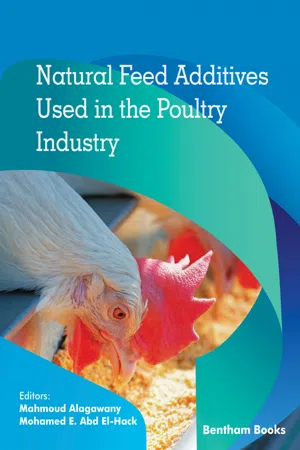
Natural Feed Additives Used in the Poultry Industry addresses recent information on the use of different natural feed additives in poultry nutrition. Chapters in the book focus on the growth, production, reproduction and health of poultry. Key Features: - 15 chapters contributed by more than 30 experts and scientists involved in animal and poultry nutrition, physiology, toxicology, pharmacology, and pathology - Chapters highlight the significance of a variety of herbal plant extracts and derivatives, cold pressed and essential oils, fruits by-products, immunomodulators, organic acids, probiotics, nanoparticles and their role in poultry industry instead of the growth promoter antibiotics. - Provides details about the use of antibiotic as growth promoters in poultry and the development of bacterial resistance. - Provides a holistic approach on how natural feed additives can provide an efficient solution to animal health, - Covers the main categories of poultry, including broiler chickens, laying hens, quails, geese, ducks, and turkey. - References in each chapter for further reading This handbook represents an up-to-date review of the existing knowledge on natural feed additives, both in vitro and in vivo and the basis for future research. The text is useful to students of poultry sciences, nutritionists, scientists, veterinarians, pharmacologists, poultry breeders, and animal husbandry extension workers.
eBook - ePub
Natural Feed Additives Used in the Poultry Industry
- English
- ePUB (mobile friendly)
- Available on iOS & Android
eBook - ePub
Natural Feed Additives Used in the Poultry Industry
About this book
Information
Topic
MedicineSubtopic
Veterinary MedicineAntibiotics as Growth Promoters in Poultry Feeding
Mayada R. Farag1, *, Mahmoud Alagawany2, *, Mohamed E. Abd El-Hack2, Shaaban S. Elnesr3, Gihan G. Moustafa1, Kuldeep Dhama4, Nabela I. El-Sharkawy1
1 Forensic Medicine and Toxicology Department, Veterinary Medicine Faculty, Zagazig University, Zagazig 44519, Egypt
2 Poultry Department, Faculty of Agriculture, Zagazig University, Zagazig 44519, Egypt
3 Poultry Production Department, Faculty of Agriculture, Fayoum University, Fayoum 63514, Egypt
4 Division of Pathology, ICAR-Indian Veterinary Research Institute, Izatnagar, Bareilly, 243 122, Uttar Pradesh, India
Abstract
The improvement in the growth of birds through the use of antibiotics could be obtained by reducing the count of harmful microorganisms, providing beneficial ones by suitable growth media, decreasing the thickness of gut mucosa and regulating the motility of gut, leading to better absorption of nutrients. However, achieving these desirable goals is not devoid of risks. Where, the frequent and improper use of antibiotics can reverse their therapeutic advantages through giving the opportunity to any existent microorganism to develop antibiotic resistance, which can hinder the effectiveness of antibiotics as chemotherapeutic or prophylactic agents in poultry. Additionally, antibiotic resistance genes can be transmitted to the natural environment and contaminate soil, water and plants. Moreover, the indiscriminate application of antibiotics could result in the accumulation of noticeable amounts of drug residues (the parent compounds or their injurious metabolites) in the edible tissues of poultry, including eggs and meat, which are very important sources in human feeding. The residues of antibiotics in poultry products can result in various pathological conditions and hazardous impacts on human health, such as being sensitive to antimicrobials in addition to allergy, cell mutations, imbalanced microbiota in the intestine and the development of bacteria resistance to antibiotics. This chapter describes the benefits and the hazards of using antibiotics as growth promoters in poultry feeding.
Keywords: Antibiotics, Feed additives, Growth promoters, Poultry.
* Corresponding authors Mayada R. Farag: Forensic Medicine and Toxicology Department, Veterinary Medicine Faculty, Zagazig University, Zagazig - 44519, Egypt; E-mail: [email protected];Mahmoud Alagawany: Poultry Department, Faculty of Agriculture, Zagazig University, Zagazig, Egypt; E-mail: [email protected]
Introduction
Antibiotics are among the most essential veterinary drugs associated with animal and poultry production as they could inhibit the growth of microorganisms or destroy them when used at low levels without damaging the host [1]. The antibiotics are used in the poultry industry for treatment (therapeutic) and prevention (prophylaxis) of diseases, modifying the body physiology, and for growth-promoting purposes [2]. The growth-promoting properties of antibiotics were first observed by Moore et al. [3]. They reported that birds exposed to streptomycin in their diet showed improved growth response. Some other experiments followed this study in chickens and different animal species with similar results [4-7]. Since then, the use of antibiotics as growth promoters became one of the most common well-established practices in the livestock industry and increased with animal production intensification. Antibiotics are utilized in poultry diet as feed additives to improve the growth, feed efficiency and productivity and to ensure food safety [8-10]. However, reaching these desirable objectives is related to some risks, where the inappropriate handling and use of these antibiotics have led to the accumulation of noticeable concentrations of harmful residues in edible poultry tissues and eggs [11]. Consumption of these residues can lead to various health problems and the development of antibiotic resistance in pathogens and/or commensal microorganisms, which may result in severe pathological conditions and consequently threaten the public health [12]. However, the transfer of antimicrobial resistance genes from animals to human pathogens is still unconfirmed. Several works showed a relationship between the improper use of antibiotics at sub-therapeutic levels and the development of antibiotic resistance in microflora [13-17].
Therefore, the antibiotic-treated birds should be held for specific withdrawal periods for the depletion of the antibiotic residues to safe levels in eggs and tissues. Moreover, applicable and straightforward screening methods should be developed for the detection of antimicrobial residues in edible tissues before reaching consumers [18]. Additionally, it is important to search for antibiotic alternatives such as probiotics, prebiotics, synbiotics, phytogenics and others to increase birds’ productivity and help them perform their genetic potentials under commercial conditions [19]. The main objectives of the following sections are to provide an overview on the use of antibiotics as growth promoters in poultry production and to review the public health risks related to the residues of antibiotics (human health effects, antimicrobial resistance) and the techniques of their screening and detection in food from animal origins. Lastly, this chapter highlights the measures and recommendations to control or prevent antimicrobial residues in poultry tissues.
Types and Properties of Antibiotics
Antibiotics are all bacteriostatic, which could prevent the growth and division of the bacterial cell. Some of them can be bacteriocidal or even caused bacteriolysis. Antibiotics can exert...
Table of contents
- Welcome
- Table of Content
- Title
- BENTHAM SCIENCE PUBLISHERS LTD.
- PREFACE
- FOREWORD
- List of Contributors
- An Overview of Natural Feed Additive Alternatives to AGPs
- Antibiotics as Growth Promoters in Poultry Feeding
- The Role of Garlic and Rosemary Herbs in Poultry Nutrition
- Nigella sativa Seeds and their Derivatives in Poultry Feed
- Beneficial Impacts of Licorice (Glycyrrhiza glabra) Herb to Promote Poultry Health and Production
- The Useful Applications of Origanum Vulgare in Poultry Nutrition
- Importance of Quinoa (Chenopodium Quinoa) in Poultry Nutrition
- Turmeric (Curcuma longa) as a Useful Feed Supplement in Poultry
- Nutritional and Promising Therapeutic Potential of Chia Seed as a Feed Additive in Poultry
- Cassia Fistula: Potential Health-Promoting Candidate for Livestock and Poultry
- Moringa (Moringa oleifera) and its Role in Poultry Nutrition
- Green Tea (Camellia sinensis) and its Beneficial Role in Poultry Nutrition
- Beneficial Impacts of Essential Oils on Poultry Health and Production
- Organic Acids as Eco-Friendly Growth Promoters in Poultry Feed
- Beneficial Impacts of Probiotics on Poultry Nutrition
- Nutritional Applications of Nanotechnology in Poultry with Special References to Minerals
Trusted by 375,005 students
Access to over 1.5 million titles for a fair monthly price.
Study more efficiently using our study tools.
Frequently asked questions
Yes, you can cancel anytime from the Subscription tab in your account settings on the Perlego website. Your subscription will stay active until the end of your current billing period. Learn how to cancel your subscription
No, books cannot be downloaded as external files, such as PDFs, for use outside of Perlego. However, you can download books within the Perlego app for offline reading on mobile or tablet. Learn how to download books offline
Perlego offers two plans: Essential and Complete
- Essential is ideal for learners and professionals who enjoy exploring a wide range of subjects. Access the Essential Library with 800,000+ trusted titles and best-sellers across business, personal growth, and the humanities. Includes unlimited reading time and Standard Read Aloud voice.
- Complete: Perfect for advanced learners and researchers needing full, unrestricted access. Unlock 1.5M+ books across hundreds of subjects, including academic and specialized titles. The Complete Plan also includes advanced features like Premium Read Aloud and Research Assistant.
We are an online textbook subscription service, where you can get access to an entire online library for less than the price of a single book per month. With over 1.5 million books across 990+ topics, we’ve got you covered! Learn about our mission
Look out for the read-aloud symbol on your next book to see if you can listen to it. The read-aloud tool reads text aloud for you, highlighting the text as it is being read. You can pause it, speed it up and slow it down. Learn more about Read Aloud
Yes! You can use the Perlego app on both iOS and Android devices to read anytime, anywhere — even offline. Perfect for commutes or when you’re on the go.
Please note we cannot support devices running on iOS 13 and Android 7 or earlier. Learn more about using the app
Please note we cannot support devices running on iOS 13 and Android 7 or earlier. Learn more about using the app
Yes, you can access Natural Feed Additives Used in the Poultry Industry by Mahmoud Mohamed Alagawany,Mohamed Ezzat Abd El-Hack, Mahmoud Mohamed Alagawany, Mohamed Ezzat Abd El-Hack in PDF and/or ePUB format, as well as other popular books in Medicine & Veterinary Medicine. We have over 1.5 million books available in our catalogue for you to explore.