Both Asia and Africa are home to many plants that can be used for the treatment of many diseases and their medicinal properties are gaining interest in western societies. Medicinal plants from Asia and Africa are used for their healing abilities and also have a symbolic meaning in communities.The importance of traditional autochthonous plant remedies plays a crucial role in the health of millions of people of these two continents. Even today, traditional medicine represents the dominant medical system for millions of people showing a significant impact on health care practices. Therefore, traditional operators still represent a vital part of regional healthcare systems. For this reason, pharmaceutical industries consider traditional medicine as a source for the identification of bioactive compounds that can be used in the preparation of synthetic drugs.Biologically Active Natural Products from Asia and Africa: A Selection of Topics guides the reader toinformation about new natural products from these regions and the different ways to use them to treat or alleviate many of the most common diseases. The volume presents nine topics covering a number of facets of natural product medicine including: - pharmaceutical analysis of anti-diabetic herbal medicines from Bangladesh and local retailers- caffeine intake and the risk of female infertility- pharmaceutical analysis of Urena sinuata (bur mallow)- anti-CHIKV activities of diterpenes and their derivatives- anti-inflammatory nanogel for the treatment of psoriasis- antlithiatic properties of Moroccan medicinal plants- ethnobotanic, phytochemical and biological activities of Aristolochia longa L. (pipevine)- wound healing potential of combined extracts of stem bark and leaves of sphenocentrum jollyanum (an African shrub) This is a handy reference for specialists and R&D experts in pharmaceutical chemistry who wish to be informed about current knowledge on developing natural remedies in Asia and Africa.
eBook - ePub
Biologically Active Natural Products from Asia and Africa: A Selection of Topics
- English
- ePUB (mobile friendly)
- Available on iOS & Android
eBook - ePub
Biologically Active Natural Products from Asia and Africa: A Selection of Topics
About this book
Information
Topic
MedicineSubtopic
PharmacologyEthnobotanic, Phytochemical, and Biological Activities of Aristolochia longa L.: A Review
Amina El Yahyaoui El Idrissi, Aya Khouchlaa*, Abdelhakim Bouyahya, Mereym El Fessikh, Youssef Bakri, M'hamed Tijane
Department of Biology, Faculty of Science, Genomic Center of Human Pathologies, Faculty of Medicine, Laboratory of Human Pathologies Biology, Mohammed V University, Rabat, Morocco
Abstract
Aristolochia longa is a medicinal plant used in traditional Mediterranean pharmacopeia to treat different diseases. It shows significant anti-inflammatory, antidiabetic, antioxidant, antibacterial, and antitumoral pharmacological effects. The extracts of this plant are rich in bioactive molecules belonging to different chemical families such as limonene, aristolochic acid, β-caryophyllene, and deenax. However, excessive use of this plant causes severe toxicity to the user. The aim of the present review is to give particular emphasis on the most recent findings on biological effects of the major groups of Aristolochia longa components, their therapeutic use, and the active ingredient responsible for the toxicity of this plant, which constitutes a public health problem observed with it’s wide use in cancer patients.
Keywords: Aristolochia longa, Anticancer, Antibacterial, Anti-inflammatory, Phytochemical, Toxicity.
* Corresponding author Aya Khouchlaa: Department of Biology, Faculty of Science, Genomic Center of Human Pathologies, Faculty of Medicine, Laboratory of Human Pathologies Biology, Mohammed V University, Rabat, Morocco; Tel: 00212674158222; E-mail: [email protected]
INTRODUCTION
Aristolochiaceae is a family for Aristolochia, which includes nearly 500 species for most tropical, subtropical, and Mediterranean countries [1]. This family has been reported in the forests of America, Asia, Africa, Europe, and rarely in other countries with different species depending on the country viz. Aristolochia indica in India, Aristolochia didyma in South Americ, Aristolochia clematitis in Europe, Aristolochia heppii Merxm in East Africa, and is known in foreign languages as Isharmul (India), Wild dutchman's pip (Americ), Saracen (France), and chivide (East Africa) [2-4]. Aristolochia longa (A. longa), Mediterranean species in North Africa, known as Bereztem, was recommended since antiquity against ovarian insufficiency and snake bites [5].
It was employed in traditional medicine to treat different diseases, such as cancer, diabetes, asthma, and skin and intestinal infections, using different parts of this plant with several forms as honey, milk, and jus [6-8]. Recently, it was increasing used against cancer and 44% of the Moroccan population studied approved healing by this plant [9].
Herbal remedies have a huge advantage over chemical treatment. Their secondary metabolites sowed several biological activities such as anti-tumor, antibacterial, antioxidant, antifungal, anti-inflammatory, and antidiabetic [1, 6-8, 10-14]. The biological properties of this plant have been attributed to a wide range of bioactive compounds, including polyphenols, flavonoids, alkaloids, tannic acid, and fatty acids [6]. In this way, studies showed that A. longa possessed actives molecules, such as aristolochic acid (AA), limonene, β-carotene, and palmitic acid (Fig. 1), which have proven their pharmacological effects [10, 11, 15]. However, it is necessary to carefully determine the administered dose in order to be safe.
The aim of this review was, firstly, to make a synthesis of traditional therapeutical usages of A. longa in disease treatment and, secondly, to give data for the most recent findings on biological activity effect. Finally, we identified the major compounds from different parts of this plant and the mechanisms responsible for their action.
CLASSIFICATION AND BOTANICAL DESCRIPTION
- Kingdom: Plantae
- Branch: Angiosperms
- Class: Magnoliopsida
- Family: Aristolochiaceae
- Genus: Aristolochia
A. longa is a perennial plant glabrescent (20-50cm of high), with slender stems, spreading, often ramose, with triangular, oval leaves, slightly heart-shaped (3-5cm of wide), corded base, margins whole and solitary green-brown flowers (Fig. 1). It also gives very long fruits, compared to other species of aristolochia [16].
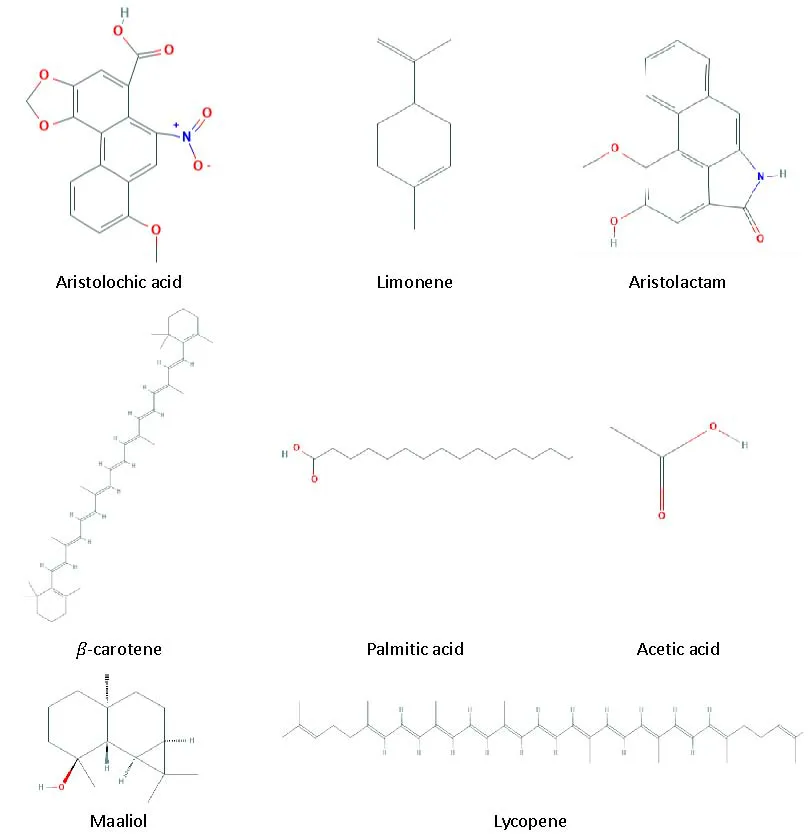
Table of contents
- Welcome
- Table of Content
- Title
- BENTHAM SCIENCE PUBLISHERS LTD.
- PREFACE
- List of Contributors
- Biological and Physical Contaminants in Anti-Diabetic Herbal Medicines of Bangladesh
- Quantification and Health Safety Assessment of Some Toxic Metals in Anti-Diabetic Herbal Preparations Collected from Local Retailers Using the XRF Analytical Tool
- Caffeine Intake and the Risk of Female Primary Infertility: An Evidence-Based Case Report
- An Overview of Urena sinuata: Phytochemistry and Pharmacological Activities
- Anti-CHIKV Activities of Diterpenes and Their Derivatives
- Design Development and Evaluation of Anti-Inflammatory Nanogel For The Treatment of Psoriasis
- Antilithiatic Properties of Moroccan Medicinal Plants and Mechanism Insights of their Phytochemicals
- Ethnobotanic, Phytochemical, and Biological Activities of Aristolochia longa L.: A Review
- Wound Healing Potential of Combined Extracts of Stem Bark and Leaves of Sphenocentrum Jollyanum: A Classical Factorial Design Model Approach
Trusted by 375,005 students
Access to over 1.5 million titles for a fair monthly price.
Study more efficiently using our study tools.
Frequently asked questions
Yes, you can cancel anytime from the Subscription tab in your account settings on the Perlego website. Your subscription will stay active until the end of your current billing period. Learn how to cancel your subscription
No, books cannot be downloaded as external files, such as PDFs, for use outside of Perlego. However, you can download books within the Perlego app for offline reading on mobile or tablet. Learn how to download books offline
Perlego offers two plans: Essential and Complete
- Essential is ideal for learners and professionals who enjoy exploring a wide range of subjects. Access the Essential Library with 800,000+ trusted titles and best-sellers across business, personal growth, and the humanities. Includes unlimited reading time and Standard Read Aloud voice.
- Complete: Perfect for advanced learners and researchers needing full, unrestricted access. Unlock 1.5M+ books across hundreds of subjects, including academic and specialized titles. The Complete Plan also includes advanced features like Premium Read Aloud and Research Assistant.
We are an online textbook subscription service, where you can get access to an entire online library for less than the price of a single book per month. With over 1.5 million books across 990+ topics, we’ve got you covered! Learn about our mission
Look out for the read-aloud symbol on your next book to see if you can listen to it. The read-aloud tool reads text aloud for you, highlighting the text as it is being read. You can pause it, speed it up and slow it down. Learn more about Read Aloud
Yes! You can use the Perlego app on both iOS and Android devices to read anytime, anywhere — even offline. Perfect for commutes or when you’re on the go.
Please note we cannot support devices running on iOS 13 and Android 7 or earlier. Learn more about using the app
Please note we cannot support devices running on iOS 13 and Android 7 or earlier. Learn more about using the app
Yes, you can access Biologically Active Natural Products from Asia and Africa: A Selection of Topics by Anna Capasso in PDF and/or ePUB format, as well as other popular books in Medicine & Pharmacology. We have over 1.5 million books available in our catalogue for you to explore.