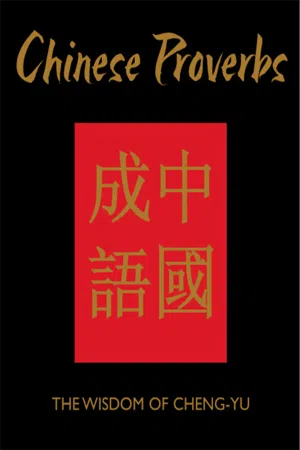
The elegant pen-strokes and visual harmony of Chinese writing have long been admired in the west. Classical Chinese calligraphy is a popular and valuable art form, and with the increasing economic and cultural power of China, its writing is becoming more widely appreciated and understood. In particular, the deep layers of history and symbolism which exist behind even the most everyday phrases have a strong appeal to those seeking understanding from an alternative philosophy. The sayings known as Cheng-yu, represented by four characters, are used frequently in Chinese. They are comparable to proverbs or idioms in English, but each adds a depth of meaning and linguistic colour very unlike their English equivalents. Many are rooted in ancient Chinese culture, and make oblique references to poetry, philosophy or history. Four characters may take a whole paragraph to explain, yet, to a native speaker brought up and educated in the traditions to which they refer, they are instantly comprehensible. Chinese Proverbs: The Wisdom of Cheng-Yu features a selection of the most famous and most interesting of the more than 5000 Cheng-yu. Alongside the phrase is an accessible and inspiring explanation, its literal translation in English, what the particular strokes symbolize, and its various uses.
eBook - ePub
Chinese Proverbs
About this book
Information
Subtopic
Langues
Introduction
成語, chéngyŭ in standard pinyin transliteration and pronounced chung ewe, literally
translates as “become a saying” or more idiomatically “set phrase”. They usually consist
of four characters, though there is one chengyu in this collection with five characters.
Chengyu add a depth and richness of expression to modern Chinese, which quite often
is difficult to fully translate. English, too, has its own proverbs and idioms. These serve
much the same function but they do not have the same standard format as chengyu
and they are not as commonly used.
translates as “become a saying” or more idiomatically “set phrase”. They usually consist
of four characters, though there is one chengyu in this collection with five characters.
Chengyu add a depth and richness of expression to modern Chinese, which quite often
is difficult to fully translate. English, too, has its own proverbs and idioms. These serve
much the same function but they do not have the same standard format as chengyu
and they are not as commonly used.
Chengyu are immediately recognizable, and not just because of their format.
They are usually next to impossible to understand if you don’t know the story behind
them. This is because a whole anecdote is condensed into four characters, often
using words and grammar from Classical Chinese no longer in current usage. Both
They are usually next to impossible to understand if you don’t know the story behind
them. This is because a whole anecdote is condensed into four characters, often
using words and grammar from Classical Chinese no longer in current usage. Both
dă tiě chèn rè
(pronounced da tieh chen rerr)
Literal meaning: hit iron still hot
Idiomatic meaning: strike while the iron is hot
Literal meaning: hit iron still hot
Idiomatic meaning: strike while the iron is hot
4

of these things contribute to their effectiveness when used correctly, but if you are a
foreigner you cannot be expected to comprehend them.
foreigner you cannot be expected to comprehend them.
Some chengyu do not have a historical story attached to them and are just
clever ways of expressing a common sentiment. However, almost all of the chengyu
included in this collection refer back to stories found in some of the earliest Chinese
literature. Many of these sources stem from either famous Chinese philosophers,
such as Confucius and Zhuangzi, or historical records, particularly of the period
known as the Warring States (476–221 BCE), when China was almost constantly
caught up in civil war. Gaining a familiarity of chengyu does not just improve one’s
spoken Chinese, but it also gives an insight into the richness and variety of Chinese
history and tradition.
clever ways of expressing a common sentiment. However, almost all of the chengyu
included in this collection refer back to stories found in some of the earliest Chinese
literature. Many of these sources stem from either famous Chinese philosophers,
such as Confucius and Zhuangzi, or historical records, particularly of the period
known as the Warring States (476–221 BCE), when China was almost constantly
caught up in civil war. Gaining a familiarity of chengyu does not just improve one’s
spoken Chinese, but it also gives an insight into the richness and variety of Chinese
history and tradition.
qián lÜ jì qióng
(pronounced chien lew jee chiung)
Literal meaning: Qian donkey exhausts tricks
Idiomatic meaning: have one’s bluff called; to run out of excuses
Literal meaning: Qian donkey exhausts tricks
Idiomatic meaning: have one’s bluff called; to run out of excuses
5

āi bīng bì shèng
(pronounced eye bing bee shung)
Literal meaning: sorrowing army must win
Idiomatic meaning: justice will prevail
Literal meaning: sorrowing army must win
Idiomatic meaning: justice will prevail
The philosopher Lao Zi (c. sixth century BCE) author of the Dao De Jing, the principal
text of Daoism, first expressed the sentiment of this chengyu. It is perhaps not immediately
apparent why a “sorrowing” army must be guaranteed victory. In fact “sorrowing”, which is the
direct translation of the character 哀, really has to be expanded into “grieving with righteous
indignation over an injustice”. This shows just how much meaning
a single character can carry.
text of Daoism, first expressed the sentiment of this chengyu. It is perhaps not immediately
apparent why a “sorrowing” army must be guaranteed victory. In fact “sorrowing”, which is the
direct translation of the character 哀, really has to be expanded into “grieving with righteous
indignation over an injustice”. This shows just how much meaning
a single character can carry.
6

bān mén nòng fŬ
(pronounced ban mun noong foo)
Literal meaning: Ban’s door use axe
Idiomatic meaning: teach your grandmother to suck eggs
Literal meaning: Ban’s door use axe
Idiomatic meaning: teach your grandmother to suck eggs
Lu Ban was a semi-legendary craftsman who was highly skilled with the axe. This chengyu was
first used to describe aspiring poets who once visited the tomb of the great Tang Dynasty poet
Li Bai (701–762) and left inscriptions of their own poems on the rocks around it. The Ming
scholar Mei Zhihuan said this was like “showing off with an axe outside Lu Ban’s door”. This
saying can either be used to criticize someone else’s actions, or to politely belittle one’s
own efforts in comparison to another’s.
first used to describe aspiring poets who once visited the tomb of the great Tang Dynasty poet
Li Bai (701–762) and left inscriptions of their own poems on the rocks around it. The Ming
scholar Mei Zhihuan said this was like “showing off with an axe outside Lu Ban’s door”. This
saying can either be used to criticize someone else’s actions, or to politely belittle one’s
own efforts in comparison to another’s.
7

bàn tú ér fèi
(pronounced ban too ahr fay)
Literal meaning: half road then stop
Idiomatic meaning: give up too easily; leave something half done;
if it’s worth doing, it’s worth doing well
Literal meaning: half road then stop
Idiomatic meaning: give up too easily; leave something half done;
if it’s worth doing, it’s worth doing well
This comes from a parable told by a grandson of Confucius, the philosopher Zisi (481–402
BCE), in his book The Doctrine of the Mean. A man went off to the city to study, but decided it
was too difficult and came home after only a year. His wife was very cross with him. She had
been weaving a piece of fine cloth for many months and on her husband’s return she cut it
into pieces. He asked her why she had wasted so many months’ work. She replied that it was
just the same as him giving up his studies halfway through. If something is worth doing you
must be prepared to spend time on it.
BCE), in his book The Doctrine of the Mean. A man went off to the city to study, but decided it
was too difficult and came home after only a year. His wife was very cross with him. She had
been weaving a piece of fine cloth for many months and on her husband’s return she cut it
into pieces. He asked her why she had wasted so many months’ work. She replied that it was
just the same as him giving up his studies halfway through. If something is worth doing you
must be prepared to spend time on it.
8

bēi gōng shé yĭng
(pronounced bay goong sher ying)
Litera...
Litera...
Table of contents
- Cover
- Title
- Copyright
- Introduction
- Glossary of principal people and texts
- Index
Trusted by 375,005 students
Access to over 1.5 million titles for a fair monthly price.
Study more efficiently using our study tools.
Frequently asked questions
Yes, you can cancel anytime from the Subscription tab in your account settings on the Perlego website. Your subscription will stay active until the end of your current billing period. Learn how to cancel your subscription
No, books cannot be downloaded as external files, such as PDFs, for use outside of Perlego. However, you can download books within the Perlego app for offline reading on mobile or tablet. Learn how to download books offline
Perlego offers two plans: Essential and Complete
- Essential is ideal for learners and professionals who enjoy exploring a wide range of subjects. Access the Essential Library with 800,000+ trusted titles and best-sellers across business, personal growth, and the humanities. Includes unlimited reading time and Standard Read Aloud voice.
- Complete: Perfect for advanced learners and researchers needing full, unrestricted access. Unlock 1.5M+ books across hundreds of subjects, including academic and specialized titles. The Complete Plan also includes advanced features like Premium Read Aloud and Research Assistant.
We are an online textbook subscription service, where you can get access to an entire online library for less than the price of a single book per month. With over 1.5 million books across 990+ topics, we’ve got you covered! Learn about our mission
Look out for the read-aloud symbol on your next book to see if you can listen to it. The read-aloud tool reads text aloud for you, highlighting the text as it is being read. You can pause it, speed it up and slow it down. Learn more about Read Aloud
Yes! You can use the Perlego app on both iOS and Android devices to read anytime, anywhere — even offline. Perfect for commutes or when you’re on the go.
Please note we cannot support devices running on iOS 13 and Android 7 or earlier. Learn more about using the app
Please note we cannot support devices running on iOS 13 and Android 7 or earlier. Learn more about using the app
Yes, you can access Chinese Proverbs by James Trapp in PDF and/or ePUB format, as well as other popular books in Langues et linguistique & Langues. We have over 1.5 million books available in our catalogue for you to explore.