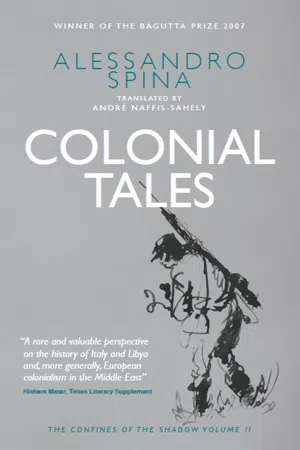
Set in the inter-war period, between the late 1920s, when Italy began solidifying its power in its new Libyan colony, and the end of World War II, when control of the country passed into British hands. Spina's chief subjects in these stories are Italian military officers who idle their time away at their club or exploring the strange lands where they have been posted, always at odds between the jingoistic education they received at home and the lessons they've learned during their time in Libya. These short stories map the transformation of the Libyan city of Benghazi from a sleepy Ottoman backwater in the 1910s to the second capital of an oil-rich kingdom in the 1960s. Employing a cosmopolitan array of characters, ranging from Ottoman functionaries, to Sanussi aristocrats and Italian officers, Spina chronicles Italy's colonial experience from the euphoria of conquest - giving us a front row seat to the rise and subsequent fall of Fascism in the aftermath of World War II - to the country's independence in the 1950s. Spina continues his narrative with the discovery of Libya's vast oil and gas reserves, which triggered the tumultuous changes that led to Muammar Gaddafi's forty-two-year dictatorship.
eBook - ePub
Colonial Tales
The Confines of the Shadow – Volume II
- English
- ePUB (mobile friendly)
- Available on iOS & Android
eBook - ePub
About this book
Trusted by 375,005 students
Access to over 1.5 million titles for a fair monthly price.
Study more efficiently using our study tools.
Information
Twenty-four Colonial Tales
BOOK ONE
1
ON THE SHORE
1939
‘Africa is a giant riding-stable, the ideal place where one can train and hone the ancient art of horse-riding,’ the General said, shattering the silence.
They were standing by the shore, on the boundless plain. The palm trees, few and far between, looked as if they’d been planted by an invisible hand to mark out paths that knew no end. The General was fond of spending time with Captain Valentini, who was a reserved man and always on the alert, but who carried on the conversation on his own, inside his head, where there was never the bother of having to listen to a reply. What good would it do anyway?
They had been riding for two hours. The sun was oppressive, but a sonorous breeze was rising from the sea (it felt like the plain’s invisible twin, a continuous flowing) – like how music, sometimes, which is a movement in itself, ensnares our immobility, while we’re sat in the profound recesses of a theatre or a closed room. There wasn’t a single structure in sight: neither native and wretched nor colonial and optimistic. Nothing except the littoral’s expanse – ‘one of the great wonders of the world,’ the General sternly commented, as though he was mocking his listener – that extended for thousands of miles along the colony’s coast, a testament to the fact that it wasn’t inviolate. Nothing could be seen along the greyish strip, neither man nor machine: as though it had been created for ghosts.
The General took to horse-riding with his customary ceremoniousness even in that deserted place, as though he were at a parade and was busy inspecting the troops. His bearing was always proud and erect, a joker had once said that he’d resembled the Four Horsemen of the Apocalypse, as he frighteningly held four fingers up.
‘Do you know Professor Curri?’ the General asked.
Changing his tone, which grew a little more irritated, he added: ‘Yesterday we dined together at the air force’s chalet, I don’t know who invited him. He said that Montaigne once questioned an Indian chief who was held as a prisoner in France what prerogatives he enjoyed in his country. The chief replied that he had the right to be at the head of his troops when leading them into battle. What else is new? That’s what history teaches us.’
Valentini nodded his head very slightly.
‘Professors always talk such rubbish when they speak of battles.’
They carried on riding in silence.
‘Come on, there’s no need to drag Montaigne into this: even heroes in action films put themselves first and drag everyone else along.’
A pause.
‘Who knows where? Needless to say, the “enemy” is nothing but a metaphor.’
Just like the sea-breeze, they too looked like the victims of a kind of perpetual motion owed to atmospheric events, fated to always keep floating. The breeze was the wind generated by the unequal heating of different zones.
Even the littoral carried on sliding towards the East.
‘Captain!’ the General exclaimed, as though his comrade was far away and he was calling him back. Instead, their horses were right next to one another, just like during the ritualistic military exercises where they weren’t free to heed either their own caprices, or their knight’s.
‘Do you know what a chief’s prerogative really is? To fall from even greater heights, the highest possible heights is what I mean.’
Valentini raised no objections whatsoever. His silence had a soothing effect, leaving something unexplored, unfinished. This was why the General loved talking to him.
‘Anyone who doesn’t understand that doesn’t have the right to lead anybody, because he is oblivious to his tragic privilege. Bloody hell! I would have liked to tell that chap that tragic destinies were the exclusive prerogative of kings in the old plays of antiquity!’
He suddenly spurred his horse into a gallop.
Ready to follow him, Valentini leapt after him.
However, the littoral looked like an infinite thread, and it too ran alongside them, with all its unrivalled reserve, overwhelming them.
2
BLOOD MUST FLOW AND YOU MUST DIExxx
Her name was Elena Petrović, and just like Her Majesty, she was born in Montenegro, the ancient Illyria, and she had married an Italian man who wore a uniform: but the similarities ended there. The Captain was a man of average height, portly, optimistic, and his character was entirely different from Victor Emmanuel, who sat on the throne so diffidently, as if he didn’t actually wield supreme authority, but rather feared it. Captain Andolfato on the other hand liked the world he lived in, and everything seemed beautiful and well-disposed towards him: nature, the State, the Fascist party, the colony, the Army. If one put a problem before him, he would try to minimise its importance, to dismiss it, and this appeared to free him from the need to try and resolve it. He wasn’t held in especially high regard by either his superiors or his underlings, but neither did he have any enemies, since everyone recognised the goodness of his soul and his inexhaustible human sympathy.
In the midst of that pleasant life – the Captain also enjoyed perfect health, despite being quite the drinker, and the alcohol accentuated his good cheer – only a single eccentric detail stood out: his wife’s extraordinary beauty. That such an exquisitely sculpted woman had married a man who was the epitome of banality itself had stirred much disbelief in that small colonial town. ‘Mentally and physically banal,’ the skeletal Professor of Natural Sciences sarcastically commented, lusting after the man’s wife.
The woman had composed an elegant and devoted letter to the Queen, in which she had bowed before Her Majesty to proudly inform her that they shared the same name, and that she had also come from Montenegro to Italy, in fact to the colony, a land which had been restored to Rome under the reign of Victor Emmanuel III, the Victorious King.xxxi The letter sent by one of the ladies in waiting at court had been accompanied by an official portrait of the Queen, which Her Majesty herself had so graciously signed; having been slipped into a silver frame, the letter could be admired in the sitting room. The Captain made a point of bragging about it: as if he and Victor Emmanuel were in-laws now.
Nobody understood what sense it made, once the incommensurable difference in rank was accounted for, for him to call himself the King’s brother-in-law. Had he married his sister, or was the King perhaps his wife’s brother? Someone put the question to him and he had replied with a laugh; at times it seemed as though he didn’t understand the way the word should be used, in the way one doesn’t know the various names of animal species, and he therefore formulated his answer with a gesture of laugh.
‘He’s the only animal who laughs,’ a shopkeeper angrily commented, passing sentence on the man, Mrs Andolfato – who had never laid eyes on him a single time – being one of his customers. It was as if the Captain and Victor Emmanuel had married the same woman, who had somehow – as if magically – been split into two identical copies. The dictionary, while being vast, did not account for the relationship between two men who had married different models of the same woman, Elena Petrović. ‘It’s a neologism that idiotic Captain came up with,’ Strino, the Professor of Literature mockingly explained. ‘But doesn’t neologism mean a word borrowed from another language?’ the Professor of Gymnastics asked, proud of his strapping physique, but devoted to the arts of the spirit, to culture, which his education had forced him to abstain from (as Pirovano Maria, the Professor of French put it).
‘A neologism can also indicate a new meaning for a word already in use, my dear colleague,’ the Professor of Literature replied, placated.
If the professor nursed an opinion on this, it was because the beautiful damsel lived in a building at the bottom of Via Fiume, on the second floor. In order to reach the Corso, she therefore had to walk along the pavement beside the secondary school. Thus, while a professor would be explaining one of Horace’s odes, or complicated equations, they would see this image on the street pass by like a vision, in a white, straight-cut princess dress. Elena wore no jewellery, neither real stones, nor fakes, ‘in the same way nobody looks at an old canvas painted by the hand of an artistic god and thinks of adding some trinket to the picture,’ the Professor of Philosophy explained in his baritone, comblé.xxxii He too – all the while never losing the thread of his lesson on Kant’s philosophy, unlike his thirty-odd students, who understood none of it – would follow that lady’s steps with his eyes, as she strode hurriedly along, as if fleeing from something. It felt as though she wasn’t a material presence, but rather a collective dream conjured by the male teachers who were crushed by the boredom of their lessons. Even the headmaster, a furtive man, often cast a quick glance across the street; and if he happened to cross paths with her on the street, he would rapidly remove his hat, enraptured, his reason flitted into smoke.
It was as if a tragic fact from historical memory had slipped through the fingers of the magician illustrating his point in the classroom, as if it had leapt out of the book and jumped onto the street, sorrowful, inscrutable, excited and lonely; it was right there, in that secondary school, that the details of the epilogue of that story were first learned.
‘Of turning point in that story,’ the scowling Professor of Mathematics corrected, still jealous of her looks, despite the fact they had faded.
The beautiful lady had killed herself.
She had done so right there in that apartment on the second floor of the building at the bottom of that sun-drenched road. Her eldest son, barely twelve years old, had found the door shut on his return home. He had jumped from the stairs up onto the building’s ledge and had climbed into the bedroom through the open window: in front of him lay his mother, in a pool of blood.
The Professors all talked at the same time, one was still sitting down, and another was on his feet. The council had been adjourned, and the day’s agenda lay inert beneath the headmaster’s glassy eyes: what was to be done?
Truth be told, nobody expected those eggheads to do much about anything.
However, the man who stood stridently up from behind his desk, like a Captain who leaps upon his saddle when the decisive hour has come, or so his loyal accountant said, was a businessman, who was bound by ties of friendship to the Andolfato family (the beautiful suicide had been his youngest son’s godmother). He was a man in his forties, robust, authoritarian and generous. He had burst into the Andolfato home, being among the first to arrive – having been warned by a mysterious phone-call, it was later said – and had ordered the bereaved husband and his two sons to follow him back to his own house. In fact, he had basically kidnapped them.
As it happens, events had unfolded in a far calmer manner: yet following the customary formalities, the Andolfato family had actually spent various weeks living in the houses of close friends.
The city was very small and everyone knew that the woman had committed suicide. The official version of events was that she had suffered a sudden stroke. ‘She suffered a blow, a blow!’ people constantly said.
‘Yes, she suffered a blow to the heart,’ the Professor of Mathematics and Physics creepily added; she was skinny as a rake, and had no heart.
The unhappy woman’s son, the one who had found her in a pool of blood, would go suddenly pale whenever he heard those words – a blow, a blow! The lie was meant to protect the boys from their classmates.
They played together in a group of four – the Andolfato boys and the Mariani boys – now that tragedy had united them into a single house. Yet it was always as though a dark cloud hung over them. In the way that music is sometimes like an invisible plain, an alternate reality to the slower passing of time, where nothing happens.
The youngest of the Mariano boys, Albertino, who was ten, always seemed to run along a secret track. He was the only one in that group who had noticed his friend’s binary pain: he wasn’t merely suffering because his mother was dead, but because her blood had also been concealed, and while he hadn’t been obliged to lie – and to say that she had suffered a stroke – he was required to keep quiet whenever anyone voiced that lie. The authority of his elders had therefore been compromised: it was as if they were the ones who were children, incapable of living without the help of consoling lies.
Albertino was proud of his father’s gesture. The latter had wanted to host them all in his house and he had therefore spared the Captain the need to ask. What should he have asked for, after all? That man also looked like a little boy, and was now both taciturn and dazed. Mrs Mariani, who had always been friends with the deceased, gave him some comfort; she was a woman who possessed a soothing lightness, even in the midst of tragedy. It was as though the Captain had become her third child, her big boy, as the Captain himself bitterly commented.
A blow!
If Elena’s final gesture had been rescinded and re-written, the adults had nevertheless failed to take sufficient precautions. After a carelessly mislaid sentence here, and an allusion there, either from relatives, strangers or classmates, in the end even the boys – the two Andolfatos and the Marianis – found out the truth: the beautiful woman had had a secret affair with one of her husband’s colleagues.
Adults and children alike were certain that Captain Andolfato was innocent, and the road to her suicide had taken other paths, which had had nothing to do with his thoughts, actions or words. Had he known about the affair? Nobody had had the regrettable idea to ask him, given that even baseness has its limits. There had certainly been no outbursts or thre...
Table of contents
- Cover
- About the Author
- Title page
- Coyright page
- Contents
- Translator’s Note
- Author’s Note
- Officers’ Tales
- New Officers’ Tales
- Twenty-four Colonial Tales
- Footnotes
- Back Cover
Frequently asked questions
Yes, you can cancel anytime from the Subscription tab in your account settings on the Perlego website. Your subscription will stay active until the end of your current billing period. Learn how to cancel your subscription
No, books cannot be downloaded as external files, such as PDFs, for use outside of Perlego. However, you can download books within the Perlego app for offline reading on mobile or tablet. Learn how to download books offline
Perlego offers two plans: Essential and Complete
- Essential is ideal for learners and professionals who enjoy exploring a wide range of subjects. Access the Essential Library with 800,000+ trusted titles and best-sellers across business, personal growth, and the humanities. Includes unlimited reading time and Standard Read Aloud voice.
- Complete: Perfect for advanced learners and researchers needing full, unrestricted access. Unlock 1.5M+ books across hundreds of subjects, including academic and specialized titles. The Complete Plan also includes advanced features like Premium Read Aloud and Research Assistant.
We are an online textbook subscription service, where you can get access to an entire online library for less than the price of a single book per month. With over 1.5 million books across 990+ topics, we’ve got you covered! Learn about our mission
Look out for the read-aloud symbol on your next book to see if you can listen to it. The read-aloud tool reads text aloud for you, highlighting the text as it is being read. You can pause it, speed it up and slow it down. Learn more about Read Aloud
Yes! You can use the Perlego app on both iOS and Android devices to read anytime, anywhere — even offline. Perfect for commutes or when you’re on the go.
Please note we cannot support devices running on iOS 13 and Android 7 or earlier. Learn more about using the app
Please note we cannot support devices running on iOS 13 and Android 7 or earlier. Learn more about using the app
Yes, you can access Colonial Tales by Alessandro Spina, André Naffis-Sahely in PDF and/or ePUB format, as well as other popular books in Literature & Historical Fiction. We have over 1.5 million books available in our catalogue for you to explore.