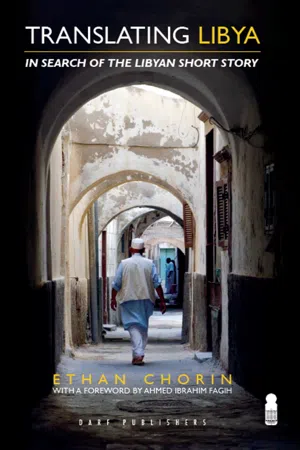
Part anthology and part travelogue, Translating Libya presents the country through the eyes of sixteen Libyan short story writers and one American diplomat. Translating Libya, published in 2008, was one of the first books to introduce Libyan literature to an English-speaking audience. The updated 2014 revision includes a foreword by Ahmed Ibrahim Fagih, one of Libya's most recognised authors, and a new introduction by the author, in light of the Libyan Revolution and its aftermath, which he witnessed firsthand. Intrigued by the apparent absence of 'place' in modern Libyan short fiction, Ethan Chorin, one of the first U.S. diplomats posted to Libya, resolved in 2004 to track down and translate stories that specifically mentioned cities and landmarks in Libya - and then to visit those places, and describe what he encountered there. The result is a mixture of travelogue and memoir that sheds light on the social factors that fed the 2011 Revolution and its aftermath. The collection includes pieces from the 'sixties generation' of writers, as well as a newer generation of Libyan writers, including several women, writing in a variety of styles, "twisted" 1001 nights, to allegory, fictionalized memoir and overt satire. Chorin explains how the stories, under cover of anonymity, distorted place-names and double-meanings reveal the depth of anger and despair that precipitated and fed the Arab Spring - and serve as a reminder to those who fought heroically for their freedom, that true courage springs from isolating, not repeating the mistakes of the past.
- English
- ePUB (mobile friendly)
- Available on iOS & Android
eBook - ePub
About this book
Information
PART ONE
Setting the Scene
Putting ‘Libya’ Back in Libyan Short Fiction
Reading through the modest body of work that is modern Libyan short fiction, a curious fact emerges: rarely does one encounter mention, let alone description, of actual places. It is as if one were to begin to walk through Kensington Gardens and suddenly realize that the usual crowd of sniffing, promenading canines is completely gone. Where did ‘Libya’ and the Libyan psyche go during the 1970s and 1980s? Will reforms mark the return of places to a country that remains, despite its proximity, largely unknown to the West?
Benghazi in the 1960s
The most distinguished Libyan writers from the 1960s were chroniclers, whose journalistic and legal training grounded them firmly in a realist genre. Through narrative and short story, they sought to log the changes that oil and foreign ideas brought to an extremely traditional and overwhelmingly rural society. Excellent examples include Bouri’s Hotel Vienna, a love story set in a ‘marvellous little hotel’ on Maidan Al-Milh (Salt Square), Ramadan Bukheit’s The Quay and the Rain, and Sadiq Neihoum’s The Good-Hearted Salt Seller. If Bouri and Neihoum were the patron saints of Benghazi-based literature, Kamel Maghur was Tripoli’s analogue. An Egyptian-educated lawyer with an impeccable resumé, including a term as Foreign Minister, Maghur set most of his stories in his family quarter of Al-Dahra. Miloud and Rubina’s Story, a gritty tale about an itinerant Zwaran and a Jewess from Tripoli, has as its backdrop The Old Hotel, near the Old City’s souk al-hout (fish market).
Why were so few stories written during this time about farther-flung Libyan locales? For one, the short story was largely an urban art form, and there were very few people living outside the coastal cities and towns. In the 1950s, the vast majority of Libyans were still illiterate. While the Gaddafi regime can be credited for teaching most Libyans to read and write, the fact that people could, did not mean they did.
The Place Moves ‘Out There’
in the 1970s and 1980s
in the 1970s and 1980s
Travelling forward a decade one finds progressively fewer examples of nuanced, ‘realistic’ prose. Writers either stopped writing, or retreated into a kind of anodyne universe where allegory and alternate realities predominate. Indeed, Mohammed Salih, a writer and literary critic, calls the 1970s ‘the age in which people before it wrote and people after it wrote’.3 In the tradition of the Arab rationalist philosophers like Ibn Rushd, writers went underground – or at least, between the lines.
In the years surrounding the 1977 Libyan Cultural Revolution, Sadiq Neihoum’s The Sultan’s Flotilla (‘An Markab As-Sultan) constitutes, geographically speaking, a major find. An allegorical tale written in the style of the One Thousand and One Nights, The Sultan’s Flotilla takes place in Jalo, a town in the Southeastern desert, once a major entrepôt on the north/south caravan trade route. In the story, an arbitrary, nail-biting sultan is persecuted by dreams of a toothy black dog, out for his hide. Ziad Ali engages in a similar technique with his Saraya Castle (Qal‘at Saraya). In The Sultan’s Flotilla, Jalo is visited by a plague, Sodom-and-Gomorrah-like. Sadiq Neihoum employs further biblical imagery in The Good-Hearted Salt Seller, where the wrestling match between the zanj and the Genie is reminiscent of Jacob’s wrestling match with God, from Genesis 32. In Ziad’s story, the Castle has retreated from the sea; it is up to the forces of good to bring it back.
If allegory didn’t suit the writer’s style in coping with censorship, outright evasion sometimes did. When reading Ahmed Fagih’s short story about a Libyan’s encounter with a prostitute in a Maltese hotel, or Ali Mustapha Misrati’s lengthy piece about efforts to capture a monkey running amok in Tripoli airport, one begins to wonder whether the authors are laughing at their publishers, or their readers. During this bleak period, authors like Ibrahim Koni, Omar Kikli and Bashir Hashimi seem to have deliberately sworn off mentioning specific places altogether. Ziad Ali was one of many writers and artists who took himself, as well as his stories, elsewhere, preferring to write about Libya from Syria and Yemen. Interestingly, one essay devoted to the role of ‘place’ in Libyan fiction interprets the word in a Platonic sense, focusing not on places, but archetypes of place, e.g., ‘the car’ or ‘the train’. Have authors been so accustomed in this period to avoiding thinking of places that vehicles begin to count?
The 1990s and Beyond:
Gradual Return of Places, but People Still Missing?
Gradual Return of Places, but People Still Missing?
Encouraged by a loosening of economic controls, a general amnesty for writers and the release of many journalists and writers from jail in the 1990s, some exiled writers began to return to Libya. A younger generation of Libyans, men and women in their late twenties and early thirties, benefited from increased access to literature from abroad. Moreover, the Internet brought quasi-underground sites like www.Libya-Alyoum.com, which offered established and aspiring authors alike both a vehicle to publish and a ready-made readership. Of those writers remaining from the ‘Golden Age’, many begin to write again, encouraging a new generation in the process. Kamel Maghur, for one, wrote a great deal of new material in the few years before his death in 2000.
Products of this period include Meftah Genaw’s Caesar’s Return (Awdat Caesar), a creative invective against urban decay in Tripoli. Genaw reanimates the story’s protagonist, a statue of Roman Emperor Septimius Severus, so that he may return to Martyr’s Square to chat up ‘The Girl with the Gazelle’, a neglected bronze nude built into a corroding fountain. Sick from their jaunt into past glory, the two decide on the spur of the moment to hop on a ferry to Malta.4 The Western desert oasis of Ghadames is the setting for Maryam Salama’s From Door to Door, a protest against continuing taboos concerning marriages between Libyan women and foreigners. In Tripoli Story (Hikaya Trabulsiya) Lamia El-Makki describes social tensions that come with new money. The piece cites a range of Tripoli landmarks, including the upmarket neighbourhoods of Al-Jaraba and Gargaresh, whose relative opulence is a product of the latest economic opening. The piece is reminiscent of Bukheit’s The Quay and the Rain, written during Libya’s last boom. Bukheit’s desperate longshoreman was one of the economic ‘losers’ of the 1960s; El-Makki’s characters, while among Tripoli’s new ‘winners’, are also losers in a sense, victims of their own greed. Even if commonly experienced, the feelings voiced by the quarrelling husband and wife are not the ‘same old’ dialogues, but evidence a twinge of sympathy for the predicament of the modern Libyan male, appreciated only for his role as a breadwinner. Abdel Raziq Al-Mansuri’s My Dead Friends, a deliciously nihilistic work, tells the story of a man apparently so depressed he doesn’t appear to care where he is. A.’s preoccupation is being memorable on the day of his death, by finding a comfortable spot in which to house visiting ‘friends’ (which he pays for with money saved for his sons’ graduate education). While A. (note the absence of any name) is linked with a place, his identity is so weak it is practically missing.
The Twenty-First Century: Return to Reality?
The idea that Libyan society is not sufficiently complex to produce literature deeper than the short story rings hollow, for it is one of the most complex and contradictory in the Middle East, a region not widely known for its penetrability. As more Libyans travel, as exiled Libyans return, as pressure increases to implement Western-style press freedoms; as the older Libyan writers feel compelled to speak about complex and painful past experiences, ‘place’ will likely feature more prominently in Libyan literature. In a country where birthplace and tribal affiliation are so critical, acknowledging relationships in the printed word is key to sorting out issues of national identity. One might go so far as to say that only through claiming title to name, person and place, will Libyans be free to place themselves solidly into a unified concept of ‘Libya’, and to write longer, self-reflective works. The Kensington pooches are starting to return, but to where?
In Search of Stories
Where did this book come from? A series of accidents and coincidences, for sure, but first and foremost, a fascination with Middle Eastern culture and history. My interest in things Middle Eastern really began in 1990 with a summer of Arabic at the Institut Bourguiba des Langues Vivantes in Tunis, Tunisia. At the time, a few French and German friends and I made holiday trips to Jerba, thought to be Homer’s ‘Island of the Lotus Eaters’, from The Odyssey, and the oasis of Douz. At the time, I remember very much regretting the fact that I was so close to mysterious Libya, but could go no farther. Thirteen years later, I took Ambassador Richard Murphy’s early advice and applied to the Foreign Service.
The assignments process, elaborated in most Foreign Service autobiographies, is more or less a lottery, the results of which are announced in a ceremony at the end of a three-month training period. In July of 2004, as I was preparing to leave for a consular posting in Kuwait, one of my cohort passed me a cable calling for volunteers for assignments in what was then the newest American diplomatic mission: Libya. Earlier in the summer, while working a bridge assignment in the press office of the Near East Bureau, I would get a taste of things to come as an observer of one of the first official Libyan delegations to the States. I had absolutely no idea that a few weeks later I’d be on a plane heading to Tripoli. Libya was exactly the kind of destination I’d hoped for when I joined the Foreign Service: Arabic speaking, interesting, culturally rich and wacky to boot.
Background
In 2004, the small American contingent that was the USLOTripoli (United States Liaison Office) was living in small rooms at the Corinthia, the sole Western-standard hotel in Libya. I was to report on economic events significant to US interests in Libya, with particular attention to the process of economic reform and developments in the oil and gas sector. Because there was no representative of the US Foreign Commercial Service in Libya at the time, I was also charged with assisting US companies to enter (or re-enter, as the case might be) the Libyan market. Given the attention Libya began to receive in the wake of Gaddafi ’s decision to give up weapons of mass destruction and the upgrading of the ‘Interests Section’ to a ‘Liaison Office’, we were for the better part of two years literally assaulted with inquiries.
Passing over Corsica, Lampedusa and offshore platforms marking the Bouri oil field, on 24 July 2006, British Airways Flight 898 made landfall just beyond Jerba. Smaller Farwa Island, pristine beaches and increasingly dense clusters of scrub and palm-lined farms came into view just before landing. As we drove to a reception at the British Embassy’s ‘Oasis Club’, located on a small estate on the outskirts of Tripoli, the mission’s interim political officer gave me a rundown of what he’d gleaned about the place in the previous two months. As we sat amongst a large group of festive Brits toasting the departure of my analogue, a British commercial officer winding up a two-year stint, I wondered what my impressions would be like at the end of my term here. The moon was so large it seemed almost absurd, and the sweet smell of olives and Jasmine hung in the air.
The atmosphere in the mission over my first six months was very different from that which prevailed two years later. In the summer of 2004 Libya was virgin territory for Americans. The Washington audience was hungry for information on everything from what people ate to how much they made and how they spent their leisure time. Libyans themselves were often startled (and interestingly, appeared downright excited) to meet an American. My office was my sleeping room. By January of 2005, I had use of a computer-equipped suite located one floor above. Thankfully, much of my day I spent outside the hotel, meeting with local businessmen and, where possible, government officials.
The way the process worked, if any of the resident diplomats wanted to meet an official of rank, a diplomatic note had to be submitted to the mini...
Table of contents
- Cover
- Copyright
- Foreword
- Introduction to the Second Edition
- Contents
- Introduction
- Acknowledgments
- PART ONE: SETTING THE SCENE
- PART TWO: THE STORIES
- PART THREE: INTERPRETING THE STORIES
- Author Biographies
- Bibliography
- Footnotes
- Back Cover
Trusted by 375,005 students
Access to over 1.5 million titles for a fair monthly price.
Study more efficiently using our study tools.
Frequently asked questions
Yes, you can cancel anytime from the Subscription tab in your account settings on the Perlego website. Your subscription will stay active until the end of your current billing period. Learn how to cancel your subscription
No, books cannot be downloaded as external files, such as PDFs, for use outside of Perlego. However, you can download books within the Perlego app for offline reading on mobile or tablet. Learn how to download books offline
Perlego offers two plans: Essential and Complete
- Essential is ideal for learners and professionals who enjoy exploring a wide range of subjects. Access the Essential Library with 800,000+ trusted titles and best-sellers across business, personal growth, and the humanities. Includes unlimited reading time and Standard Read Aloud voice.
- Complete: Perfect for advanced learners and researchers needing full, unrestricted access. Unlock 1.5M+ books across hundreds of subjects, including academic and specialized titles. The Complete Plan also includes advanced features like Premium Read Aloud and Research Assistant.
We are an online textbook subscription service, where you can get access to an entire online library for less than the price of a single book per month. With over 1.5 million books across 990+ topics, we’ve got you covered! Learn about our mission
Look out for the read-aloud symbol on your next book to see if you can listen to it. The read-aloud tool reads text aloud for you, highlighting the text as it is being read. You can pause it, speed it up and slow it down. Learn more about Read Aloud
Yes! You can use the Perlego app on both iOS and Android devices to read anytime, anywhere — even offline. Perfect for commutes or when you’re on the go.
Please note we cannot support devices running on iOS 13 and Android 7 or earlier. Learn more about using the app
Please note we cannot support devices running on iOS 13 and Android 7 or earlier. Learn more about using the app
Yes, you can access Translating Libya by Ethan Chorin in PDF and/or ePUB format, as well as other popular books in Literature & Literature General. We have over 1.5 million books available in our catalogue for you to explore.