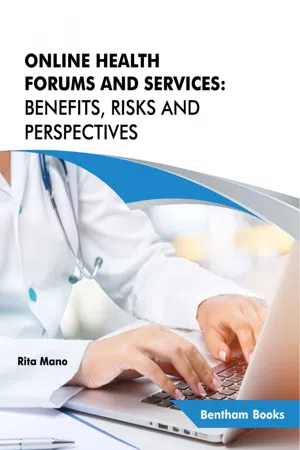
The internet provides a major source of exchanging health informationthrough online portals and new media. Internet users can access health sitesand online forums to obtain health information. In turn, these informationsources act as a catalyst for wellbeing and improving personal health carebehaviors and routines. Competent health institutions encourage the development of theseindividual behaviors that enable individuals to increase health empowerment and totake responsibility for their own health needs, diagnosis and treatment. Online Health Forums andServices: Benefits, Risks and Perspectives is an investigation of the useof online health forums and services. The author first introduces the reader tothe theories that define online social behaviors in terms of health careservices. The chapters following this introduction attempt to account for the variationsin online health care portal use and to what extent does social networkinginduce variations in health behaviors grounded in theory. A summary of mediaused for affecting health behavior change is also provided along with adiscussion of the socioeconomic attributes of the individuals most likely to beaffected in terms of their health behaviors. The book provides a comprehensive perspective that links the aspects ofthe micro-level use of the Internet for health purposes (accessing healthrelated websites, participation in health forums and networking sites) to themacro level practices of telemedicine. Readers will be able to understand thesocial and health characteristics of the different groups of patients andestimate the extent to which individuals in need of health and medicalinformation are taking advantage of the availability of information andcommunication platforms to improve their health, or if they are being left behind.This is a timely reference for healthcare professionals, researchers andconsultants involved in digital health care initiatives and public health administration who areseeking information about how access to online health information can influencelifestyles in a way that impacts human behavior in a positive, meaningful way.
- English
- ePUB (mobile friendly)
- Available on iOS & Android
eBook - ePub
Online Health Forums and Services: Benefits, Risks and Perspectives
About this book
Information
Topic
MedicineSubtopic
Health Care DeliveryThe COVID-19 Pandemic and Digital Divides
Rita Mano
The advantages of the internet as a source of health information include convenient access to a massive volume of information, ease of updating information and interactive formats that promote understanding and retention of information. The health empowerment paradigm has introduced the notion of health efficacy and the right to express health aspirations, thus enabling individuals to develop critical awareness about their existing health conditions (Bandura, 1977; Bandura, 2004; Dutta-Bergman, 2006). These models rely on two assumptions: First, as noted, easy access to information will give rise to rational consumer choice, such that individuals will be motivated to seek even more information and compare between multiple sources of information before making health decisions (Dutta-Bergman, 2006). Second, all individuals are equally able to learn and internalize aspects of health and disease. Hence, these models assess the functional aspects of digital technology and the way they complement each (Mesch et al., 2012).
THE NORMALIZATION HYPOTHESIS
According to the normalization hypothesis, the rise of the information society and the adoption of the internet have the capacity to reduce existing social inequalities in health. The prominence of the normalization hypothesis suggests that technology will ultimately minimize differences between individuals characterized by different socioeconomic variations such as education, income, occupation, gender and ethnicity (Hargitai & Hinnant, 2008; Lemire, et al., 2008; Renahy et al., 2008). Indeed, studies in the field of communication have pursued this line of thought. More specifically, the Media-System Dependency theory suggests that resources located on the internet allow users to explore a health topic fully. Users can also use the internet as a communications tool to increase their capacity to attain their goals, such as changing health behavior, engaging in physical activity and/or ceasing smoking (Dutta-Bergman, 2006; 2004b).
THE SOCIAL DIVERSIFICATION HYPOTHESIS
According to the social diversification hypothesis, computer-mediated communication provides a platform for overcoming social inequalities in access to information and social networks. Residential and social segregation prevents members of minority groups from interacting across ethnicity and migration status (Mesch et al., 2012). Consequently, segregation reduces access to social networks that have the potential to provide available information on health-related conditions. Studies examining differences in access to health information in the US found a high level of agreement among African-Americans and Hispanics that the internet is a helpful resource for health information. There is both motivation and need for accessing health information, in particular among low income members of minority groups. Accordingly, the social diversification perspective maintains that disadvantaged groups (due to migration status and ethnicity) will use the internet to expand their social circles, to diversify their sources of information and social networks through computer-mediated communication and to access non-redundant information and networks. At the same time, majority groups will use ICT to maintain their existing levels of information and social networks, for example through interpersonal communication and direct communication with health providers. Indeed, some individuals or even entire groups of people are less likely to express health-related aspirations and expectations or to develop health-related consciousness.
The concept of a digital divide indeed reflects inequalities in access and use of online information and services and unequal outcomes in health. In turn, the outcome of ICT access and use may affect the motivations and beliefs of social groups, as shown in early studies of internet uses and outcomes (Van Dijk, 2006). Generally, this literature found that digital inequalities tend to mirror existing social inequalities in terms of socioeconomic status, education, gender, age, geographic location, employment status, and race (Robinson et al., 2015).
FIRST LEVEL DIGITAL DIVIDE EFFECTS
Differences in access to technology are also called first-level digital divides (Wyatt et al., 2000; Gui & Argentin, 2011). In contrast to the functional approach, demographic and socioeconomic factors (Lemire, et al., 2008; Renahy et al., 2008) and health status (Mano, 2016, 2018) play an important role in defining the depth of the first digital divide. Kolasa et al. (2020) for example, showed that sociodemographic factors influence the use of e-health among individuals with chronic conditions, and Fabienne Reiners et al. (2019) indicated that e-health seems to be used the least by those that may need it the most, such as older individuals and those with chronic diseases, low incomes and low educational levels who live in rural areas. Indeed, the use of virtual devices can initiate first-level digital divide effects on access to health-related information. The already disadvantaged citizens in society are equally disadvantaged on the internet, either through their limited access to technology and restricted opportunities for use, and / or lack of important digital skills (Hargittai, 2002; Hargittai & Hinnant, 2008; Robinson, 2009; Sims, 2014; Zillien & Hargittai, 2009). Such groups will be less likely to capitalize on information technology than more...
Table of contents
- Welcome
- Table of Content
- Title
- BENTHAM SCIENCE PUBLISHERS LTD.
- PREFACE
- Theories
- Online Health Information Search and Epatients
- Social Media and Social Networks For Health Purposes
- Mobile Health Applications
- Health Systems
- The COVID-19 Pandemic and Digital Divides
- The Case of COVID-19 and Digital Divides
- Discussion
- Conclusions
- References
Trusted by 375,005 students
Access to over 1.5 million titles for a fair monthly price.
Study more efficiently using our study tools.
Frequently asked questions
Yes, you can cancel anytime from the Subscription tab in your account settings on the Perlego website. Your subscription will stay active until the end of your current billing period. Learn how to cancel your subscription
No, books cannot be downloaded as external files, such as PDFs, for use outside of Perlego. However, you can download books within the Perlego app for offline reading on mobile or tablet. Learn how to download books offline
Perlego offers two plans: Essential and Complete
- Essential is ideal for learners and professionals who enjoy exploring a wide range of subjects. Access the Essential Library with 800,000+ trusted titles and best-sellers across business, personal growth, and the humanities. Includes unlimited reading time and Standard Read Aloud voice.
- Complete: Perfect for advanced learners and researchers needing full, unrestricted access. Unlock 1.5M+ books across hundreds of subjects, including academic and specialized titles. The Complete Plan also includes advanced features like Premium Read Aloud and Research Assistant.
We are an online textbook subscription service, where you can get access to an entire online library for less than the price of a single book per month. With over 1.5 million books across 990+ topics, we’ve got you covered! Learn about our mission
Look out for the read-aloud symbol on your next book to see if you can listen to it. The read-aloud tool reads text aloud for you, highlighting the text as it is being read. You can pause it, speed it up and slow it down. Learn more about Read Aloud
Yes! You can use the Perlego app on both iOS and Android devices to read anytime, anywhere — even offline. Perfect for commutes or when you’re on the go.
Please note we cannot support devices running on iOS 13 and Android 7 or earlier. Learn more about using the app
Please note we cannot support devices running on iOS 13 and Android 7 or earlier. Learn more about using the app
Yes, you can access Online Health Forums and Services: Benefits, Risks and Perspectives by Rita Mano in PDF and/or ePUB format, as well as other popular books in Medicine & Health Care Delivery. We have over 1.5 million books available in our catalogue for you to explore.