About the Author
Raffaele Torella is Professor of Sanskrit at University of Rome "Sapienza", where he has also taught for long Indian Philosophy and Religion, and Indology. Dr. Bettina Bäumer, Indologist from Austria and Professor of Religious Studies (Visiting Professor at several universities), living and working in Varanasi since 1967, is the author and editor of a number of books and over 50 research articles. Her main fields of research are non-dualistic Kashmir ?aivism, Indian aesthetics, temple architecture and religious traditions of Odisha, and comparative mysticism. She has been Coordinator of the Indira Gandhi National Centre for the Arts, Varanasi, and Fellow, Indian Institute of Advanced Study, Shimla. She has translated important Sanskrit texts into German and English. Dr. Bettina Bäumer, Indologist from Austria and Professor of Religious Studies (Visiting Professor at several universities), living and working in Varanasi since 1967, is the author and editor of a number of books and over 50 research articles. Her main fields of research are non-dualistic Kashmir ?aivism, Indian aesthetics, temple architecture and religious traditions of Odisha, and comparative mysticism. She has been Coordinator of the Indira Gandhi National Centre for the Arts, Varanasi, and Fellow, Indian Institute of Advanced Study, Shimla. She has translated important Sanskrit texts into German and English. About the Book
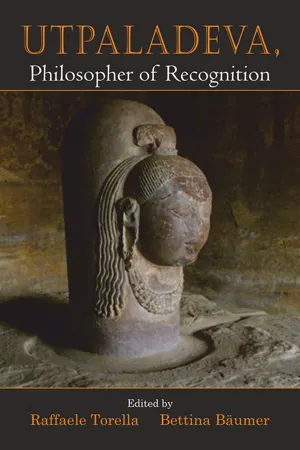
The book, which partly derives from the papers offered at the first International Seminar on Utpaladeva (IIAS, Shimla 2013), is the first ever attempt at presenting a comprehensive portrait of one of the most important philosophers of premodern India, so far mainly taken into account as a mere predecessor of the great Abhinavagupta. Recent studies by R. Torella and others have shown the central importance of Utpaladeva in the elaboration of the Pratyabhijñ? philosophy, and reduced the role of Abhinavagupta to that of his brilliant commentator.
The contributors to the present volume have shown the multifarious aspects of Utpaladeva, not only an outstanding metaphysician and epistemologist, engaged in a strenuous critical dialogue above all with the Buddhist logicians, but also one of the most extraordinary mystical poets of India. For the first time his contribution to poetics and aesthetics has been duly highlighted.
The book contains two appendices with the critical edition and translation by R. Torella of fragments from Utpaladeva's long commentary (Vivr?ti) on his ??varapratyabhijñ?-k?rik? and Vr?tti, one of the most important works of Indian philosophy as a whole, so far deemed to be totally lost.
This book should generate great interest among scholars of Sanskrit and philosophy for its uniqueness and should serve the curiosity of each and every scholarly reader of Kashmir ?aivism.
eBook - ePub
Utpaladeva
Philosopher of Recognition
- English
- ePUB (mobile friendly)
- Available on iOS & Android
eBook - ePub
Utpaladeva
Philosopher of Recognition
About this book
Information
Topic
PhilosophySubtopic
Eastern PhilosophyTable of contents
- Preface
- Importance of Utpaladeva
- Viṣam apy amr̥tāyate . . .
- Detonating or Defusing Desire
- New Fragments of the Īśvarapratyabhijñā-vivr̥ti
- Utpala’s Insights into Aesthetics and His Impact on Abhinavagupta’s Aesthetic Speculation*
- Some Hitherto Unknown Fragments of Utpaladeva’s Vivr̥ti (I)
- Utpaladeva’s Proof of God
- Alaṁkāras in the Stotras of Utpaladeva
- The Twelve Kālīs and Utpaladeva’s Appraisal of the Sensory Experience
- Appendix I*
- Appendix II*
- Contributors
- Index*
Trusted by 375,005 students
Access to over 1.5 million titles for a fair monthly price.
Study more efficiently using our study tools.
Frequently asked questions
Yes, you can cancel anytime from the Subscription tab in your account settings on the Perlego website. Your subscription will stay active until the end of your current billing period. Learn how to cancel your subscription
No, books cannot be downloaded as external files, such as PDFs, for use outside of Perlego. However, you can download books within the Perlego app for offline reading on mobile or tablet. Learn how to download books offline
Perlego offers two plans: Essential and Complete
- Essential is ideal for learners and professionals who enjoy exploring a wide range of subjects. Access the Essential Library with 800,000+ trusted titles and best-sellers across business, personal growth, and the humanities. Includes unlimited reading time and Standard Read Aloud voice.
- Complete: Perfect for advanced learners and researchers needing full, unrestricted access. Unlock 1.5M+ books across hundreds of subjects, including academic and specialized titles. The Complete Plan also includes advanced features like Premium Read Aloud and Research Assistant.
We are an online textbook subscription service, where you can get access to an entire online library for less than the price of a single book per month. With over 1.5 million books across 990+ topics, we’ve got you covered! Learn about our mission
Look out for the read-aloud symbol on your next book to see if you can listen to it. The read-aloud tool reads text aloud for you, highlighting the text as it is being read. You can pause it, speed it up and slow it down. Learn more about Read Aloud
Yes! You can use the Perlego app on both iOS and Android devices to read anytime, anywhere — even offline. Perfect for commutes or when you’re on the go.
Please note we cannot support devices running on iOS 13 and Android 7 or earlier. Learn more about using the app
Please note we cannot support devices running on iOS 13 and Android 7 or earlier. Learn more about using the app
Yes, you can access Utpaladeva by Raffaele Torella, Bettina Bäumer, Raffaele Torella,Bettina Bäumer in PDF and/or ePUB format, as well as other popular books in Philosophy & Eastern Philosophy. We have over 1.5 million books available in our catalogue for you to explore.