Fish and other seafood have always been considered as an important part of human diet and have also long been recognized as a health-promoting food for human nutrition. However, managing aquatic food resources remains a challenge as the human population is expanding and overfishing poses a threat to fishing reserves in several areas. Aquaculture is the alternative solution for food production from the sea. According to the FAO, aquaculture is probably the fastest growing food-producing sector and can be a sustainable solution for fish production. In order to maximize marine food production and achieving sustainable management of the aquatic environment, knowledge about aspects of fisheries and aquatic animal health is very important.
Trends in Fisheries and Aquatic Animal Health covers some basic and applied topics in fishery management and fish health with a focus on European regions. The textbook is a combination of reviews and research articles. Topics covered in the book include challenges in fishery management, environmental impacts on fisheries, fish health (pharmacology, histopathology, stress response), telemetry techniques in fisheries research, and specific case studies of regional marine species in localized fisheries. This textbook is a useful resource for graduates and professionals involved in advanced training courses for aquaculture and fishery management.
- English
- ePUB (mobile friendly)
- Available on iOS & Android
eBook - ePub
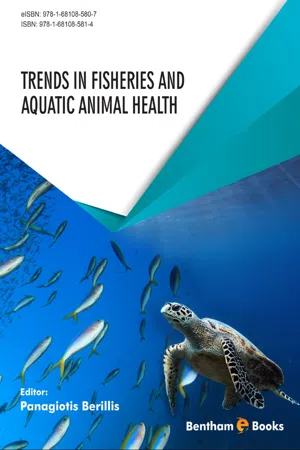
Trends in Fisheries and Aquatic Animal Health
About this book
Information
The Effect of Cyanobacteria and Their Toxins on Fish
Angeles Jos1, Ana M. Cameán1, Reyhan Akcaalan2, *, Meriç Albay2
1 Area of Toxicology, Faculty of Pharmacy, University of Sevilla, Spain
2 Istanbul University, Faculty of Aquatic Sciences, Turkey
Abstract
Cyanobacteria are grouped together with phytoplankton as primary produc-ers in aquatic environments. These organisms are very diverse and under favorable conditions, their biomass increases dramatically, leading to blooms. Cyanobacterial blooms in aquatic environments are a well known global phenomenon, largely as a result of anthropogenic pressures, such as increas-ing nutrient inputs from catchment areas or climate change. Especially, planktonic cyanobacteria can thrive in surface waters and cause several adverse effects on aquatic organisms due to variations in pH, blocking light from entering the water and oxygen deficiency as a result of respiration at night. Moreover, they also produce toxins, called cyanotoxins, which can pose harmful effects on organisms in every trophic level; phytoplankton, zooplankton, invertebrates, fish, birds and also mammals. Cyanotoxins comprise of very diverse chemical compounds with several adverse effects on organisms. Considering the diversity of cyanotoxins, we chose two cyanotoxins, microcystin and cylindrospermopsin, since there are relatively more data about their toxic effects on fish, and also the former has a worldwide distribution and the latter is an emerging toxin with an extending geographical range. Together with the other adverse effects on fish, microcystins and cylindrospermopsin could cause oxidative stress and histopathological changes which we focus on and review in detail in this chapter.
Keywords: Cyanobacteria, Cylindrospermopsin, Fish, Histopathology, Microcystin, Oxidative stress.
* Corresponding author Reyhan Akcaalan: Istanbul University, Fisheries Faculty, Turkey; Tel: +90 212 4555700; E-mail: [email protected]
INTRODUCTION
Cyanobacteria and Cyanotoxins
Cyanobacteria are prokaryotic organisms with a capacity for photosynthesis. The pigments; chlorophyll-a and phycobilins are responsible for the blue-green color, and the name blue-green algae has been used for years, however, the scientific
community now refer to them as cyanobacteria, due to them being Gram negative bacteria. Cyanobacteria are an ancient group with a long evolutionary history, ca. 3500 Ma [1] resulting from good adaptation strategies with changing geochemical and climatic conditions, and also anthropogenic pressures, such as nutrient enrichment, over-exploitation of water resources for drinking or irrigation purposes [2]. It is also a very diverse group with different morphologies [single cell, filamentous or colonial], variable size, ranging from 0.2 – 100 micron, and thriving in several habitats from freshwater to extreme saline environments. They have key roles in global primary production and nitrogen-fixation [3].
The successful growth of an organism is related to its ability to optimize resource utilization and when environmental conditions are in favor of one species in relation to its resource requirements, its population will thrive and reach high biomass [4]. Under normal circumstances, cyanobacteria contribute to the phytoplankton community of aquatic habitats, however, when environmental conditions are suitable for their growth, they form blooms. As nutrient concentrations have increased due to cultural eutrophication, cyanobacterial bloom frequency and severity have also risen. The main actor is phosphorus and there is a shift from a diverse phytoplankton community towards dominancy of cyanobacteria with increasing phosphorus concentrations [5]. Historical descriptions of cyanobacterial blooms have been recorded as early as 1188 in Wales and also in the 1800’s in Australia [6, 7] and studies has dramatically increased worldwide after the 1970’s. The proliferation of cyanobacteria has several unintended consequences in water bodies used for recreation or for the preparation of potable drinking water. These vary from economical [e.g. adverse economic effects for tourist attractions, increased costs of disinfection and treatment in drinking water plants] to environmental impacts e.g. suppression of growth of other organisms, depleting oxygen during bloom senescense [2, 4]. Besides these negative effects, cyanobacteria can produce a variety of toxic secondary metabolites, cyanotoxins, which cause serious intoxication to aquatic organisms and also mammals, including humans [2, 8, 9]. There are many reports of wild and farmed fish kills related to cyanobacterial blooms and their toxins [8].
Cyanotoxins are secondary metabolites synthesized within the cells showing great diversity [10]. It is possible to classify cyanotoxins depending on their chemical structures into three main groups; Cyclic peptides including microcystins and nodularins, alkaloids comprising a larger group including cylindrospermopsin, anatoxins, saxitoxins, applysiatoxins and lyngbyatoxins and the third group being lipopolysaccharides, which can be found in the cell membrane of many cyanobacteria. On the other hand, their toxicity mechanisms are more diverse and five groups can be identified in relation to their functions upon organisms, such as being hepatotoxins, cytotoxins, neurotoxins, dermatotoxins and irritant toxins [11-13]. Hepatotoxins include primarily microcystins and nodularins, although cylindrospermopsin also has hepatotoxic effects together with cytotoxic, genotoxic and dermatotoxic modes of action [14-16]. Neurotoxins interfere with the functioning of the neuro-muscular systems and can cause death very rapidly after the consumption of toxic cyanobacteria [12, 17]. Anatoxin-a, Homonatoxin-a, Anatoxin-a(S), Saxitoxins and BMAA are the potent neurotoxins and are produced by many cyanobacterial species including Dolichospermum, Aphanizomenon, Oscillatoria, Phormidium and Planktothrix. The only cytotoxin produced by cyanobacteria is cylindrospermopsin and mainly targets the liver and kidney, along with several other organs [7, 18]. Dermatotoxins are produced by marine benthic cyanobacteria and comprise aplysiatoxins, debromoaplysiatoxins and lyngbyatoxins. Irritant toxins are lipopolysaccharides [LPS] found in the cell wall of cyanobacteria as well as in all Gram-negative bacteria [12].
Effect of Cyanotoxins on Aquatic Organisms
Cyanobacterial blooms and their associated cyanotoxin risk are well-known around the world because of increasing anthropogenic pressures on aquatic environments. Cyanotoxins could affect all organisms in aquatic environments and can be transferred to higher trophic levels in aquatic food webs [18]. Organisms can be directly exposed to cyanobacteria or toxins via consumption, with some species of fish directly feeding on algae and cyanobacteria. On the other hand, zooplankton species, like D...
Table of contents
- Welcome
- Table of Contents
- Title Page
- BENTHAM SCIENCE PUBLISHERS LTD.
- FOREWORD
- PREFACE
- List of Contributors
- Fish and Fisheries of The Eastern Adriatic Sea in The Light of Climate Change
- Biodiversity Status of and Threats to Freshwater Fish of Croatia and Eastern Adriatic Countries
- Challenges Facing Marine Aquaculture in the EU-Mediterranean
- Mediterranean Fisheries in the Framework of a New Common Fisheries Policy (CFP): Challenges and Opportunities
- Antibiotic Resistance in Fish
- Stress and Fish Health: Towards an Understanding of Allostatic Load
- Fish Histopathology as Biomarker in Ecotoxicology
- The Effect of Cyanobacteria and Their Toxins on Fish
- Review on Rainbow Trout Desert Farming Using Underground Brackish Water
- Fishing Landings of Crustacean Decapods Their Culture and Problems Associated with Diseases
- Histological Methods to Assess the Effect of Diet and a Single Meal on the Liver and Intestine of Rainbow Trout: Fishmeal and Fishoil Replacement With Plant Protein and Oil
- Developing a Methodology for the Mariculture of Bath Sponges in Larymna Gulf, North Evoic, Greece
- The Establishment of Blue Crab Callinectes sapidus Rathbun, 1896 in the Lagoon Pogonitsa (Amvrakikos Gulf, Western Greece)
- CyHV-2 Outbreak Associated with Aeromonas spp. in Crucian Carp (Carassius carassius) in Piedmont (Italy)
- Findings from a 16-year monitoring of Viral Notifiable Diseases in Salmonid Fish in Piedmont Region (Italy)
- The Effects of Chronic Low Level Zinc (Zn) Exposure on the Hematological Profile of Tench, Tinca tinca L., 1758
- Use of Acoustic Telemetry to Management of Fishery in Artificial Reefs
Trusted by 375,005 students
Access to over 1.5 million titles for a fair monthly price.
Study more efficiently using our study tools.
Frequently asked questions
Yes, you can cancel anytime from the Subscription tab in your account settings on the Perlego website. Your subscription will stay active until the end of your current billing period. Learn how to cancel your subscription
No, books cannot be downloaded as external files, such as PDFs, for use outside of Perlego. However, you can download books within the Perlego app for offline reading on mobile or tablet. Learn how to download books offline
Perlego offers two plans: Essential and Complete
- Essential is ideal for learners and professionals who enjoy exploring a wide range of subjects. Access the Essential Library with 800,000+ trusted titles and best-sellers across business, personal growth, and the humanities. Includes unlimited reading time and Standard Read Aloud voice.
- Complete: Perfect for advanced learners and researchers needing full, unrestricted access. Unlock 1.5M+ books across hundreds of subjects, including academic and specialized titles. The Complete Plan also includes advanced features like Premium Read Aloud and Research Assistant.
We are an online textbook subscription service, where you can get access to an entire online library for less than the price of a single book per month. With over 1.5 million books across 990+ topics, we’ve got you covered! Learn about our mission
Look out for the read-aloud symbol on your next book to see if you can listen to it. The read-aloud tool reads text aloud for you, highlighting the text as it is being read. You can pause it, speed it up and slow it down. Learn more about Read Aloud
Yes! You can use the Perlego app on both iOS and Android devices to read anytime, anywhere — even offline. Perfect for commutes or when you’re on the go.
Please note we cannot support devices running on iOS 13 and Android 7 or earlier. Learn more about using the app
Please note we cannot support devices running on iOS 13 and Android 7 or earlier. Learn more about using the app
Yes, you can access Trends in Fisheries and Aquatic Animal Health by Panagiotis Berillis in PDF and/or ePUB format, as well as other popular books in Technology & Engineering & Fisheries & Aquaculture. We have over 1.5 million books available in our catalogue for you to explore.