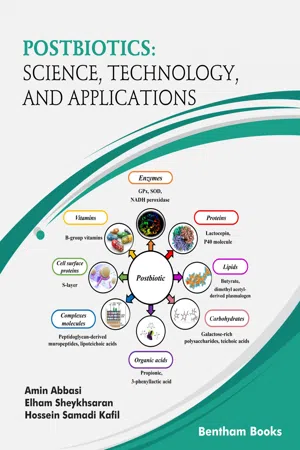
Postbiotics: Science, Technology, and Applications explains fundamental and applied knowledge about postbiotics. Chapters cover the definition and classification of postbiotics, principal methods for preparing them, information about the main postbiotic constituents and their biological activities and their clinical health benefits. The authors also familiarize the reader with potential applications of postbiotics in the food industry, pharmaceutical chemistry, medicine, and veterinary practice. The text is supported by informative illustrations, tables, and references for further reading. This comprehensive reference, with its emphasis on both basic and applied knowledge, is useful for researchers, academics, veterinarians, and students in the field of microbiology, immunology, pharmacology, biotechnology, food science, and agriculture.
eBook - ePub
Postbiotics: Science, Technology, and Applications
- English
- ePUB (mobile friendly)
- Available on iOS & Android
eBook - ePub
Postbiotics: Science, Technology, and Applications
About this book
Information
Topic
MedicineSubtopic
Nutrition, Dietics & BariatricsBioactivity Perspectives and Health Benefits of Postbiotics
Amin Abbasi, Elham Sheykhsaran, Yalda Rahbar Saadat, Hossein Samadi Kafil
Abstract
Recent investigations have reported that the intestinal microbiome community possesses a significant health-promoting effect on the host physiology by the secretion of small biomolecules that exerts a unique ability to modulate the host cellular pathways. These small molecules act as a beneficial tool for host-microbial interactions and communication. Based on current evidence, postbiotics have the potency to be a safe and appropriate alternative to prevent side effects pertinent to probiotics besides the enforceable benefits such as treatments of some human complications. These beneficial effects are feasible through various mechanisms that are explained in related chapters. Some of the clinical advantages associated with postbiotics can refer to modulating the immune system, anti-diarrhea, anti-blood pressure activity, reducing blood cholesterol, anti-oxidant and anticancer activity, as well as suppressing cell proliferation. These properties indicate that postbiotics can improve the host’s health circumstances, albeit with unknown mechanisms. Another substantial advantage of postbiotics returns to their desirable immune condition. In this case, there is no need to adsorb the trillions of live microorganisms. Besides, it is possible to impose the postbiotics in a controlled and standard way. However, the live microbes' functions depend on their interactions in the gut and their metabolical activities. Therefore, the compounds of specified bacteria may turn into a biological strategy as a complementary treatment of many important diseases. The main challenge in this respect is the scientific knowledge transformation to commercial applications, which constitute a bridge between science and industry.
Keywords: Aging, Atopic dermatitis, Anti-cancer therapy, Alcohol-induced liver diseases, Colitis, Diarrhea, Food allergy, Gut microbial community, Immunomodulation, Intestinal barrier, Inflammation, Lactose intolerance, Postbiotics, Probiotic, Tooth decay.
Gut Microbiome-Based Therapies: A New Approach
All cavities and mucosal surfaces in the human body are occupied by a broad population of microorganisms [319]. The gut microbiota implicates in the host's multifunctional physiological processes, including immunity, nutritional and metabolic homeostasis, and neuronal activity [320]. Providing a stable niche for commensal microorganism colonization is a significant ability in the host. It ensures the stabilization of dietary nutrients. Astechnology progresses, in
metagenomics (genome sequencing) and gnotobiotics (germ-free mice usage), the remarkable involvement of human health-related microorganisms has become increasingly evident. Utilizing these apparatuses, we could expand our comprehension of the host and the microbiome interactions over the last decade. Related abnormalities in the gut microbiota composition and function are associated with the molecular etiology of multiple disorders. Several factors can lead to a loss of homeostatic function, including inflammation, infection, xenobiotics, hygiene, diet, altered host genetics, and microorganism diversity [137]. Consequently, efforts are ongoing to promoting health and modulating the human microbiome through device interventions. Due to the extensive role of microbiota in various gastrointestinal and non-gastrointestinal complications, it has become an interesting therapeutic target increasingly [138]. However, one of the most vital issues in microbiome research is determining cause-effect relationships and designing therapies based on the microbiome that can attain predictable benefits related to the host health and microbial community. A massive part of present microbiome-based therapeutics focuses on the microbiome-prokaryotic arm through the enforcing to modify the composition of the gut microbiota via the administration of exogenous live microbes. These approaches referred to probiotics term collectively, which has become a popular topic during the last decade. Nevertheless, there is still restricted evidence for supporting the efficacy of the probiotic. An appropriate alternative approach for probiotics is prebiotics. Besides, to live bacteria administration, prebiotics are considering consumed compounds to affect microbiome composition or function beneficially. Probiotics and prebiotics are considered as a comparatively non-specific approach for microbiome-based strategies, and more investigation is required to fully understand the effects of prebiotics on various bacterial species [18].
At present, a microbiome-based intervention is fecal microbiota transplantation (FMT) as a successful method approved by the FDA. FMT includes the whole microbial population transferring from a healthy donor to a recipient who suffered from some disorders to disease-associated microbiome replacement. FMT has been shown to include significant efficacy in Clostridium difficile infection treatment, which is conduct commonly followed by antibiotic therapy [321]. The utilizing of FMT for conditions of additional complications is investigating currently. Nonetheless, FMTs possibly are associated with the natural risk for the recipient, such as the pathobionts and undesirable interactions for the recipient with their current microbiome community. Because of the substantial variability of microbial community and individuals and the restricted long-term stabilization in foreign microbial configuration, opportunities are ample to alternative strategies that relevant to microbiome involvement in human health and understanding of it as a new mechanistic approach.
Recent investigations have reported that the intestinal microbiome community possesses a significant health-promoting effect on the host physiology by the secretion of small biomolecules that exerts a unique ability to modulate the host cellular pathways [322-325]. These small molecules act as a beneficial tool for the host’s microbial interactions and communication. These pathways are including in target downstream signaling of the microbiome. Metabolite-based therapeutics, or “postbiotics,” target the microbiome in terms of their downstream signaling pathways and play a vital role by moderating the side effects of an excess, insufficiency, or dysregulation of metabolites associated with these pathways. In comparison to targeting the composition of aberrant microbial, metabolites exogenous inhibition or administration has a potency for counteracting and correcting the negative impacts of dysbiosis (Fig. 6). Primary instances of potential metabolite-based therapies that are existed in animal models of the human complications are involved short-chain fatty acids (SCFAs) with anti-inflammator...
Table of contents
- Welcome
- Table of Content
- Title
- BENTHAM SCIENCE PUBLISHERS LTD.
- PREFACE
- ABOUT THE AUTHORS
- Ecology of the Human Gastrointestinal Tract
- Obstacles and Challenges in the Use of Probiotics
- Postbiotics: A Solution to Leave Problems of the Production and Consumption of Probiotics
- Main Methods for the Preparation of Postbiotics
- Bioactivity Perspectives and Health Benefits of Postbiotics
- Perspectives on the Postbiotics Application
- The Challenges and Strategies to Add Postbiotic Components into Food Matrices
- REFERENCES
Trusted by 375,005 students
Access to over 1.5 million titles for a fair monthly price.
Study more efficiently using our study tools.
Frequently asked questions
Yes, you can cancel anytime from the Subscription tab in your account settings on the Perlego website. Your subscription will stay active until the end of your current billing period. Learn how to cancel your subscription
No, books cannot be downloaded as external files, such as PDFs, for use outside of Perlego. However, you can download books within the Perlego app for offline reading on mobile or tablet. Learn how to download books offline
Perlego offers two plans: Essential and Complete
- Essential is ideal for learners and professionals who enjoy exploring a wide range of subjects. Access the Essential Library with 800,000+ trusted titles and best-sellers across business, personal growth, and the humanities. Includes unlimited reading time and Standard Read Aloud voice.
- Complete: Perfect for advanced learners and researchers needing full, unrestricted access. Unlock 1.5M+ books across hundreds of subjects, including academic and specialized titles. The Complete Plan also includes advanced features like Premium Read Aloud and Research Assistant.
We are an online textbook subscription service, where you can get access to an entire online library for less than the price of a single book per month. With over 1.5 million books across 990+ topics, we’ve got you covered! Learn about our mission
Look out for the read-aloud symbol on your next book to see if you can listen to it. The read-aloud tool reads text aloud for you, highlighting the text as it is being read. You can pause it, speed it up and slow it down. Learn more about Read Aloud
Yes! You can use the Perlego app on both iOS and Android devices to read anytime, anywhere — even offline. Perfect for commutes or when you’re on the go.
Please note we cannot support devices running on iOS 13 and Android 7 or earlier. Learn more about using the app
Please note we cannot support devices running on iOS 13 and Android 7 or earlier. Learn more about using the app
Yes, you can access Postbiotics: Science, Technology, and Applications by Amin Abbasi,Elham Sheykhsaran,Hossein Samadi Kafil in PDF and/or ePUB format, as well as other popular books in Medicine & Nutrition, Dietics & Bariatrics. We have over 1.5 million books available in our catalogue for you to explore.