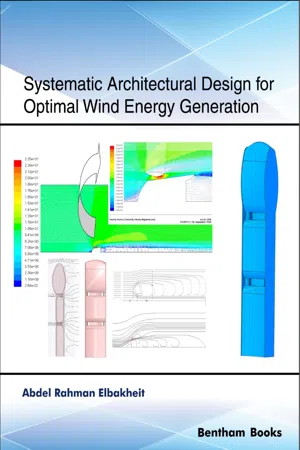
Systematic Architectural Design for Optimal Wind Energy Generation is a handy reference on the aerodynamic architectural forms in buildings for optimizing wind energy conversion processes. Chapters of the book cover the basics of wind energy generation and building design that make them more conducive for generating wind power, and in line with sustainable energy design goals. Key Features: - 7 chapters organized in a simple, reader friendly layout - A learning approach to the subject that highlights key concepts in architectural science and wind energy physics - Introduces readers to the application of computational Fluid Dynamics (CFD) tools to visualize and simulate architectural forms under wind actions - An objective focus on architectural forms is presented, including the role of the form in optimizing wind energy conversion and the negative effects of wind on certain forms - Covers the building and positioning of different types of wind turbines - References for further reading Systematic Architectural Design for Optimal Wind Energy Generation is an essential reference for students of architecture at all levels, professional architects, as well as readers interested in green building design, renewable energy and sustainability studies that pave the way towards proactive environment-friendly solutions.
eBook - ePub
Systematic Architectural Design for Optimal Wind Energy Generation
- English
- ePUB (mobile friendly)
- Available on iOS & Android
eBook - ePub
Systematic Architectural Design for Optimal Wind Energy Generation
About this book
Information
Topic
ArchitectureSubtopic
Sustainability in ArchitectureWind and Architecture
Abdel Rahman Elbakheit
1 College of Architecture and Planning, Department of Architecture and Building Sciences, King Saud University, Riyadh, Saudi Arabia
Abstract
In this chapter, the influences of wind on architecture are highlighted. Wind can have both positive and negative effects on architecture. Moreover, architecture can respond in proactive ways to maximise the benefits of wind forces and reduce or eliminate the negative impacts. This chapter sheds further light on notable architectural ideas translated into architectural case studies on harvesting wind energy in the built environment. Moreover, this chapter enables gaining insight into successful practices in architectural design solutions and ways and means to further enhance the performance of the buildings. In addition, the negative impacts of high wind velocities are identified, and possible solutions to mitigate them at their source are presented and discussed. Optimised architectural forms that can completely avoid excessive wind forces and devastating vortex shedding during the design stage are presented.
Keywords: Architectural forms, Aerodynamic architectural optimisation, Architectural form finding, Architectural stability, Vortex shedding, Wind energy, Wind energy harvesting, Wind forces.
* Corresponding author Abdel Rahman Elbakheit: College of Architecture and Planning, Department of Architecture and Building Sciences, King Saud University, Riyadh, Saudi Arabia. E-mail:[email protected]
1. INTRODUCTION
Mankind encountered wind and its effects from the dawn of existence. The history of using this renewable energy source has been well integrated in human civilisation, being implemented for sailing boats and operating wind mills [1], wind catchers [2], etc. However, for buildings in general, architectural form in particular, wind is associated either with structural safety or ventilation of interior spaces. With technology advancement, structural safety and ventilation have developed to be well established aspects of architectural form, although under different specialisations: structural safety under structural engineering [3] and ventilation under mechanical engineering [4]. However, architectural design retained the initiative of combining these two, among others, to produce more environmentally friendly buildings. Thus, the need to adequately benefit from wind arose. In other words, the need to find a way to tame the giant to harvest its energy at the point where it is made. In this regard, some notable conceptual architectural ideas put forth by architect Bill Dunster [5] were ground breaking, wherein he proposed the integration of a flower-shaped structure with at Tall
building concentracting and accelerating wind flow for energy harvesting.Another wind energy harvesting design was developed by the European funded project of ‘WEB – JOR3-CT98-0270’ [September 1998–August 2000] [6], which performed a systematic study on the generation of wind flows by design manipulation to enhance wind energy harvesting. This study included the use of two large kidney-shaped towers that channel and accelerate wind flows between them, where large turbines are present. A prototype was erected and tested. Fig. (1) shows this prototype, which was designed under the collaborative efforts of Imperial College London, Mecal applied mechanics (i.e., consulting firm), University of Stuttgart, and BDSP partnership Ltd. (i.e., engineering consulting firm). This project highlighted that this architectural design enabled increasing wind energy generation by a factor of at least 25% compared with the annual yield of the same turbines under a standalone scenario.
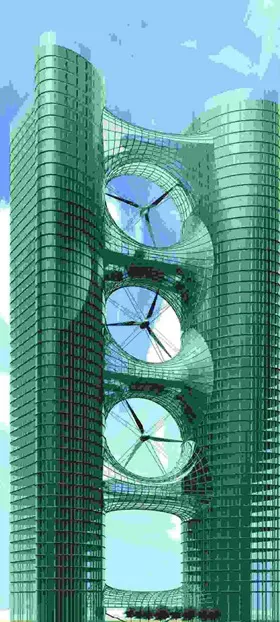
Conceptual architectural design of kidney-shaped twin towers with three horizontal-axis wind turbines integrated, having diameters of 35 m and generating 250 kW of power [8].
Derek Tayler of Altechnica [7] invented ‘the Aeolian roof’ that contained a pitched roof with a flat wing at the ridge, which accelerated wind in this area. Wind turbines were then proposed to be used to harvest energy from this accelerated wind.
In 2005, a report was published from the joint venture of the Carbon Trust UK and some consulting and research bodies such as Imperial College London and Altechnica. It detailed the potential of building-integrated wind turbines.
2. Examples of Fully Developed Architectural Designs for Wind Energy Harvesting
Recently, some projects involving architectural forms incorporating wind turbines have been completed around the globe, such as the Bahrain World Trade Center (BWTC) in Manama, Bahrain, Strata SE1 in London, UK, and Pearl River Tower in Guangzhou, China.
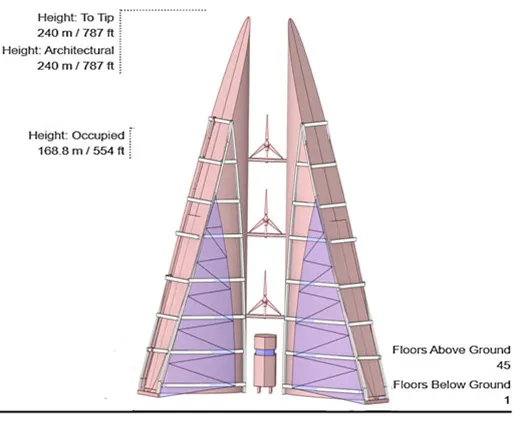
Schematic of the Bahrain World Trade Center, Gulf view.
2.1. Bahrain World Trade Center
The BWTC is a man...
Table of contents
- Welcome
- Table of Content
- Title
- BENTHAM SCIENCE PUBLISHERS LTD.
- PREFACE
- Wind and Architecture
- Aerodynamic Architectural Design
- Wind as an On-site Energy Source
- Architectural Aerofoil Form Optimisation for Wind Energy Generation
- Building-Integrated Wind Turbines
- Effect of Turbine Resistance and Positioning on the Performance of Aerofoil Building-Augmented Wind Energy Generation
- Conclusion
Trusted by 375,005 students
Access to over 1.5 million titles for a fair monthly price.
Study more efficiently using our study tools.
Frequently asked questions
Yes, you can cancel anytime from the Subscription tab in your account settings on the Perlego website. Your subscription will stay active until the end of your current billing period. Learn how to cancel your subscription
No, books cannot be downloaded as external files, such as PDFs, for use outside of Perlego. However, you can download books within the Perlego app for offline reading on mobile or tablet. Learn how to download books offline
Perlego offers two plans: Essential and Complete
- Essential is ideal for learners and professionals who enjoy exploring a wide range of subjects. Access the Essential Library with 800,000+ trusted titles and best-sellers across business, personal growth, and the humanities. Includes unlimited reading time and Standard Read Aloud voice.
- Complete: Perfect for advanced learners and researchers needing full, unrestricted access. Unlock 1.5M+ books across hundreds of subjects, including academic and specialized titles. The Complete Plan also includes advanced features like Premium Read Aloud and Research Assistant.
We are an online textbook subscription service, where you can get access to an entire online library for less than the price of a single book per month. With over 1.5 million books across 990+ topics, we’ve got you covered! Learn about our mission
Look out for the read-aloud symbol on your next book to see if you can listen to it. The read-aloud tool reads text aloud for you, highlighting the text as it is being read. You can pause it, speed it up and slow it down. Learn more about Read Aloud
Yes! You can use the Perlego app on both iOS and Android devices to read anytime, anywhere — even offline. Perfect for commutes or when you’re on the go.
Please note we cannot support devices running on iOS 13 and Android 7 or earlier. Learn more about using the app
Please note we cannot support devices running on iOS 13 and Android 7 or earlier. Learn more about using the app
Yes, you can access Systematic Architectural Design for Optimal Wind Energy Generation by Abdel Rahman Elbakheit in PDF and/or ePUB format, as well as other popular books in Architecture & Sustainability in Architecture. We have over 1.5 million books available in our catalogue for you to explore.