This text book is a guide for pharmaceutical academics (students and teachers) as well as industry professionals learning about drug delivery and formulation. Chapters presents comprehensive information about self-emulsifying formulations by providing an in-depth understanding of the basic concepts and formulation mechanisms. This information is supplemented by details about current research and development in this field. Readers will learn about the types of self-emulsifying drug delivery systems, evaluation parameters and digestion models, among other topics. Key Features:
- 9 chapters organized in a reader-friendly layout
- complete guide on self-emulsifying drug delivery formulations, including lipid based systems, SMEDOs, surfactants, and oral dosage forms
- includes basic concepts and current developments in research and industrial applications
- presents information on conventional and herbal formulations
- references for further reading
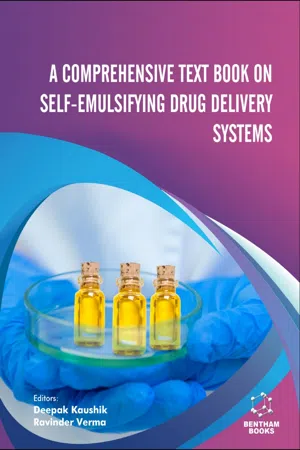
eBook - ePub
A Comprehensive Text Book on Self-emulsifying Drug Delivery Systems
- English
- ePUB (mobile friendly)
- Available on iOS & Android
eBook - ePub
A Comprehensive Text Book on Self-emulsifying Drug Delivery Systems
About this book
Information
Topic
MedicineSubtopic
PharmacologyDifferent Methodologies for Improving Solubility and Bioavailability
Ravinder Verma1, Deepak Kaushik1, *, Ritu Kaushik1, Vandana Singh1
1 Department of Pharmaceutical Sciences, Maharshi Dayanand University, Rohtak (Haryana), 124001, India
Abstract
Drug delivery through the oral route is perfect for both solid and liquid dosage forms. Notwithstanding numerous favorable circumstances, the improvement of the oral delivery route still speaks to an excellent test attributable to interesting curious physicochemical characteristics of lipophilic drug compounds and physiological barriers, such as gastrointestinal unsteadiness, pre-systemic metabolism and efflux pump. Upon oral intake, lipophilic drug in a dosage form is effortlessly taken by patients, passes the GIT via a tremendously versatile environment. Factors affecting solubilization are the size of particle, temperature, pressure, molecular size, nature of solute and solvent, polarity and polymorphs. Ways of enhancing oral bioavailability includeboth chemical modifications and formulation modifications. The chemical modification includes soluble pro-drug and salt formation. While formulation modification comprises of physical changes like size reduction, crystal habit modification, complexation (e.g. with β-cyclodextrin), solubilization with co-solvents or surfactants, drug dispersion with carriers (e.g. eutectic mixture, solid dispersion and polymeric carriers like micro/nanoemulsions, self-emulsifying drug delivery systems, liposomes, solid lipid nanoparticles (SLNs) and nanostructured lipid carriers which are described briefly. A formulation approach is a preferable option to chemical modification approaches which may prompt the change in chemical structure and may have an impact on the pharmacological action. Particle size reduction is classified into two categories - mechanical micronization and engineered particle size control. Mechanical micronization includes jet milling, ball milling, high-pressure homogenization. Engineered particle size control includes the cryogenic method, spray freezing onto cryogenic fluids, spray freezing into cryogenic liquids, spray freezing into vapor over liquid, ultra-rapid freezing and cryogenic spray processes. Crystal engineering includes nanocrystals, solid dispersion, co-crystal formation, sonocrystallization, liquisolid technique, self-microemulsifying drug delivery systems and inclusion complex which are discussed in detail. This chapter highlights various methods for solubility enhancements with their merits and demerits.
Keywords: Crystal engineering, Cryogenic method, High-pressure homoge-nization, Liposomes, Nanostructured lipid carriers, Oral bioavailability.
* Corresponding author Deepak Kaushik: Department of Pharmaceutical Sciences, Maharshi Dayanand University, Rohtak (Haryana), 124001, India; Tel: +91 9315809626; E-mail: [email protected]
INTRODUCTION
The oral route is the most favorable route for the administration of the drug owing to its multiple benefits such as ease of administration, strong patient compliance, possibility of different release options, cost-effectiveness, self-administration, convenience for prolonged repeated use, the most valuable non-invasive and the most common route for the treatment of various diseases.
Drug delivery through the oral route is perfect for both solid and liquid dosage forms. Liquid dosage forms are noticeable because of the simplicity of administration, the precision of measurements, self-administration, pain avoidance and especially patient compliance [1].
As our human body comprises around 70% water, a drug must be soluble in aqueous GIT fluid to have adequate bioavailability. The drug present in the dosage forms discharges in gastrointestinal (GI) fluid after its breaks down that results in a solution after gentle agitation. This process is solubility dependent. The passage of the solution form of a drug across the cell lining membrane in the GI tract is permeability constrained. Then, the drug assimilates into the blood. The oral bioavailability of a drug is measured by the rate of drug solubility and permeability.
Difficulties in the Oral Drug Delivery
Notwithstanding numerous favorable circumstances, the oral drug delivery is a big challenge due to complex physicochemical characteristics of lipophilic drug compounds and physiological conditions. Gastrointestinal contents, pre-systemic metabolism, aqueous solubility, drug permeability, drug extent of dissolution and efflux pumps are some of the complex factors which affect the efficiency of drug administration through the oral route. Oral intake of lipophilic drug in a dosage form is effortlessly taken by patients, goes in GIT via a tremendously versatile environment. When a drug transits from a highly acidic pH to the digestive system, the stomach digestive enzymes and microflora alter its pH. In this perspective, the main issues of oral delivery are the physicochemical characteristics of drugs and physiological conditions of human body [2].
Oral Bioavailability
The majority of the new chemical compounds being worked on nowadays are planned to be utilized as solid dosage forms so that a viable and reproducible in vivo plasma concentration can be acquired after oral administration. In any case, poor retention and poor bioavailability do not allow oral route for intake of numerous drugs. That is why in many cases, injections are preferred for administration of such therapeutic moieties, for example, proteins and peptides due to their poor oral bioavailability that prompts high fluctuation and poor control of plasma concentrations and therapeutic effects.
The process of drug dissolution is vital for the therapeutic efficacy of the orally administered drug and route of intake. Drug dissolution includes the transfer of a solid drug into the aqueous phase in the physiological fluid. The dissolution extent of a drug is influenced by factors incorporated in the Noyes-Whitney equation [3].
Reason for Poor Oral Bioavailability
Less bioavailability is frequently connected with the drugs related to BCS II, III and IV. Drugs such as acyclovir, aspirin, atorvastatin, simvastatin, ibuprofen etc. with less water solubility and less permeability or both as are shown in Fig. (1).
There are a few reasons which are credited for poor bioavailability of drug. These components include drug properties, dosage form, solubility, acid-base characteristics, partition coefficient, large molecular size and fundamental physiology of the gastrointestinal tract (GIT). The gastrointestinal variables incorporate physiological properties of GIT fluids, gastric motility, gastric resistance time, presence of processing enzymes causing potential enzymatic degradation of the drug (e.g., cytochrome P450) and interaction with efflux transporter systems like P-glycoprotein (P-gp), poor membrane permeability and intestinal efflux properties of GIT lumen [4].
Also, the irreversible expulsion of drugs by first-pass organs, including the digestive system, liver and lungs, are other impediments of drug retention. Likewise, despite their high permeability a large portion of the new chemical entities are commonly assimilated in the upper part of the small intestinal system, retention being significantly decreased after ileum. Therefore, if these drugs are not discharged in GIT, they will have less bioavailability. In this manner, the real difficulties of the pharmaceutical industries are the identification of the methodologies that reduce the oral retention of the drugs. Drug discharge is an essential and restricting parameter for the oral bioavailability of drugs, especially for drugs with le...
Table of contents
- Welcome
- Table of Content
- Title
- BENTHAM SCIENCE PUBLISHERS LTD.
- FOREWORD
- PREFACE
- List of Contributors
- Different Methodologies for Improving Solubility and Bioavailability
- Introduction to Lipid-Based Drug Delivery Systems for Oral Delivery
- Self-Micro Emulsifying Drug Delivery Systems and their Applications
- Components of Self-Microemulsifying Drug Delivery System
- Lymphatic Transport of Lipid-Based Drug Delivery System
- Advantages, Marketed Formulations and Evaluation Parameters of SMEDDS
- Solid-SMEDDS: Techniques of Solidification and Recent Advancements
- Herbal Self-emulsifying Formulations
- In Vitro Digestion Models and Pharmacokinetic Aspects of SMEDDS
Trusted by 375,005 students
Access to over 1.5 million titles for a fair monthly price.
Study more efficiently using our study tools.
Frequently asked questions
Yes, you can cancel anytime from the Subscription tab in your account settings on the Perlego website. Your subscription will stay active until the end of your current billing period. Learn how to cancel your subscription
No, books cannot be downloaded as external files, such as PDFs, for use outside of Perlego. However, you can download books within the Perlego app for offline reading on mobile or tablet. Learn how to download books offline
Perlego offers two plans: Essential and Complete
- Essential is ideal for learners and professionals who enjoy exploring a wide range of subjects. Access the Essential Library with 800,000+ trusted titles and best-sellers across business, personal growth, and the humanities. Includes unlimited reading time and Standard Read Aloud voice.
- Complete: Perfect for advanced learners and researchers needing full, unrestricted access. Unlock 1.5M+ books across hundreds of subjects, including academic and specialized titles. The Complete Plan also includes advanced features like Premium Read Aloud and Research Assistant.
We are an online textbook subscription service, where you can get access to an entire online library for less than the price of a single book per month. With over 1.5 million books across 990+ topics, we’ve got you covered! Learn about our mission
Look out for the read-aloud symbol on your next book to see if you can listen to it. The read-aloud tool reads text aloud for you, highlighting the text as it is being read. You can pause it, speed it up and slow it down. Learn more about Read Aloud
Yes! You can use the Perlego app on both iOS and Android devices to read anytime, anywhere — even offline. Perfect for commutes or when you’re on the go.
Please note we cannot support devices running on iOS 13 and Android 7 or earlier. Learn more about using the app
Please note we cannot support devices running on iOS 13 and Android 7 or earlier. Learn more about using the app
Yes, you can access A Comprehensive Text Book on Self-emulsifying Drug Delivery Systems by Deepak Kaushik,Ravinder Verma, Deepak Kaushik, Ravinder Verma in PDF and/or ePUB format, as well as other popular books in Medicine & Pharmacology. We have over 1.5 million books available in our catalogue for you to explore.