eBook - PDF
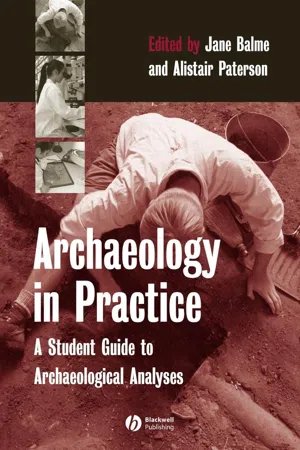
Archaeology in Practice
A Student Guide to Archaeological Analyses
- English
- PDF
- Available on iOS & Android
eBook - PDF
Archaeology in Practice
A Student Guide to Archaeological Analyses
About this book
Archaeology in Practice: A Student Guide to Archaeological Analyses offers students in archaeology laboratory courses a detailed and invaluable how-to manual of archaeological methods and provides insight into the breadth of modern archaeology.
- Written by specialists of material analyses, whose expertise represents a broad geographic range
- Includes numerous examples of applications of archaeological techniques
- Organized by material types, such as animal bones, ceramics, stone artifacts, and documentary sources, or by themes, such as dating, ethics, and report writing
- Written accessibly and amply referenced to provide readers with a guide to further resources on techniques and their applications
- Enlivened by a range of boxed case studies throughout the main text
Frequently asked questions
Yes, you can cancel anytime from the Subscription tab in your account settings on the Perlego website. Your subscription will stay active until the end of your current billing period. Learn how to cancel your subscription.
No, books cannot be downloaded as external files, such as PDFs, for use outside of Perlego. However, you can download books within the Perlego app for offline reading on mobile or tablet. Learn more here.
Perlego offers two plans: Essential and Complete
- Essential is ideal for learners and professionals who enjoy exploring a wide range of subjects. Access the Essential Library with 800,000+ trusted titles and best-sellers across business, personal growth, and the humanities. Includes unlimited reading time and Standard Read Aloud voice.
- Complete: Perfect for advanced learners and researchers needing full, unrestricted access. Unlock 1.4M+ books across hundreds of subjects, including academic and specialized titles. The Complete Plan also includes advanced features like Premium Read Aloud and Research Assistant.
We are an online textbook subscription service, where you can get access to an entire online library for less than the price of a single book per month. With over 1 million books across 1000+ topics, we’ve got you covered! Learn more here.
Look out for the read-aloud symbol on your next book to see if you can listen to it. The read-aloud tool reads text aloud for you, highlighting the text as it is being read. You can pause it, speed it up and slow it down. Learn more here.
Yes! You can use the Perlego app on both iOS or Android devices to read anytime, anywhere — even offline. Perfect for commutes or when you’re on the go.
Please note we cannot support devices running on iOS 13 and Android 7 or earlier. Learn more about using the app.
Please note we cannot support devices running on iOS 13 and Android 7 or earlier. Learn more about using the app.
Yes, you can access Archaeology in Practice by Jane Balme, Alistair Paterson, Jane Balme,Alistair Paterson in PDF and/or ePUB format, as well as other popular books in Social Sciences & Archaeology. We have over one million books available in our catalogue for you to explore.
Information
Table of contents
- Chapter Abstracts
- Preface and Acknowledgments
- Notes on Contributors
- 1 Finding Sites
- Introduction
- Archaeological Prospection
- Remote Sensing
- Aerial photography
- Remote imaging
- High-altitude photography
- Multispectral imaging
- Thermal imaging
- Airborne radar and LIDAR
- Field Methods
- Reconnaissance survey
- Earthwork survey
- Intrusive and semi- intrusive methods
- Metal detection
- Geochemical survey
- Ground-Based Remote Sensing: Geophysical Methods
- Electrical methods
- Magnetic techniques
- Topsoil magnetic susceptibility survey
- Electromagnetic EM)detection: ground-penetrating radar
- Other geophysical methods
- Underwater geophysical techniques
- The Future Role and Development Archaeological Prospecting
- Acknowledgments
- Resources
- References
- 2 Consulting Stakeholders
- Introduction
- What and Who is an Archaeological Stakeholder?
- A Brief History of Interaction between Archaeologists and Other Stakeholders
- Learning to work with stakeholders: a personal journey
- Learning to work with stakeholders:a discipline ’s journey
- Differing Ways of Knowing the Past
- True or valid?
- How can there be different versions of the same past?
- General Thoughts about How to Consult with Stakeholders
- Speci •c Issues and Concerns
- Differential power levels
- Competing claims
- Informed consent
- When pasts con •ict
- Good Examples of Consultation with Stakeholders
- Why Consult with Stakeholders? The Past as Cultural and Intellectual Property
- Acknowledgments
- References
- 3 Rock-Art
- What is Rock-Art?
- How is Rock-Art Made?
- Classi •cation
- Technique
- Form
- Motif
- Size
- Character
- How is Rock-Art Recorded?
- Photography
- Drawing and sketching
- Tracing
- Counting
- How is Rock-Art Analyzed?
- Informed methods
- Formal (or structural)methods
- Spatial distribution analysis
- Information exchange and stylistic heterogeneity
- Gendered behavior and art
- Statistical techniques
- Diachronic change
- Dating art
- Differential weathering and patination
- Chronology from spatial analysis
- Superimposition analysis
- Stylistic dating
- Association of dated portable art
- Association with dated archaeological deposit or art materials
- Portrayal of datable subject matter
- Direct (or absolute) dating
- Case Study The Depiction of Species in Macropod Track Engravings
- The zoological experiment
- The results
- The archaeological experiment
- Interpretation of the Sturt ’s Meadows art
- Conclusion
- Resources
- Further reading
- References
- 4 Stratigraphy
- Introduction
- What is Stratigraphy?
- Why do Archaeologists Study Strati •cation?
- How do Different Layers Occur in Archaeological Sites?
- Principles (or laws)of stratigraphy
- Sources of disturbance
- Excavation and Stratigraphy
- Recording Strati •cation
- The Harris Matrix: interpreting the spatial record
- Creating Analytical Units
- Case Study Sos Höyük
- Conclusion
- Acknowledgments
- Resources
- Further reading
- References
- 5 Absolute Dating
- Introduction
- Chronometry
- Sidereal methods
- Isotopic methods
- Radiogenic methods
- Chemical and biological methods
- Geomorphic methods
- Limits on Chronometric Techniques
- Maximum limits
- Minimum limits
- Limits on radiogenic techniques
- Precision
- From Age Estimates to Chronology
- Temporal Resolution and Behavioral Variation
- Fidelity and resolution
- Time averaging
- Multiple Scales of Time
- Case Study 1 Assessing Different Scales of Time at Bone Cave
- Case Study 2 Time Perspectivism in Practice,Stud Creek, Western New South Wales
- Geomorphological history
- Heat-retainer hearths
- Stud Creek chronology
- Conclusion
- Acknowledgments
- Further reading
- References
- 6 An Introduction to Stone Artifact Analysis
- Introduction
- An overview
- Why study stone artifacts?
- What are stone artifacts?
- How are they made?
- How do you recognize different techniques?
- Analyzing Stone Artifacts
- Research design
- What are you trying to •nd out?
- How do you build your questions?
- Are some analyses more meaningful than others?
- Classifying an assemblage of stone artifacts
- Why classify?
- Are there rules of classi •cation?
- What are the different types of classi •cation?
- What are the different methods of classi •cation?
- How do you choose between classi •catory systems?
- How do you build your own classi •cation?
- Choosing attributes to record and measure
- What attributes should you choose?
- What is a “basic ” analysis?
- Managing data
- How should you record your attributes?
- When do you need to use statistics and what statistics are most useful?
- Measuring extent of reduction
- Why measure reduction?
- How do you measure core reduction?
- How do you measure •ake reduction?
- How can you explore blank selection?
- How do you measure retouch?
- Dealing with dif •cult assemblages
- What if most of your artifacts are broken or damaged?
- What should you do if you can ’t tell artifacts from natural rocks?
- What if you only have a small number of stone artifacts?
- How can you overcome sample size effects?
- When do you need specialist archaeometric analyses?
- Determining the type and •aking properties of stone
- How do you identify different raw material types?
- How do you determine whether it is good-or poor-quality stone?
- Sourcing stone artifacts
- Why is sourcing important?
- How do you •nd out which source an artifact came from?
- What is an adequate sample?
- Conclusion
- Acknowledgments
- References
- 7 Residues and Usewear
- Introduction
- Functional Analysis
- Methodology, Experiments,and Procedures
- Microscopes
- Artifact Cleaning
- Plant Residues Found on Artifacts
- Starch
- Raphides
- Phytoliths
- Resin,gums, waxes,and other exudates
- Animal Residues Found on Artifacts
- Hair and feathers
- Blood
- Bone
- Shell
- Usewear
- Scarring or edge fracturing
- Striations
- Polish
- Edge rounding
- Beveling
- Post-depositional damage
- Hafting traces
- Conclusion
- Acknowledgments
- Resources
- Further reading
- References
- 8 Ceramics
- Introduction
- What is a “Ceramic ”?
- How is Pottery Made?
- Clay preparation
- Object formation
- Pre-•re decoration
- Firing
- Post-•re treatment
- Handling of Ceramics During and After Excavation
- Careful excavating
- Cleaning ceramics
- Marking ceramics
- Repairing ceramics
- Initiating an Analytical Program for Ceramics
- Prefatory issues before undertaking an analytical program
- Quantitative analysis of ceramics
- Sampling for laboratory analysis
- How to begin analysis and select an appropriate analytical method
- Areas of Ceramics Research and their Analytical Approaches
- Technology studies
- Usewear studies of ceramics
- Dating of ceramics
- Identifying the potters
- Sourcing of ceramics
- Resources
- References
- 9 Animal Bones
- Introduction
- Project Planning, Sampling,and Recovery
- Look Before You Dig – On--Site Observation
- Bagging and Tagging
- The Laboratory
- Making the Record
- Using the Record – Quanti •cation
- Conclusion
- Resources
- References
- 10 Plant Remains
- Introduction:A Scene
- Macroscopic Plant Remains
- What can Plant Remains Contribute to Archaeology?
- The relationship between people and plants
- Plants and technology
- Plants and regional subsistence
- Archaeological theories and plants
- What are the Problems (and Solutions)for Identifying and Determining the Origin of Macroscopic Plant Remains?
- Technical problems in analyzing macro- plants,and their solutions
- Archaeological sources
- Ethnobotany and ethnoarchaeology
- What Kinds of Methods can be Effectively Used to Retrieve and Analyze Plant Remains?
- Basic plant classi •cation
- Archaeological retrieval and identi •cation of seeds and fruits
- Wood and charcoal
- More problems in the analysis of plant remains
- Case Study Plant Remains from Kawambarai Cave,near Coonabarabran,Eastern Australia (by Wendy Beck and Dee Murphy)
- The excavations
- Recovery techniques
- Quanti •cation methods
- Case study results
- Case study conclusions
- Conclusion
- Further reading
- References
- 11 Mollusks and Other Shells
- Introduction
- Background
- The Creation of Middens
- The Identi •cation of Middens
- Field Procedures
- Dating Middens
- Laboratory Procedures
- Mechanical Sorting
- Hand Sorting into Components
- Shell •sh Analysis
- Identi •cation of Shell •sh and Other Species
- Further Analysis
- Shell Artifacts
- Fish Remains
- Interpretation
- Acknowledgments
- Resources
- References
- 12 Sediments
- Introduction
- Granulometry
- pH
- Organic Matter
- Phosphorus
- Case Study 1 Prehistoric Canals in the American Southwest
- Case Study 2 Kennewick Man,Washington State,USA
- Conclusion
- Resources
- References
- 13 Artifacts of the Modern World
- Introduction
- Cataloging Artifacts
- Domestic Ceramics
- Clay Tobacco Pipes
- Bottle Glass
- Glass Tools
- Beads and Buttons
- Metal Containers
- Firearms
- Building Materials
- Cemeteries and Gravestones
- Artifact Analysis
- Case Study Kelly and Lucas ’s Whaling Station,Adventure Bay, Tasmania,Australia
- Resources
- Further reading
- References
- 14 Historical Sources
- Introduction
- Archaeology and Historical Sources
- Preparing for research
- Identifying sources
- Verify,evaluate, and discriminate
- Case Study The Use of Documents at Annapolis
- Long-term history
- Social time
- Individual time
- What are the Relationships between Documents and Archaeological Evidence?
- Identi •cation
- Complement
- Hypothesis formation and testing
- Contradiction
- Confronting myths
- Creating context
- Making an archaeological contribution to history
- Resources
- Further reading
- References
- 15 Producing the Record
- Introduction
- First Decisions
- What do I want to write about?
- Who is my audience?
- Structure
- Introduction
- Background
- Methods
- Results
- Conclusions
- The abstract
- References
- Acknowledgments
- Writing
- Language
- Writing for Publication
- Target carefully
- Start afresh
- Follow instructions
- Think about illustrations and tables
- Reference ef •ciently
- Read the proofs carefully
- Conclusion
- Acknowledgments
- Appendix:getting things right
- Further reading
- References
- Index