Carbon nanotubes are exceptionally interesting from a fundamental research point of view. Many concepts of one-dimensional physics have been verified experimentally such as electron and phonon confinement or the one-dimensional singularities in the density of states; other 1D signatures are still under debate, such as Luttinger-liquid behavior. Carbon nanotubes are chemically stable, mechanically very strong, and conduct electricity. For this reason, they open up new perspectives for various applications, such as nano-transistors in circuits, field-emission displays, artificial muscles, or added reinforcements in alloys.
This text is an introduction to the physical concepts needed for investigating carbon nanotubes and other one-dimensional solid-state systems. Written for a wide scientific readership, each chapter consists of an instructive approach to the topic and sustainable ideas for solutions. The former is generally comprehensible for physicists and chemists, while the latter enable the reader to work towards the state of the art in that area. The book gives for the first time a combined theoretical and experimental description of topics like luminescence of carbon nanotubes, Raman scattering, or transport measurements. The theoretical concepts discussed range from the tight-binding approximation, which can be followed by pencil and paper, to first-principles simulations. We emphasize a comprehensive theoretical and experimental understanding of carbon nanotubes including
- general concepts for one-dimensional systems
- an introduction to the symmetry of nanotubes
- textbook models of nanotubes as narrow cylinders
- a combination of ab-initio calculations and experiments
- luminescence excitation spectroscopy linked to Raman spectroscopy
- an introduction to the 1D-transport properties of nanotubes
- effects of bundling on the electronic and vibrational properties and
- resonance Raman scattering in nanotubes.
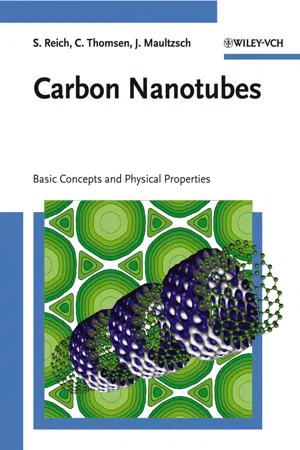
eBook - PDF
Carbon Nanotubes
Basic Concepts and Physical Properties
- 226 pages
- English
- PDF
- Available on iOS & Android
eBook - PDF
Carbon Nanotubes
Basic Concepts and Physical Properties
About this book
Information
Table of contents
- Carbon Nanotubes Basic Concepts and Physical Properties
- Contents
- Preface
- 1 Introduction
- 2 Structure and Symmetry
- 3 Electronic Properties of Carbon Nanotubes
- 4 Optical Properties
- 5 Electronic Transport
- 6 Elastic Properties
- 7 Raman Scattering
- 8 Vibrational Properties
- Appendix A Character and Correlation Tables of Graphene
- Appendix B Raman Intensities in Unoriented Systems
- Appendix C Fundamental Constants
- Bibliography
- Index
Trusted by 375,005 students
Access to over 1.5 million titles for a fair monthly price.
Study more efficiently using our study tools.
Frequently asked questions
Yes, you can cancel anytime from the Subscription tab in your account settings on the Perlego website. Your subscription will stay active until the end of your current billing period. Learn how to cancel your subscription
No, books cannot be downloaded as external files, such as PDFs, for use outside of Perlego. However, you can download books within the Perlego app for offline reading on mobile or tablet. Learn how to download books offline
Perlego offers two plans: Essential and Complete
- Essential is ideal for learners and professionals who enjoy exploring a wide range of subjects. Access the Essential Library with 800,000+ trusted titles and best-sellers across business, personal growth, and the humanities. Includes unlimited reading time and Standard Read Aloud voice.
- Complete: Perfect for advanced learners and researchers needing full, unrestricted access. Unlock 1.5M+ books across hundreds of subjects, including academic and specialized titles. The Complete Plan also includes advanced features like Premium Read Aloud and Research Assistant.
We are an online textbook subscription service, where you can get access to an entire online library for less than the price of a single book per month. With over 1.5 million books across 990+ topics, we’ve got you covered! Learn about our mission
Look out for the read-aloud symbol on your next book to see if you can listen to it. The read-aloud tool reads text aloud for you, highlighting the text as it is being read. You can pause it, speed it up and slow it down. Learn more about Read Aloud
Yes! You can use the Perlego app on both iOS and Android devices to read anytime, anywhere — even offline. Perfect for commutes or when you’re on the go.
Please note we cannot support devices running on iOS 13 and Android 7 or earlier. Learn more about using the app
Please note we cannot support devices running on iOS 13 and Android 7 or earlier. Learn more about using the app
Yes, you can access Carbon Nanotubes by Stephanie Reich,Christian Thomsen,Janina Maultzsch in PDF and/or ePUB format, as well as other popular books in Technology & Engineering & Microelectronics. We have over 1.5 million books available in our catalogue for you to explore.