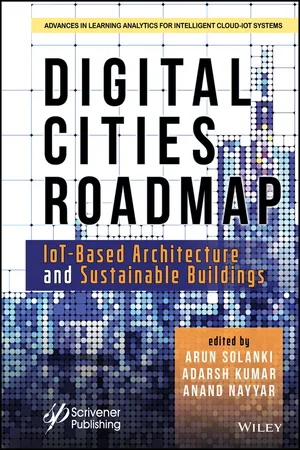
Digital Cities Roadmap
eBook - ePub

Digital Cities Roadmap

IoT-Based Architecture and Sustainable Buildings

  1. English
  2. ePUB (mobile friendly)
  3. Available on iOS & Android
eBook - ePub

Digital Cities Roadmap

IoT-Based Architecture and Sustainable Buildings

About this book

DIGITAL CITIES ROADMAP

This book details applications of technology to efficient digital city infrastructure and its planning, including smart buildings.

Rapid urbanization, demographic changes, environmental changes, and new technologies are changing the views of urban leaders on sustainability, as well as creating and providing public services to tackle these new dynamics. Sustainable development is an objective by which the processes of planning, implementing projects, and development is aimed at meeting the needs of modern communities without compromising the potential of future generations. The advent of Smart Cities is the answer to these problems.

Digital Cities Roadmap provides an in-depth analysis of design technologies that lay a solid foundation for sustainable buildings. The book also highlights smart automation technologies that help save energy, as well as various performance indicators needed to make construction easier. The book aims to create a strong research community, to have a deep understanding and the latest knowledge in the field of energy and comfort, to offer solid ideas in the nearby future for sustainable and resilient buildings. These buildings will help the city grow as a smart city. The smart city has also a focus on low energy consumption, renewable energy, and a small carbon footprint.

Audience

The information provided in this book will be of value to researchers, academicians and industry professionals interested in IoT-based architecture and sustainable buildings, energy efficiency and various tools and methods used to develop green technologies for construction in smart cities.

Trusted by 375,005 students

Access to over 1.5 million titles for a fair monthly price.

Study more efficiently using our study tools.

Information

Year
2021
Print ISBN
9781119791591
Edition
1
eBook ISBN
9781119792055

1
The Use of Machine Learning for Sustainable and Resilient Buildings

Kuldeep Singh Kaswan1* and Jagjit Singh Dhatterwal2
1School of Computing Science and Engineering, Galgotias University, Greater Noida, India
2Department of Computer Science & Applications, PDM University, Bahadurgarh, India
Abstract
The use of Artificial Intelligence to ensure that intelligent and resilient buildings are sustainably developed. The intelligence displayed in buildings by electronic devices and software operated systems is artificial intelligence which perceives the building environment and takes actions aimed at optimizing output in a given context or constraint. A complex, sensitive infrastructure that ensures efficient, cost-effective and environmentally acceptable conditions for every occupant by constantly communicating with its four basic elements: locations (components, frameworks, facilities); processes (automation, control systems), staff (services, users) and management (maintaining, performance) and processes (controlling, systems); and they separate current technologies into two major groups, occupantcentered and energy-centered facilities. The first level approaches that use ML for occupant dimensions, including (1) occupancy and identity estimations, (2) behavior recognition and (3) choice and enforcement estimates. The approach in the second-class category used ML to approximate energy or device-related aspects. It is divided into three categories, (1) estimating the energy profiling and demand, (2) profiling and detection of faults of devices, and (3) sensor inferiority. In this chapter, we focus on guided study, unrestricted learning and improving learning. The main variants, implications of specific parameter choices are explored and we generate standard algorithms. Finally, discuss some of the challenges and opportunities in the built environment to apply machine learning.
Keywords: Machine learning, big data analytics, Internet of Things, smart building, resilient building, sustainable building

1.1 Introduction of ML Sustainable Resilient Building

The hyperconnectivity generated by IoT will enhance the assurance of Smart Sustainable Resilient Building (SSRB) as all basic construction facilities and goods from your home electronics to your plant vessels have now been connected [15]. Nevertheless, this hyperconnectivity could hinder the control of SSRBs at the same time. In particular, massive quantities of streaming data are required from SSRB and its residents. The management of large data streams is becoming more and more relevant with ML, testing, compaction, learning and filtration technologies. In order to obtain a greater interpretation of human beings than their environment computers, the amount of sensory data obtained by sensors and devices needs to be processed by algorithms, converted into details and derived expertise [68]. This awareness can also contribute, and most significantly, innovative goods and services that change our lives drastically. For starters, smart meter readings may be used to help estimate and control power usage. To optimize this convenience, reduce expenses adapting to requirements of its residents, the SSRB requires sophisticated tools to understand, anticipate and make intelligent decisions. SSRB must also provide a variety of wearable sensor data linked to its patients and produce new remote sensors. SSRB algorithms include estimation, decision analysis, robots, smart devices, wireless sensor networks, interactive, web computing and cloud computing and include several other developments. Cognitive maintenance of offices is necessary in several SSRB programs for starters, fitness, safety, energy management, illumination, repair, the elderly and digital entertainment through these technologies.

1.2 Related Works

While several SB-focused survey papers have been released, none focuses on the role of data analysis and ML within SBs. All the relevant survey papers are comprehensively presented in Table 1.1.
Table 1.1 Report data of a survey.
Cite Purpose Limitations
Chan et al. [12] A country and continent arranged project SH Review as well as the associated technologies for monitoring systems and assistive robotics. It not emphasized on the importance of ML and big data analytics, it does not review and classify the papers according to the applications of SH
Alam et al. [13] Research objectives and services-based review of SH projects; namely, comfort, healthcare, and security. It not emphasized on the importance of ML and big data analytics for SB.
Lobaccaro et al. [14] Review of existing software, hardware, and communications control systems for S.H and smart grid. It not emphasized on the importance of ML and big data analytics. It also does not f...

Table of contents

  1. Cover
  2. Table of Contents
  3. Title Page
  4. Copyright
  5. Preface
  6. 1 The Use of Machine Learning for Sustainable and Resilient Buildings
  7. 2 Fire Hazard Detection and Prediction by Machine Learning Techniques in Smart Buildings (SBs) Using Sensors and Unmanned Aerial Vehicles (UAVs)
  8. 3 Sustainable Infrastructure Theories and Models
  9. 4 Blockchain for Sustainable Smart Cities
  10. 5 Contextualizing Electronic Governance, Smart City Governance and Sustainable Infrastructure in India: A Study and Framework
  11. 6 Revolutionizing Geriatric Design in Developing Countries: IoT-Enabled Smart Home Design for the Elderly
  12. 7 Sustainable E-Infrastructure for Blockchain-Based Voting System
  13. 8 Impact of IoT-Enabled Smart Cities: A Systematic Review and Challenges
  14. 9 Indoor Air Quality (IAQ) in Green Buildings, a Pre-Requisite to Human Health and Well-Being
  15. 10 An Era of Internet of Things Leads to Smart Cities Initiatives Towards Urbanization
  16. 11 Trip-I-Plan: A Mobile Application for Task Scheduling in Smart City’s Sustainable Infrastructure
  17. 12 Smart Health Monitoring for Elderly Care in Indoor Environments
  18. 13 A Comprehensive Study of IoT Security Risks in Building a Secure Smart City
  19. 14 Role of Smart Buildings in Smart City—Components, Technolo Indicators, Challenges, Future Research Opportunities
  20. 15 Effects of Green Buildings on the Environment
  21. Index
  22. End User License Agreement

Frequently asked questions

Yes, you can cancel anytime from the Subscription tab in your account settings on the Perlego website. Your subscription will stay active until the end of your current billing period. Learn how to cancel your subscription
No, books cannot be downloaded as external files, such as PDFs, for use outside of Perlego. However, you can download books within the Perlego app for offline reading on mobile or tablet. Learn how to download books offline
Perlego offers two plans: Essential and Complete
  • Essential is ideal for learners and professionals who enjoy exploring a wide range of subjects. Access the Essential Library with 800,000+ trusted titles and best-sellers across business, personal growth, and the humanities. Includes unlimited reading time and Standard Read Aloud voice.
  • Complete: Perfect for advanced learners and researchers needing full, unrestricted access. Unlock 1.5M+ books across hundreds of subjects, including academic and specialized titles. The Complete Plan also includes advanced features like Premium Read Aloud and Research Assistant.
Both plans are available with monthly, semester, or annual billing cycles.
We are an online textbook subscription service, where you can get access to an entire online library for less than the price of a single book per month. With over 1.5 million books across 990+ topics, we’ve got you covered! Learn about our mission
Look out for the read-aloud symbol on your next book to see if you can listen to it. The read-aloud tool reads text aloud for you, highlighting the text as it is being read. You can pause it, speed it up and slow it down. Learn more about Read Aloud
Yes! You can use the Perlego app on both iOS and Android devices to read anytime, anywhere — even offline. Perfect for commutes or when you’re on the go.
Please note we cannot support devices running on iOS 13 and Android 7 or earlier. Learn more about using the app
Yes, you can access Digital Cities Roadmap by Arun Solanki,Adarsh Kumar,Anand Nayyar in PDF and/or ePUB format, as well as other popular books in Computer Science & Artificial Intelligence (AI) & Semantics. We have over 1.5 million books available in our catalogue for you to explore.