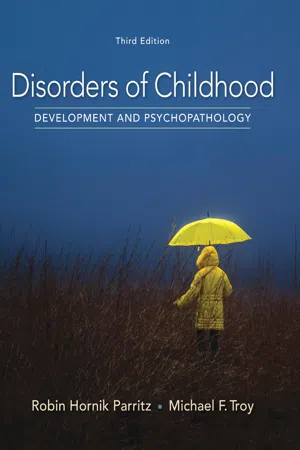
To provide you with a meaningful framework for learning and understanding, this text is written with the whole child in mind and presents disorders in the context of typical development and developmental pathways. Multiple themes recur throughout the text: the continuity between typical and atypical development; risk and resilience; complex models of psychopathology; children in relationships over time; children in larger social contexts (ethnic backgrounds, neighborhoods, cultures); and the holistic nature of development (thinking about the whole child and his or her abilities and strengths as well as his or her disorder or areas of struggle). This developmental psychopathology approach, which reflects the most up-to-date understanding of child and adolescent psychopathology, will teach you to think about disorders in terms of the individual children who are coping with distress and dysfunction.
- 422 pages
- English
- PDF
- Available on iOS & Android
About this book
Key takeaways
Analyze how the developmental psychopathology framework integrates typical development, risk and resilience, and social contexts to explain the emergence and course of childhood and adolescent disorders. Evaluate the various theoretical models that inform this understanding.
Formulate appropriate classification, assessment, and diagnostic strategies for various childhood and adolescent disorders. Design evidence-based intervention plans tailored to specific developmental presentations.
Differentiate between various disorders of infancy, childhood, and adolescence by examining their unique developmental tasks, challenges, etiology, and course. Propose appropriate assessment and intervention strategies for each specific disorder.
Information
Table of contents
- Cover
- Brief Contents
- Contents
- About the Authors
- Preface
- Acknowledgments
- Chapter 1: Introduction
- Chapter 2: Models of Child Development, Psychopathology, and Treatment
- Chapter 3: Principles and Practices of Developmental Psychopathology
- Chapter 4: Classification, Assessment and Diagnosis, and Intervention
- Chapter 5: Disorders of Early Childhood
- Chapter 6: Intellectual Developmental Disorder and Learning Disorders
- Chapter 7: Autism Spectrum Disorder
- Chapter 8: Maltreatment and Trauma-and Stressor-Related Disorders
- Chapter 9: Attention Deficit/Hyperactivity Disorder
- Chapter 10: Oppositional Defiant Disorder and Conduct Disorder
- Chapter 11: Anxiety Disorders, Obsessive-Compulsive Disorder, and Somatic Symptom Disorders
- Chapter 12: Depressive Disorders, Bipolar Disorders, and Suicidality
- Chapter 13: Eating Disorders
- Chapter 14: Substance-Related Disorders and Transition to Adult Disorders
- Glossary
- References
- Name Index
- Subject Index
Trusted by 375,005 students
Access to over 1.5 million titles for a fair monthly price.
Study more efficiently using our study tools.
Frequently asked questions
- Essential is ideal for learners and professionals who enjoy exploring a wide range of subjects. Access the Essential Library with 800,000+ trusted titles and best-sellers across business, personal growth, and the humanities. Includes unlimited reading time and Standard Read Aloud voice.
- Complete: Perfect for advanced learners and researchers needing full, unrestricted access. Unlock 1.5M+ books across hundreds of subjects, including academic and specialized titles. The Complete Plan also includes advanced features like Premium Read Aloud and Research Assistant.
Please note we cannot support devices running on iOS 13 and Android 7 or earlier. Learn more about using the app