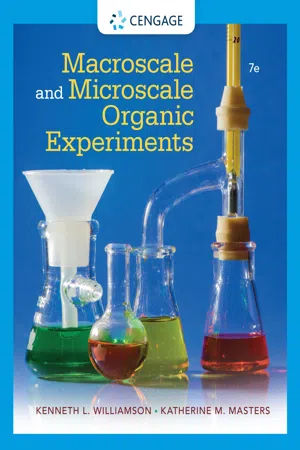
Succeed in your organic laboratory course with MACROSCALE AND MICROSCALE ORGANIC EXPERIMENTS, Seventh Edition. This proven, authoritative manual emphasizes safety and features new themed Modules experiments with real world applications. Using the manual's mix of macroscale and microscale experiments, you'll gain the knowledge and confidence you need to perform a wide variety of experiments, as well as experience working with conventionally-sized glassware.
- 870 pages
- English
- PDF
- Available on iOS & Android
eBook - PDF
Macroscale and Microscale Organic Experiments
About this book
Information
Topic
DidatticaSubtopic
Didattica generaleTable of contents
- Dedication
- Contents
- Preface
- Organic Experiments and Waste Disposal
- Ch 1: Introduction
- Ch 2: Laboratory Safety, Courtesy, and Waste Disposal
- Ch 3: Melting Points and Boiling Points
- Ch 4: Recrystallization
- Ch 5: Distillation
- Ch 6: Steam Distillation, Vacuum Distillation, and Sublimation
- Ch 7: Extraction
- Ch 8: Thin-Layer Chromatography: Analyzing Analgesics and Isolating Lycopene from Tomato Paste
- Ch 9: Column Chromatography: Fluorenone, Cholesteryl Acetate, Acetylferrocene, and Plant Pigments
- Ch 10: Gas Chromatography: Analyzing Alkene Isomers
- Ch 11: Infrared Spectroscopy
- Ch 12: Nuclear Magnetic Resonance Spectroscopy
- Ch 13: Mass Spectrometry
- Ch 14: Ultraviolet Spectroscopy, Refractive Indices, and Qualitative Instrumental Organic Analysis
- Ch 15: Computational Chemistry
- Ch 16: The SN2 Reaction: 1-Bromobutane
- Ch 17: Nucleophilic Substitution Reactions of Alkyl Halides
- Ch 18: Radical Initiated Chlorination of 1-Chlorobutane
- Ch 19: Alkenes from Alcohols: Cyclohexene from Cyclohexanol
- Ch 20: Bromination and Debromination: Purification of Cholesterol
- Ch 21: Dichlorocarbene
- Ch 22: Oxidation: Cyclohexanol to Cyclohexanone; Cyclohexanone to Adipic Acid
- Ch 23: The Cannizzaro Reaction: Simultaneous Synthesis of an Alcohol and an Acid in the Absence of Solvent
- Ch 24: Oxidative Coupling of Alkynes: 2,7-Dimethyl-3,5-Octadiyn-2,7-Diol
- Ch 25: Catalytic Hydrogenation
- Ch 26: Sodium Borohydride Reduction of 2-Methylcyclohexanone: A Problem in Conformational Analysis
- Ch 27: Epoxidation of Cholesterol
- Ch 28: Nitration of Methyl Benzoate
- Ch 29: Friedel-Crafts Alkylation of Benzene and Dimethoxybenzene; Host-Guest Chemistry
- Ch 30: Alkylation of Mesitylene
- Ch 31: The Friedel-Crafts Reaction: Anthraquinone and Anthracene
- Ch 32: Friedel-Crafts Acylation of Ferrocene: Acetylferrocene
- Ch 33: Reactions of Triphenylmethyl Carbocation, Carbanion, and Radical
- Ch 34: 1,2,3,4-Tetraphenyl-Naphthalene via Benzyne
- Ch 35: Triptycene via Benzyne
- Ch 36: Aldehydes and Ketones
- Ch 37: Dibenzalacetone by the Aldol Condensation
- Ch 38: Grignard Synthesis of Triphenylmethanol and Benzoic Acid
- Ch 39: The Wittig and Wittig-Horner Reactions
- Ch 40: Esterification and Hydrolysis
- Ch 41: Acetylsalicylic Acid (Aspirin)
- Ch 42: Malonic Ester of a Barbiturate
- Ch 43: Amines
- Ch 44: The Sandmeyer Reaction: 1-Bromo-4-Chlorobenzene, 2-Iodobenzoic Acid, and 4-Chlorotoluene
- Ch 45: Synthesis and Bioassay of Sulfanilamide and Derivatives
- Ch 46: Dyes and Dyeing
- Ch 47: Martius Yellow
- Ch 48: Diels-Alder Reaction
- Ch 49: Ferrocene [Bis(Cyclopentadienyl)Iron]
- Ch 50: A Diels-Alder Reaction Puzzle: The Reaction of 2,4-Hexadien-1-ol with Maleic Anhydride
- Ch 51: Tetraphenylcyclopentadienone
- Ch 52: Hexaphenylbenzene and Dimethyl Tetraphenylphthalate
- Ch 53: The Benzoin Condensation: Catalysis by the Cyanide Ion and Thiamine
- Ch 54: Nitric Acid Oxidation; Preparation of Benzil from Benzoin; and Synthesis of a Heterocycle: Diphenylquinoxaline
- Ch 55: The Borohydride Reduction of a Ketone: Hydrobenzoin from Benzil
- Ch 56: The Synthesis of 2,2-Dimethyl-1,5-Dioxolane; The Acetonide Derivative of a Vicinal Diol
- Ch 57: 1,4-Addition: Reductive Acetylation of Benzil
- Ch 58: The Synthesis of an Alkyne from an Alkene by Bromination and Dehydrobromination: Stilbene and Diphenylacetylene
- Ch 59: The Perkin Reaction: Synthesis of a-Phenylcinnamic Acid and Its Decarboxylation to cis-Stilbene
- Ch 60: Multicomponent Reactions: The Aqueous Passerini Reaction
- Ch 61: Chemiluminescence: Syntheses of Cyalume and Luminol
- Ch 62: Photochemistry: The Synthesis of Benzopinacol
- Ch 63: Carbohydrates and Sweeteners
- Ch 64: Virstatin, a Possible Treatment for Cholera
- Ch 65: Biosynthesis of Ethanol and Enzymatic Reactions
- Ch 66: The Synthesis of Natural Products: The Sex Attractant of the Cockroach and Camphor
- Ch 67: Polymers: Synthesis and Recycling
- Ch 68: Searching the Chemical Literature
- Index
Trusted by 375,005 students
Access to over 1.5 million titles for a fair monthly price.
Study more efficiently using our study tools.
Frequently asked questions
Yes, you can cancel anytime from the Subscription tab in your account settings on the Perlego website. Your subscription will stay active until the end of your current billing period. Learn how to cancel your subscription
No, books cannot be downloaded as external files, such as PDFs, for use outside of Perlego. However, you can download books within the Perlego app for offline reading on mobile or tablet. Learn how to download books offline
Perlego offers two plans: Essential and Complete
- Essential is ideal for learners and professionals who enjoy exploring a wide range of subjects. Access the Essential Library with 800,000+ trusted titles and best-sellers across business, personal growth, and the humanities. Includes unlimited reading time and Standard Read Aloud voice.
- Complete: Perfect for advanced learners and researchers needing full, unrestricted access. Unlock 1.5M+ books across hundreds of subjects, including academic and specialized titles. The Complete Plan also includes advanced features like Premium Read Aloud and Research Assistant.
We are an online textbook subscription service, where you can get access to an entire online library for less than the price of a single book per month. With over 1.5 million books across 990+ topics, we’ve got you covered! Learn about our mission
Look out for the read-aloud symbol on your next book to see if you can listen to it. The read-aloud tool reads text aloud for you, highlighting the text as it is being read. You can pause it, speed it up and slow it down. Learn more about Read Aloud
Yes! You can use the Perlego app on both iOS and Android devices to read anytime, anywhere — even offline. Perfect for commutes or when you’re on the go.
Please note we cannot support devices running on iOS 13 and Android 7 or earlier. Learn more about using the app
Please note we cannot support devices running on iOS 13 and Android 7 or earlier. Learn more about using the app
Yes, you can access Macroscale and Microscale Organic Experiments by Kenneth Williamson, Katherine Masters in PDF and/or ePUB format, as well as other popular books in Didattica & Didattica generale. We have over 1.5 million books available in our catalogue for you to explore.