![]()
1
Engineering Water Flows
[T]he Special Project Majes-Siguas, an ingenious hydraulic work of high engineering, constructed in 11 years (1971–1982) […] served to direct the water from Colca River to the desert Pampas of Majes. This work involved an ambitious colonizing effort on land with no register of previous human action, but thanks to this titanic work, the expansion of the agricultural frontier has been accomplished, making it the fourth greatest valley of Peru.
(Zamalloa 2013: 2)
This quote is taken from the introduction of a book on the history of the MIP, a book that I bought in the author’s seed shop in Villa El Pedregal in 2014.1 Edgar Zamalloa is an engineer by profession and came to Majes to work on the construction of the irrigation project in 1985. A self-taught historian, he wrote a book about how the MIP came into being: the construction of the Condoroma dam, the Tuti water intake, the Majes canal and the irrigation of the pampa of Majes. Presenting the MIP largely as a success story, the book emphasises the vision and ingenuity of the politicians and engineers who designed and constructed the infrastructure, which is intrinsically associated with the condition of modernity (Edwards 2003). Zamalloa’s descriptions of the engineering and infrastructure are infused with an ‘enthusiasm of the imagination’ (Mrázek 2002) and ‘deep affectual commitments’ (Larkin 2013). By focusing on the achievements in the unpopulated desert, however, the public story of MIP overlooks the damages and problems that people struggle with in Colca Valley.
It is easy to be enchanted by large-scale infrastructure because of the promise of emancipatory modernity it retains, even though it often fails to deliver, as Harvey and Knox (2012) have shown in their work on roads in Peru. In the process of planning and construction, dams and canals might – like roads – hold divergent expectations together. People in the highlands might, for example, hope to get work and be integrated in the national project of modernity and progress. However, unlike roads, large-scale dams and irrigation systems only promise connectivity, integration, freedom and prosperity to those at the receiving end of the canal, while those living by the dam or alongside the canal soon realise that they have been left out of the circuit of value and prosperity. Infrastructure often appears to be paradoxical – constructive and destructive; solid and durable, yet doomed to be ruined and exceeded (Howe et al. 2016). More than paradoxical, however, the Majes canal is political; it is involved in negotiations and struggles over the flow and distribution of water. The Majes canal soon became an object of contestation (Barry 2001), where the construction through mountains and fields, and the access to water and work were contested and negotiated. During the planning and construction of the MIP, the possible consequences for the farmers in Colca Valley were not taken into consideration. Yet, the impact was huge; the MIP transformed the ecological and social composition of the watershed, and opened spaces for economic and political demands and struggles. The possibilities for extending areas of cultivation improved greatly for some, while others were left with water scarcity. The canal altered relations between those who were able to tap into the water flow and those who did not (cf. Barnes 2012). Like the Colorado River in Richard White’s (1995) analysis, the Majes-Colca watershed can be seen as an ‘organic machine’, which not only is a reflection of social divisions, but the site in which these divisions play out. Agreeing with Jensen and Morita (2017), who see infrastructures as ‘ontological experiments’, which reconfigure relations and environments, I suggest that infrastructures do not have physical, social and cultural aspects that can be understood as separate spheres. Rather, the dams and canals are made with cultural values and ideas, which shape the material physicality and also shape the impact on wider socio-ecological systems. Majes canal not only transformed the physical landscape that it runs through; it altered the relations between farmers and the state; between communities; between farmers, mountains and water springs.
Control over water can provide an effective means of consolidating power (Worster 1985). Influenced by both Marx and Weber, Karl August Wittfogel (1957) was the architect of the controversial ‘hydraulic society’ thesis, in which he postulated that large-scale irrigation systems, composed of ever larger dams and increasingly elaborate canal networks, lead to centralised coordination and administrative bureaucracies. Distribution of water requires high levels of organisation and cooperation, and necessitates regulations, manuals and bureaucratic details, and Wittfogel was concerned with the role of bureaucrats – those who ‘rule through bureaus’ – in governments that turn into despotic regimes (Wittfogel 1957). In a study inspired by Wittfogel, Donald Worster (1985) analysed large-scale manipulation of water in the arid American West, which generated a social order that he called ‘a modern hydraulic society’. What Worster observed was a coercive, monolithic, and hierarchical system built on a sharply alienating and intensely managerial relationship with nature (Worster 1985). Water management in the Andes, and in Colca Valley in particular, has often been analysed in terms of opposition and conflict between state power and local governance; state intervention and control versus local user rights and resistance (Boelens 2009, 2015; Gelles 2000; Guillet 1992; Guillet and Mitchell 1994; Paerregaard 1994, 2013; Treacy 1994; Trawick 2003; Vera Delgado 2011). The MIP has been analysed particularly as an imposition of power, in which local needs were much neglected (Gelles 2000; Vera Delgado 2011). The stories and observations presented in this book confirm that the MIP was – and still is – a project of conquest and extractivism, and that in the same period the state has imposed regulations that come into conflict with communal water governance (Gelles 2000; Boelens 2015). However, although the state has often been imagined as a coherent, rational and stable entity, anthropologists have for some time criticised this view, focusing instead on state ‘effects’ (Mitchell 1991), practices and processes (Trouillot 2001), and forms of agency (Krohn-Hansen and Nustad 2005). In more recent scholarship, the state is increasingly being scrutinised and analysed as a configuration of dispersed and flexible practices (Pinker and Harvey 2015), and an aggregation of many levels of bureaucracies, agendas, offices and officials that may act in contradictory ways (Rasmussen 2015). Not only is the state an incoherent agent, but also the consequences of bureaucratic practices are arbitrary (Gupta 2012). However, since this book is more about world-making than state-making, I have looked to Rancière’s thinking about the difference between ‘police’ and ‘politics’ to elicit the point that not only are the practices of statecraft multiple and emergent, but also that, by looking beyond the ‘known’ sphere of human activities, we can begin to understand the politics of multiple world-making projects. According to Rancière, what he calls ‘police’ is not the same as a ‘state apparatus’ understood as separate from ‘society’, but is about the configuration of the perceptible:
The police is thus first an order of bodies that defines the allocation of ways of doing, ways of being, and ways of saying, and sees that those bodies are assigned by name to a particular place and task; it is an order of the visible and the sayable that sees that a particular activity is visible and another is not, that this speech is understood as discourse and another as noise. (Rancière 1999: 29)
In other words, policing is about shaping a uniform and normalised ‘order’, in which some bodies are acknowledged as having a legitimate place and voice. Politics, on the other hand, is a completely different activity: ‘a mode of expression that undoes the perceptible divisions of the police order’ (Rancière 1999: 30). What I will show below and in the rest of the book is that the boundaries between practices and processes of ‘police’ and ‘politics’ are not clear cut, and that politics is not always easy to discern and define since it can often only be glimpsed through ruptures, just as water leaks and flows through cracks and openings.
In this chapter, then, I suggest that although the official policies and legislation aim to curtail and contain local normative diversity in the Andes (Boelens 2009) – which singularise water in the process – the everyday practices of the engineers working in water management are complex. Arguably, the MIP has strengthened a managerial relationship to water in the Majes-Colca watershed, yet there is no monolithic and despotic hydraulic bureaucracy in complete control of the management of the watershed. Instead of seeing a Weberian ideal of an impersonal bureaucracy, which ‘segregates official activity from the sphere of private life’ (Weber 1978: 957), I observed engineers and bureaucrats whose lives were not sharply separated from the lives and irrigation practices of farmers (see also Stensrud 2019c). The work of the engineers and technicians in the hydraulic bureaucracy in the Majes-Colca watershed was embedded in ecological and social relationships, and they practised forms of care in their working relations with water users and hydraulic infrastructure. Care has usually been associated with loving and ‘warm’ human relationships, in contrast to ‘cold’ and rational technology. Following Mol et al. (2010), Stevenson (2014) and Yates-Dorr (2014), I suggest that care work can potentially be found anywhere, including in state bureaucracies and the work of engineers, and that caring practices – understood as a way of working and ‘persistent tinkering’ (Mol et al. 2010: 14) – can include water, technology and infrastructure.
Inspired by Lisa Stevenson (2014), who analyses different forms of care in the Canadian Arctic, I further understand care as the way something comes to matter – in this case water and water users – and the corresponding ethics that follow. Stevenson (2014) describes everyday forms of care in Inuit communities as keeping promises and practices of sharing that are not exclusive to the sphere of living humans, but often bind ‘the living and the dead in ways that are not always straightforward or obvious’ (Stevenson 2014: 3). She also explains how forms of bureaucratic care – informed by good intentions and an ethics of professionalism and anonymity – are tied to a colonial form of governance and surveillance. When water comes to matter in Colca Valley – both for users and the authorities – different forms of care are elicited in different relationships. Bureaucratic practices are informed by forms of care that are ambivalent – both controlling and enabling – and as I will show below, the divisions between bureacrats and users are often blurred. Thinking back to the quote that opened this chapter, I suggest that Zamalloa, as an engineer who was part of the construction of the MIP, wrote his book with careful attention to technical and personal details, as well as showing explicitly care for the continued shaping of the identity of the place and its people (see also Stensrud 2016c). Since Majes as a project mattered deeply to him, his work of archiving and writing also mattered, in which he not only showed his care but also attempted to control the narrative of what Majes is and should become, which will be explored in more detail in the next chapter. This chapter will mainly focus on the work of the engineers and how they intervene in the watershed. The first part will discuss the construction of the Majes canal and the tensions and struggles that this generated in Colca Valley in the 1970s and 1980s. After examining the neoliberal deregulation in the 1990s, and today’s institutional plurality, I discuss the social embeddedness in the current management and regulation of water and water users, and the practices of care that I witnessed in the work of Miguel, José and other engineers in the Majes-Colca watershed.
Hydraulic dreams
Engineers dream and plan as often and intensely as the rest of us. More than the rest of us, however, they believe that there is a calculated sameness between the planning and the dreaming.
(Mrázek 2002: xvii)
As far as is known, the arid flat lands of Majes and Siguas have never previously been irrigated and populated.2 However, the vast possibilities were obvious for the farmers who lived in Arequipa and in the nearby river valleys of the Majes and Siguas rivers. Since the climatic conditions and the location near Arequipa city and the Panamerican highway make it a strategic place for food production for various markets, the possibilities for irrigation and agriculture in this area have been envisioned for more than a century. According to Zamalloa’s book, already in the 19th century farmers in the neighbouring province of Castilla expressed this desire to President Ramón Castilla (1858–62), to which he responded that this was ‘a dream’ (Zamalloa 2013: 23). When President Velasco finally introduced legislation to move the MIP forward, he said that this would ‘make Arequipa’s dream a reality’ (Gelles 2000: 60). In 2014, one of the engineers in Autodema told me: ‘This was a big dream from many years ago; to irrigate these pampas by directing water from the highlands of Arequipa, from the rivers in the high parts.’
The first engineer who took the dream seriously was Charles W. Sutton, a North American who in 1908 was asked by the government of Augusto B. Leguía (1908–12) to elaborate projects of irrigation in Peru. After specialising in irrigation studies in USA and working on the Panama canal, he returned to Peru, where he travelled along the coastline making proposals for possible irrigation projects. Several of Peru’s large-scale irrigation projects were originally designed by Sutton, like Chavimochic in La Libertad and Olmos in Lambayeque. In 1946, based on detailed studies of water availability and land, Sutton made a proposal for a project that considered the use of water from the Colca River to irrigate the pampas of Majes and Siguas (Zamalloa 2013). The practice of engineering, aiming to control the environment by constructing infrastructure, is backed by a vision of development and modern statecraft. Civil engineering expertise in Peru was central to the rise of the modern state, not only in relation to the technical infrastructures – like roads, bridges, dams and canals – through which territorial integrity was imagined and materialised but also for the ways in which a sense of public benefit was consolidated around these arenas of state practice (Harvey and Knox 2015). Sutton supposedly insisted, ‘the greatness of Peru would start the day that Peru decides to incorporate gradually, and without pause, nothing less that five thousand hectares per year to the national production’ (Zamalloa 2013: 25). Indeed, there was little controversy around the importance of large infrastructural projects among the elite, and several presidents made studies and plans for Majes-Siguas: Bustamante y Rivero (1945–48), Odría (1949–53), Prado y Ugarteche (1956–62), and Belaúnde Terry (1963–68), before General Velasco Alvarado (1968–75) executed the project (Zamalloa 2013: 25).
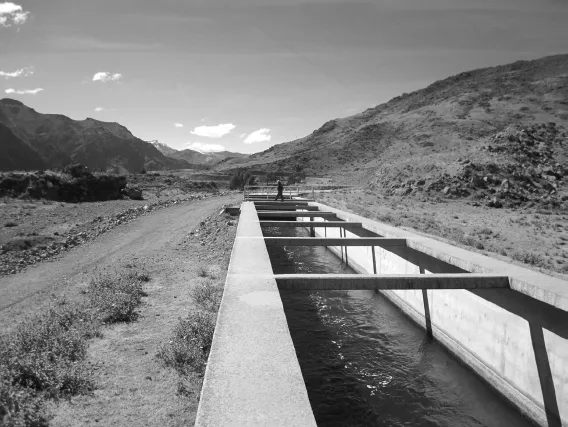
In 1960, the Italian firm ELC Electroconsult made the project design, and the first Belaúnde government secured the financial part in 1967 by signing a contract with the General Mining and Finance Corporation Ltd. Robert Construction of South Africa. In 1971, the military left-wing government of Juan Velasco Alvarado (1968–75) started the execution of the ‘Special Project Majes-Siguas’ by taking up loans and creating the state entity Depema (Dirección Ejecutiva del Proyecto Majes), which in 1982 would change its name to Autodema – the Autonomous Authority of Majes. The Velasco government signed the financial and construction contracts for the first phase of the project with the International Consortium MACON (Majes Consorcio), which consisted of five companies from Sweden, England, South Africa, Canada and Spain. In the 1970s, the MIP was considered ‘the world’s most expensive irrigation project’ (CIP 2013), and the total investment was US $630 million; 65 per cent of which was financed by MACON, and the rest by the state (Zamalloa 2013: 38). MACON built the Majes canal, consisting of 88 km of tunnels and 13 km of open canal through the districts of Tuti, Chivay, Yanque, Achoma, Maca, Cabanaconde and Huambo, and the water intake dam (bocatoma) in Tuti, where water from Colca River is dammed and directed into the tunnel-canal. Later, the Condoroma dam, with a storage capacity of 285 million cubic metres (MMC), was built at an altitude of 4,158 metres in Callalli district and finished in 1985.
Figure 2 The Majes Canal leads large amounts of water from the headwaters, through Colca Valley and down to the arid pampa of Majes. Engineers do regular inspections of the canal and its valves.
Conquering mountains
In a speech held after signing a contract for completing the project in 1977, the CEO of the MIP, engineer Oscar Valdivia Ávalos, talked about the challenges they were up against seen from the state’s modernising perspective. ‘In Majes we are at war against a hostile and tough topography, against a nature that we must change, we are at war with the underdevelopment and this makes us impatient’, he said (Zamalloa 2013: 36). The construction phase, which the CEO talked about as a war against nature, is remembered by many people in Colca Valley as a time of rapid change and intrusive encounters. Already in 1972, the work to construct the water intake in Tuti and Majes canal had started. MACON brought specialists from all over the world and workers from other parts of Peru, who were stationed in an encampment in Achoma district. In the years that they lived and w...