- 146 pages
- English
- ePUB (mobile friendly)
- Available on iOS & Android
eBook - ePub
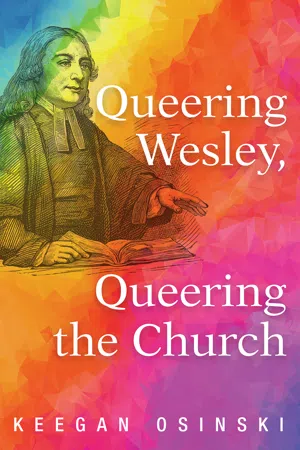
Queering Wesley, Queering the Church
About this book
Fifty years after Stonewall, the experiences of LGBTQ+ Christians are--rightfully--beginning to be received with interest by their churches. Queering Wesley, Queering the Church presents a prototype for thinking about Wesleyan holiness as an expansive openness to the love and grace of God in queer Christian lives rather than the limiting and restrictive legalism that is sometimes found in Wesleyan theology and praxis.
This inventive project consists of queer readings of ten John Wesley sermons. Reading these sermons from a queer perspective offers the church a fresh paradigm for theological innovation, while remaining in line with the tradition and legacy of Wesley that is so central and generative to Wesleyan churches. Arguing that a coherent line of thought can be drawn from Wesley's conception of holiness to the queer, holy lives of LGBTQ+ Christians, Queering Wesley, Queering the Church playfully utilizes queer theory in a way that is fully compatible with Wesleyan teaching. This book aims to be a first step in seriously considering the theological voices of LGBTQ+ Christians in the Wesleyan tradition as a valuable asset to a vital church.
Information
Topic
Theology & ReligionSubtopic
Christian DenominationsThe General Deliverance
One of John Wesley’s most well-known sermons, the 1782 “The General Deliverance,” lays out Wesley’s conviction of God’s planned redemption of the entire cosmos to a state that, as Albert Outler explains, “may well enhance the status and glory of all creatures above their originals.”174 The sermon has three sections, which move from the prelapsarian paradise, to the current sinful state of nature, and finally to the “manifestation of the children of God” when all things will be made new.
My queer reading of “The General Deliverance” focuses on pleasure. Wesley highlights pleasure as an aspect of the initial perfected state of creation—for humans and non-humans alike—and so I propose that practicing pleasure, in its myriad forms and occasions, can be part of practicing holiness as Christians. The unruly erotic pleasure of queer desire, when acknowledged, honored, and engaged, can lead us toward an embodied, holistic holiness that is indeed very good.
In the first section of this sermon, Wesley takes up the question, “What was the original state of the brute creation?”175 He explores the nature of the creation before the Fall in its glory and perfection, outlining the natural image of God in humanity that consisted in the principles of self-motion, understanding, will, and liberty. In this uncorrupted state, humanity enjoyed the perfection of these faculties in a way that we today may only experience partially due to the sin in the world. Wesley believes the original state of creation in its perfection can give hints of what is to come in the redeemed Kingdom of God, which, as Jesus told us, is yet at hand. For the promise of God is not simple restoration but renewal, not renovation but transformation.
A perhaps surprising aspect of Wesley’s explication of this perfect state of humanity and the rest of creation is his emphasis on pleasure. In fact, pleasure seems to be an integral part of what it means to be a perfect creation. Happiness, pleasure, and joy are the chief descriptors of the state of first humanity. The first human’s perfection of self-motion, understanding, will, and liberty resulted in a perfect state of being, from which their “happiness naturally flowed.”176 And this perfect, innate happiness was actually able to be increased by pleasure affected externally.
Wesley says the first human “saw with unspeakable pleasure the order, the beauty, the harmony of all the creatures: of all animated, all inanimate nature.”177 The sensual experience of the materiality of the earth increased the first human’s pleasure. Wesley provides a litany of the sensuality of pleasure-making nature: “the serenity of the skies, the sun walking in brightness, the sweetly variegated clothing of the earth; the trees, the fruits, the flowers, ‘and liquid lapse of murmuring streams.’”178 The anthropomorphizing of nature here stresses that pleasure is an embodied, sensual experience. Wesley appeals to all the senses. The sky is serene as an eye fluttering closed or a deep, full breath of fresh air. The sun walks, warm and bright, feeling the stretch and contraction of muscles moving and feet planted on the ground. The earth wears clothing, perhaps striped and silken, smooth and many-colored. The trees sway in a cool breeze. The fruits burst with flavor and juice that runs down the chin and stains the tongue and lips red. The flowers are beautiful and strange-looking and sweet-smelling and pop up where they will. The streams murmur, whispering secrets if one would just listen closely and hear what they have to say. All of these pleasures of nature are to be seen, heard, felt, tasted, smelled. The body is where pleasure plays.
In Wesley’s other foundational work, A Plain Account of Christian Perfection, he discusses the function of pleasure in the pursuit of Christian perfection. He addresses the question of pleasure, specifically of food but also in general. He asserts that those who are of pure heart, living in perfect love of God and neighbor, “may use pleasing food, without the danger which attends those who are not saved from sin.”179 Holy pleasure can actually be a conduit of God’s grace rather than a threat of impertinence or unholiness for those who are dedicated to a life of holiness. Indeed, Wesley says, if one is called to something such as “marriage or worldly business,” perhaps here we would well include the experience of sex, “he would be more capable than ever; as being able to do all things without hurry or carefulness, without any distraction of spirit.”180 It is clear then in Wesley’s thinking that pleasure and perfection are utterly compatible. Wesley says a perfected Christian “may smell to a flower, or eat a bunch of grapes, or take any other pleasure which does not lessen but increase his delight in God.”181 We can surely liken sexual and bodily pleasure to that of smelling flowers and eating grapes. The warm ocean breeze and summer afternoon light coming through the window while looking into the eyes of your lover. All of these can be constructive in the journey of sanctification and experience of Christian perfection.
Wesley says that this first human’s pleasure and joy were completely pure, with “no alloy of sorrow or pain,” and “nor was this pleasure interrupted by evil of any kind.”182 In their perfection, they experienced perfect and complete pleasure—which would have been grounded in their body—and it was very good. Both humans and creatures experienced pure pleasure by design. “They were all surrounded not only with plenteous food, but with everything that could give them pleasure; pleasure unmixed with pain; for pain was not yet.”183 Having everything provided for their pleasure was a standard feature of the perfection of Eden. This link betw...
Table of contents
- Title Page
- Acknowledgments
- Introduction
- The New Birth
- Circumcision of the Heart
- On Perfection
- Free Grace
- A Caution Against Bigotry
- The Imperfection of Human Knowledge
- The General Deliverance
- On the Wedding Garment
- On Charity
- Of the Church
- Conclusions
- Bibliography
Trusted by 375,005 students
Access to over 1.5 million titles for a fair monthly price.
Study more efficiently using our study tools.
Frequently asked questions
Yes, you can cancel anytime from the Subscription tab in your account settings on the Perlego website. Your subscription will stay active until the end of your current billing period. Learn how to cancel your subscription
No, books cannot be downloaded as external files, such as PDFs, for use outside of Perlego. However, you can download books within the Perlego app for offline reading on mobile or tablet. Learn how to download books offline
Perlego offers two plans: Essential and Complete
- Essential is ideal for learners and professionals who enjoy exploring a wide range of subjects. Access the Essential Library with 800,000+ trusted titles and best-sellers across business, personal growth, and the humanities. Includes unlimited reading time and Standard Read Aloud voice.
- Complete: Perfect for advanced learners and researchers needing full, unrestricted access. Unlock 1.5M+ books across hundreds of subjects, including academic and specialized titles. The Complete Plan also includes advanced features like Premium Read Aloud and Research Assistant.
We are an online textbook subscription service, where you can get access to an entire online library for less than the price of a single book per month. With over 1.5 million books across 990+ topics, we’ve got you covered! Learn about our mission
Look out for the read-aloud symbol on your next book to see if you can listen to it. The read-aloud tool reads text aloud for you, highlighting the text as it is being read. You can pause it, speed it up and slow it down. Learn more about Read Aloud
Yes! You can use the Perlego app on both iOS and Android devices to read anytime, anywhere — even offline. Perfect for commutes or when you’re on the go.
Please note we cannot support devices running on iOS 13 and Android 7 or earlier. Learn more about using the app
Please note we cannot support devices running on iOS 13 and Android 7 or earlier. Learn more about using the app
Yes, you can access Queering Wesley, Queering the Church by Keegan Osinski in PDF and/or ePUB format, as well as other popular books in Theology & Religion & Christian Denominations. We have over 1.5 million books available in our catalogue for you to explore.