- 118 pages
- English
- ePUB (mobile friendly)
- Available on iOS & Android
eBook - ePub
About this book
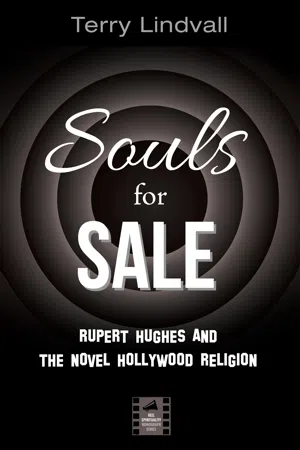
The beginning of the twentieth century evolved out of an era of Freethinking atheists and agnostics who challenged the Protestant hegemony of the day. Key among these mavericks was author and filmmaker Rupert Hughes, uncle to Howard Hughes. In 1922, Hughes published Souls for Sale, his wickedly playful satire of the Bible belt and Hollywood, offering a mischievous snapshot of the film industry as it struggled against a conservative Zeitgeist. The novel follows the prodigal adventures of a clergyman's daughter as she stumbles into the movie industry and finds it to be a new and liberating moral universe. Hughes's adaptation of his sly work challenged the religious hierarchy of his day, but ultimately fell by the wayside, even with the support of Hollywood icons like Eric von Stroheim and Charlie Chaplin. Souls for Sale offers a glimpse into the emerging Jazz age of moviemaking against the backdrop of a country moving from its traditional roots into the kinetic ways of Hollywood.
Trusted by 375,005 students
Access to over 1.5 million titles for a fair monthly price.
Study more efficiently using our study tools.
Information
Subtopic
Film & Video1
NINETEENTH-CENTURY EVANGELICAL FICTION AND MORAL PROPAGANDA
A heyday of religious publishing culminated near the end of the nineteenth century with the arrival of former New Mexico governor Lew Wallace’s Ben Hur (Harper, 1880), subtitled A Tale of the Christ. Wallace had been aroused to the importance of religion after hearing the audacious and spellbinding rhetoric of the “great agnostic” Robert Ingersoll attacking belief in God and the divinity of Christ. In The Gods and Other Lectures, Ingersoll paraded his freethinking down Main Street, mocking the pious, “Banish me from Eden when you will, but first let me eat of the fruit of the tree of knowledge.”3 His cheeky excoriation provoked Wallace’s indifference and ignorance of the Christian faith so much so that he resolved to investigate it closely, with the result of his own conversion and the publication of his famous novel.
The narrative sermons implanted in numerous religious novels also planted an expectation of God’s communication being expressed in non-didactic and fictional forms. Back in 1872, Harriet Beecher Stowe, after writing her famous abolitionist novel, Uncle Tom’s Cabin (claiming it was the result of divine dictation), called upon Christians to show forth their creativity:
Hath any one in our day, as in St. Paul’s, a psalm, a doctrine, a tongue, a revelation, an interpretation—forthwith he wraps it up in a serial story, and presents it to the public? Soon it will be necessary that every leading clergyman should embody in his theology a serial story, to be delivered from the pulpit Sunday after Sunday.4
Her summons inspired one “serial” preacher of note, Charles M. Sheldon. Borrowing the seed idea from British William T. Snead’s If Christ Came to Chicago? (1894), Sheldon concocted a series of narrative sermons that were literary cliffhangers, blending evangelism and social work. Absolute ethical obedience and suffering stood as his litmus tests for following the Christian faith.
Following closely in 1896, Sheldon introduced the most enduring religious tract of the era, In His Steps, which asked the pesky, and much parodied, question, “What Would Jesus Do?” The book’s tremendous popularity catapulted Sheldon onto the national stage where he would continue the inquiry into such areas as “What Would Jesus Do with the Drama?” Herein, the Lord gently castigated everyone concerned, from writers and producers to actors and exhibitors, for their greed, pandering, and lust. Ultimately, Jesus would set forth an ideal example of the participants working together for the uplift of all. In her dissertation, Susan Craig argued that the social gospel messages in books like Sheldon’s shared common religious themes with silent films of the era. “Many, like those listed above, extol the virtues of study in advancing an enlightened faith, while celebrating the importance of direct contact simple human kindness (the ‘Golden Rule’) in dealings with the poor and outcast of society.”5
On April 24, 1902, Sheldon published his views on “The Use and Abuse of Fiction” calling for works of art to “inspire the reader to higher and holier things.”6 His serial novel stemmed from Sunday evening sermons and it allegedly achieved for the “social gospel what Uncle Tom’s Cabin did for slavery.”7 His book was the quintessential representation of an emerging genre of literature at the fin de siecle, the social gospel novel. Subsequently, visualized as a lanternslide picture play in early 1900, the book evolved into a silent film in 1916.
Sheldon’s religious novel, however, inhabited a larger literary context, in which according to Brown University historian Carl F. Kaestle, “Dime novels, beginning in the 1860s, were the first highly profitable mass-market fiction, and Westerns were the predominant genre among the dimes.”8 In her examination of early evangelical writing, publishing, and reading, from the Methodist Book Concern in 1789 through the publication of works like Lew Wallace’s Ben Hur, Cathy Gunther Brown found evangelicals appropriating narratives of purity and transformation from popular texts of sermons, Sunday school material, cheap tracts, hymnals, and novels packaged for the faithful. As readers sought out inspirational material, the distinctive boundaries between evangelical and non-evangelical texts were crossed. For Brown, evangelical and American popular culture intermingled, blurring cultural identities, with culture absorbing ambiguous and even contradictory ideas. Historian David Paul Nord also emphasized how the publishing activities of missionary and tract societies gave birth to an era of mass publication of popular culture. What Nord called “a finger of Providence” pointed to the coming of faith outside the canon of sacred texts.9 In a parallel movement, visual historian David Morgan traced the evolution of pictorial materials used by Protestants during this era, noting how dispensationalists as well as Roman Catholics appropriated visual texts to promote the faith, advance piety, and evangelize others. Nineteenth-century pictures, not yet moving, combi...
Table of contents
- Title Page
- Acknowledgments
- Introduction
- Chapter 1: Nineteenth-Century Evangelical Fiction and Moral Propoganda
- Chapter 2: Billy Sunday and the Virtuous Cinema
- Chapter 3: A Modernist Turn and Hollywood Scandals
- Chapter 4: The Birth of a Novel
- Chapter 5: The Novel as Sermon
- Chapter 6: The Novel Religion
- Chapter 7: The Bowdlerized Adaptation
- Conclusion
- Bibliography
Frequently asked questions
Yes, you can cancel anytime from the Subscription tab in your account settings on the Perlego website. Your subscription will stay active until the end of your current billing period. Learn how to cancel your subscription
No, books cannot be downloaded as external files, such as PDFs, for use outside of Perlego. However, you can download books within the Perlego app for offline reading on mobile or tablet. Learn how to download books offline
Perlego offers two plans: Essential and Complete
- Essential is ideal for learners and professionals who enjoy exploring a wide range of subjects. Access the Essential Library with 800,000+ trusted titles and best-sellers across business, personal growth, and the humanities. Includes unlimited reading time and Standard Read Aloud voice.
- Complete: Perfect for advanced learners and researchers needing full, unrestricted access. Unlock 1.5M+ books across hundreds of subjects, including academic and specialized titles. The Complete Plan also includes advanced features like Premium Read Aloud and Research Assistant.
We are an online textbook subscription service, where you can get access to an entire online library for less than the price of a single book per month. With over 1.5 million books across 990+ topics, we’ve got you covered! Learn about our mission
Look out for the read-aloud symbol on your next book to see if you can listen to it. The read-aloud tool reads text aloud for you, highlighting the text as it is being read. You can pause it, speed it up and slow it down. Learn more about Read Aloud
Yes! You can use the Perlego app on both iOS and Android devices to read anytime, anywhere — even offline. Perfect for commutes or when you’re on the go.
Please note we cannot support devices running on iOS 13 and Android 7 or earlier. Learn more about using the app
Please note we cannot support devices running on iOS 13 and Android 7 or earlier. Learn more about using the app
Yes, you can access Souls for Sale by Terry Lindvall in PDF and/or ePUB format, as well as other popular books in Media & Performing Arts & Film & Video. We have over 1.5 million books available in our catalogue for you to explore.