The Shaker faith is estimated to have had a total of fewer than 20,000 members across its 250-year history, yet more than 100,000 people visit the various Shaker villages and museums scattered across the eastern United States every year. We are still fascinated with the world of the Shakers, and authentic examples of Shaker architecture, furniture, and crafts are prized wherever they remain.
In The Shaker Village, author and photographer Raymond Bial brings readers the history of the Shaker religion and an examination of the Shaker way of life, which was based on cooperation and self-sufficiency. Each Shaker village was built with the goal of creating a heaven on earth for its inhabitants. The Shaker people were among the first in America to apply science and new learning directly to traditional farming and homekeeping. They invented or improved significantly upon designs of many farm and household items, including some still used today: the flat broom, the slotted spoon, the circular saw, and the idea of selling gardening seeds in packets. Although each Shaker community was self-supporting, the Shakers' success at applying their core values—simplicity, utility, and tranquility—carried Shaker villages to a point of abundance: they were able to export their beautiful furniture, delicious foods, and superior wares to the outside world, where they have been appreciated ever since.
The Shaker Village is generously illustrated with Bial's evocative photographs of buildings and artifacts from the Shaker Village of Pleasant Hill, Kentucky, one of the largest and best-preserved Shaker sites. The Shaker movement reached its peak in the mid-nineteenth century. Membership began to drop with the onset of the Civil War, and as the new promise of industrialization began to take hold in America, Shaker numbers steadily dwindled. Although the Shaker religion has all but departed, The Shaker Village captures a revelatory glimpse of a legacy that still resounds with modern Americans.
- 48 pages
- English
- ePUB (mobile friendly)
- Available on iOS & Android
eBook - ePub
The Shaker Village
About this book
Information
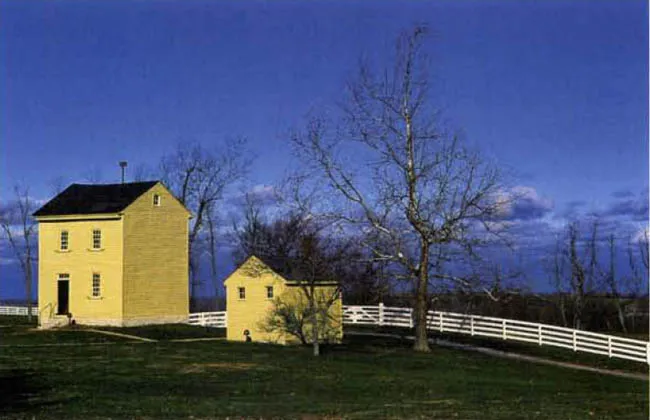
Whether in Sabbathday Lake, Maine, or Pleasant Hill, Kentucky, Shaker villages seem far removed from the rest of the world. To the Shakers who once inhabited these places—and to the handful still living in New England—each community served as a retreat from the world and the center of their universe.
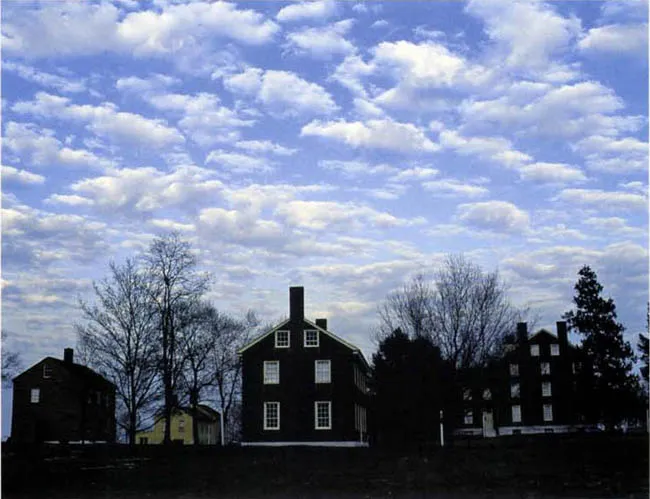
Seen from a distance, a cluster of trim buildings is the first indication that the Shakers pursued a unique way of life. Not only are the buildings solidly constructed with thick stone foundations, but everything from the lines of the roofs to the placement of the windows expresses simplicity and grace. The Shakers sought perfection in their lives, intending to create heaven on earth, and the buildings indeed have a light, airy feel about them. As one brother explained, “We think that man cannot hope to attain a spiritual heaven until he first creates a heaven here on earth.”
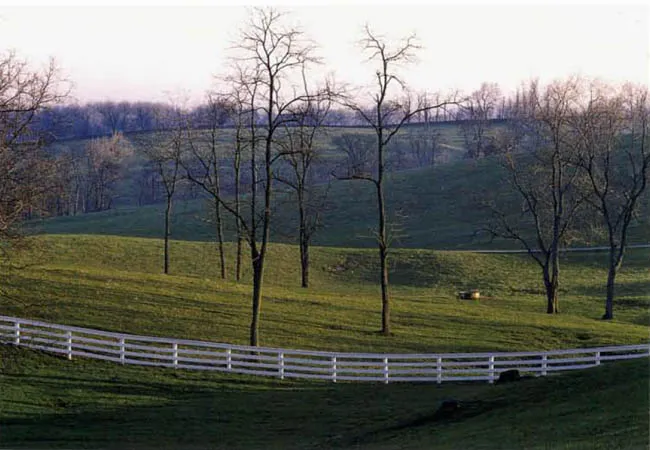
Visitors who stroll along the paths lined with trees, wade through the undulating green fields, or wander through the buildings can still feel the presence of the community of souls who once worked and worshipped in these villages. The efforts of the Shakers to create a utopian society are reflected in everything from the elegant sweep of a picket fence to the ingenious workings of a door handle.
Known formally as the United Society of Believers in Christ’s Second Appearing, the Shakers are the oldest communal society in America. For more than two hundred years, they lived in these secluded villages, sharing quiet lives and striving for perfection in every detail of living, from tending gardens to making furniture.
From Maine to Kentucky, Shaker communities once dotted the eastern half of the United States. Yet while the number of Shakers has declined, other people have become increasingly fascinated with their way of life. The Shakers have come to be widely admired, not only for their hundreds of clever inventions and remarkable creations but for their progressive values and beliefs. As Sister Frances Carr of Sabbathday Lake observes, “We’ll go away in time, as will everybody. But our ideas and our way of life will never go away.”
The Shakers were not always viewed so favorably. During the early years of their religion in the mill town of Manchester, England, they were persecuted. Even their name was originally a derisive term: Some of the Shakers became so excited during their worship services that they would shout, tremble, and whirl about, “shaking” off their sins. Because many of the early Believers came from the Society of Friends, or Quakers, they became known as the Shaking Quakers, later shortened to Shakers. Although the term was used in derision, the Shakers eventually adopted it themselves. They also refer to themselves as Believers or members of the United Society.
In 1758 the Shakers attracted a young woman named Ann Lees (later shortened to Lee). Married in 1762 to a blacksmith, she bore four children, three of whom died in infancy and the fourth as a small child. Always a spiritual woman, Ann Lee turned to religion after these tragedies. In giving herself fully over to her faith, she declared, “My soul broke forth to God.”
Ann Lee began to take an increasingly active role in the sect, notably speaking out against “cohabitation of the sexes.” Meetings grew more animated, and outside opposition to them became so intense that at one point Ann Lee was imprisoned for “profanement of the Sabbath.” Upon her release, she spoke of having had a vision of Christ. Given the title Mother, she became the leader and the spiritual force of the Shakers.
To escape persecution in England, Mother Ann and seven followers immigrated to the American colonies in 1774. They settled on land that is now Watervliet, New York. For several years they scratched out a living, failing to attract new members. However, Mother Ann’s charismatic personality gradually began to draw people. When she died in 1784 at the age of...
Table of contents
- Cover
- Half title
- Title
- Copyright
- The Shaker Village
- Acknowledgments
- Further Reading
- Shaker Historic Resources
Trusted by 375,005 students
Access to over 1.5 million titles for a fair monthly price.
Study more efficiently using our study tools.
Frequently asked questions
Yes, you can cancel anytime from the Subscription tab in your account settings on the Perlego website. Your subscription will stay active until the end of your current billing period. Learn how to cancel your subscription
No, books cannot be downloaded as external files, such as PDFs, for use outside of Perlego. However, you can download books within the Perlego app for offline reading on mobile or tablet. Learn how to download books offline
Perlego offers two plans: Essential and Complete
- Essential is ideal for learners and professionals who enjoy exploring a wide range of subjects. Access the Essential Library with 800,000+ trusted titles and best-sellers across business, personal growth, and the humanities. Includes unlimited reading time and Standard Read Aloud voice.
- Complete: Perfect for advanced learners and researchers needing full, unrestricted access. Unlock 1.5M+ books across hundreds of subjects, including academic and specialized titles. The Complete Plan also includes advanced features like Premium Read Aloud and Research Assistant.
We are an online textbook subscription service, where you can get access to an entire online library for less than the price of a single book per month. With over 1.5 million books across 990+ topics, we’ve got you covered! Learn about our mission
Look out for the read-aloud symbol on your next book to see if you can listen to it. The read-aloud tool reads text aloud for you, highlighting the text as it is being read. You can pause it, speed it up and slow it down. Learn more about Read Aloud
Yes! You can use the Perlego app on both iOS and Android devices to read anytime, anywhere — even offline. Perfect for commutes or when you’re on the go.
Please note we cannot support devices running on iOS 13 and Android 7 or earlier. Learn more about using the app
Please note we cannot support devices running on iOS 13 and Android 7 or earlier. Learn more about using the app
Yes, you can access The Shaker Village by Raymond Bial in PDF and/or ePUB format, as well as other popular books in History & North American History. We have over 1.5 million books available in our catalogue for you to explore.