Published by the Kentucky Historical Society & Distributed by the University Press of Kentucky
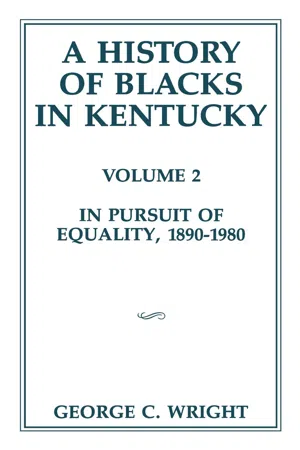
This is the second part of a two-volume study which covers the entire spectrum of the black experience in Kentucky from earliest exploration and settlement to 1980. Mandated and partially funded by the Kentucky General Assembly in 1978, this pathbreaking work is the most comprehensive consideration of the subject ever undertaken. It fills a long-recognized void in Kentucky history. George C. Wright describes the struggle of blacks in the twentieth century to achieve the promise of political, social, and economic equality. From the rising tide of racism and violence at the turn of the century to the civil rights movement and school integration in later decades, Wright describes the accomplishments, frustrations, and defeats suffered by the race, concluding that even in 1980 only a few blacks had actually achieved the long-sought toal of equality.
- 288 pages
- English
- ePUB (mobile friendly)
- Available on iOS & Android
eBook - ePub
About this book
Information
Publisher
Kentucky Historical SocietyYear
2021Print ISBN
9780916968373
9780916968212
eBook ISBN
9780813188911
One
Black Life from the 1890s to the Great Depression
BY 1890, of Kentucky’s 1,590,462 citizens, 268,071 or 16.9 percent were black. When compared with 1860, the actual number of blacks had increased, but always at an uneven pace from decade to decade. For instance, from 1860 to 1870 the black population decreased by almost 14,000, as many exslaves left the state for the North; yet from 1870 to 1880 the black population experienced its largest increase ever when it grew by 22.2 percent to 271,451. The next decade, 1880-90, saw a decline of 3,000 in the black population. But in a complete demographic shift from the previous ten years, the black population grew by almost 14,000 (a rate of 6.2 percent) from 1890-1900, reaching 284,706. By contrast, the state’s total population increased consistently, growing from 1,155,684 in 1860 to 2,147,174 in 1900. Its smallest period of growth was from 1880-90, when it increased by only 12.7 percent. Throughout this period, and indeed down to the present, both the percentage and number of blacks in the total population of Kentucky remained by comparison much smaller than in any of the states in the South.1
Furthermore, by 1890 and most surely the start of the new century, the black percentage of the total population had decreased, and Afro-Americans were becoming concentrated in several areas and almost nonexistent in other regions of the state. In 1860 blacks comprised 20.4 percent of the total population. Thirty years later this had dropped to 16.8 percent; the percentage of blacks within Kentucky continued to decline so that by 1930 less than nine of every one hundred Kentuckians were Afro-Americans. By 1900 some of the counties in the eastern Kentucky mountains had less than twenty blacks, with Johnson and Elliott counties combining for a grand total of three black residents. At the opposite end of the scale was Jefferson County (comprising the city of Louisville), the central Kentucky area around Lexington, and an area in southwest Kentucky. Louisville had the largest number of blacks, around 44,000. The greatest concentration of Afro-Americans, however, lived in twenty counties surrounding Lexington. For instance, Fayette had 15,409, while Boyle, Clark, and Franklin each had around 5,000 and Madison had 6,690 blacks. In these counties blacks comprised anywhere from a fourth to a third of the population. A substantial number of blacks also resided in Christian, Henderson, Daviess, and Hopkins, all in southwest Kentucky. For instance, in Christian County blacks comprised 43.7 percent of the population in 1900.2
Like their counterparts farther south, black Kentuckians were migrating from rural areas to cities both large and small within the state. Of the state’s total population in 1890, three out of four Kentuckians lived in rural areas; however, one in three blacks, roughly 100,145 of the state’s 284,706 Negroes, lived in cities. Clearly, they made up a large percentage of city dwellers. They comprised 52.4 percent of the residents in Winchester, 46.7 percent in Shelbyville, 44.9 percent in Richmond, 44.6 percent in Danville, and 44.5 percent in Hopkinsville. After Louisville, the largest numbers of blacks were found in Lexington (10,130), Paducah (5,814), Frankfort (3,316), and Hopkinsville (3,243). According to the 1910 census, Afro-Americans made up almost 20 percent of all the people living in Kentucky’s urban areas; by 1940 55 percent of the state’s black citizens lived in urban areas.3
Undoubtedly, countless numbers of Afro-Americans migrated from rural Kentucky, and ultimately from the state, because of the difficulties they experienced in acquiring or holding on to farm lands. Despite the state’s reputation for having very fertile land and being a place where industrious, hardworking farmers could prosper, most white and black farmers experienced hardships that were all too common to farmers throughout the South. To be sure, the state had a sizable number of self-sufficient farmers who produced livestock and food products to sustain themselves and to sell at the marketplace, but far more farmers relied solely on a cash crop, usually tobacco, and the success or failure of their crop determined whether or not they survived, were in debt, or faced foreclosure.
To be successful, farmers need equipment and animals, capital, and access to credit. Not surprisingly, because they lacked these essentials, the vast majority of Kentucky blacks did not own the farm lands on which they toiled. The 1900 census listed 11,238 black farmers, but only 38.5 percent (4,322) of them owned their land. By comparison, of the 223,429 white farmers, fully 61.3 percent of them—137,015—had purchased their farms. Each census thereafter revealed a decline in the number of black farm owners, falling to an all-time low in 1940 during the Great Depression, when only 2,702 blacks were listed as owning their farms.4 Regardless of race, all farm laborers received extremely low wages, with blacks being paid far less than whites doing similar jobs. Without a doubt, much of the racial violence that occurred in rural Kentucky centered around disputes between white farm owners and black farm laborers over pay and working conditions. Violence often erupted when black workers attempted to quit their jobs to protest the repeated abuses of white farmers.
Logan County, an area where white farmers relied heavily on black labor, was often the scene of violent confrontations. Though the white establishment claimed that murders and rapes by blacks were the reasons for the thirteen lynchings that occurred in the county between 1880 and 1910, in reality, labor unrest had often played a leading role in racial outbreaks. In July 1908, Rufus Browder, a black sharecropper, argued with James Cunningham over working conditions. Several days later as Browder and his family attempted to leave the farm, Cunningham cursed them and struck the black man with a whip. The white farmer next drew a pistol and shot Browder in the chest, whereupon Browder, though wounded, reached for a gun and shot Cunningham to death. Even though Browder had been shot and had clearly defended himself, he was arrested and sentenced to death for Cunningham’s murder. After having his case reviewed by the Kentucky Court of Appeals, he was given a second trial and again found guilty; but this time, the all-white jury, aware that the court might intervene again, sentenced him to life in prison instead of death. Convinced that Browder was not guilty of first-degree murder, Republican Governor Augustus E. Willson commuted the sentence to ten years, but tragically the young black man, who was twenty years old when the incident occurred, died in prison.5
Several days after Cunningham’s death, Logan County authorities raided a meeting being conducted by four sharecroppers, all friends and fellow lodge brothers of Browder. According to the outrageous rumor circulating in the white community, the four young men—Virgil, Robert, and Thomas Jones, and Joseph Riley—had expressed approval of the killing of Cunningham and had targeted other prominent white landowners for assassination. The authorities arrested them for “disturbing the peace,” even though their meeting was being conducted in a private home. On the night of August 1, a mob entered the Russellville jail, took the four men, and hanged them from a cedar tree. The note pinned to one of the bodies contained a message for Logan County’s other black sharecroppers: “Let this be a warning to you niggers to let white people alone or you will go the same way.” Despite whatever official statements were given for the hangings, the four young men were lynched because they, like Browder, were sharecroppers who had expressed dissatisfaction with their working conditions. The white farmers of Logan County well knew what could happen if all their poorly paid, overworked laborers left the area. Fulton County, another rural area in western Kentucky, had an even greater number of lynchings than Logan County.6
Perhaps more threatening to white farmers than the “militant” sharecroppers were the few successful black landowners in their midst, who by their very presence exhibited the wrong type of “role model” for other blacks. From the end of the Civil War through the 1930s, black farmers were the special targets of whites as countless attempts were made to run them off their lands. (These attempts were called “whitecapping” in the Deep South.) This form of racial violence first occurred in Lebanon shortly after the war when a white mob destroyed the homes and crops of blacks and forced all of them to leave the area at once. In Daviess County several months later another white mob posted signs in an area where a number of black farmers lived, warning all of them to leave by the next day. They also informed several white farmers who had rented or leased lands to the ex-slaves that their property would be burned unless the blacks left. Several white gangs in northern Kentucky also attempted to force successful black farmers to move elsewhere. In the small community of Warsaw, whites began systematically attacking blacks, whipping them, stealing their property, and forcing them to leave the area under threats of death. According to the Freedmen’s Bureau, these tactics proved to be effective as more than two hundred left the area, moving to Ohio for protection and a new start. A decade later in Henry County at least a dozen black farmers and their families were forced to leave the county. A group of whites openly acknowledged removing them, saying that they had been offended by a black’s making lewd comments to a white woman. The charge of offending a white woman, a doubtful one at best, involved only one black; nevertheless, it became the occasion to remove from this northern Kentucky community well over thirty Afro-Americans who were innocent of any wrongdoing.7
Though the exact number is impossible to determine, additional black landowners fled the state because of the “tobacco wars” of the early 1900s. A group of western Kentucky farmers, many of whom were prominent citizens, formed the Planter’s Protective Association and agreed to withhold their crop from market to obtain a higher price from the tobacco trust. These farmers became outraged when some of their neighbors refused to join the association. In response, a group calling themselves the Night Riders started destroying crops, burning tobacco barns, whipping reluctant farmers, and ultimately murdering several outspoken foes. Once the violence started, it was only a short time before the Night Riders began running blacks out of several counties, even though black farmers as a group had not expressed opposition to the association. While occurring all over the region, these attacks became especially pronounced in Lyon and Trigg counties. By 1908 no blacks remained in Lyon. The white mob next targeted the blacks living in the Birmingham area of Trigg. In March a large group of whites rode into the community and fired off hundreds of shots, wounding seven blacks. Signs were posted warning the blacks that they had ten days to leave the area. Most of them left Birmingham by the designated time. In their rush, they left behind household goods and farm equipment. The Louisville Courier-Journal made a telling point in describing the racial hostility: Birmingham had some of the best farming land in Kentucky, and practically the entire Negro population of Trigg County was concentrated in that area. Unfortunately for black farmers and landowners, what happened in western Kentucky occurred on a number of occasions during the next twenty years. Indeed, by the 1930s whites in some counties across the state had “cleansed” themselves of all black residents, while in other rural areas the only black residents were common laborers, not landowners.8
In addition to working as farm laborers, many of the Afro-Americans living in the state’s rural areas and small towns worked as common laborers and personal servants. As laborers, blacks worked on road and bridge construction and on numerous jobs relating to shipping goods on the Kentucky and Ohio rivers. In small cities blacks were the garbage men, street cleaners, and stablehands. A number of small towns had manufacturing concerns that employed anywhere from twenty to fifty workers. Blacks, however, were excluded from these industrial jobs except, of course, as janitors. Indeed, what blacks experienced in the small town of Carrollton mirrored conditions elsewhere. According to a black newspaper reporter in 1890, “Carrollton has made much progress. The city has several manufacturing concerns: a woolen mill, a furniture factory, two saw and planning mills.” But, the reporter concluded, “no colored hands work at any” of the jobs in these industries.9
The work career of Hugh D. Palmer illustrates what some Afro-Americans experienced in Kentucky until well into the twentieth century. Palmer’s family had been slaves in Trigg County, and after emancipation they remained in the small community of Cerulean as employees of their former master. Born in the 1890s, Palmer began working when he was eight years old at a wide assortment of tasks ranging from running errands, to house cleaning, to serving as a driver for this prominent white family. Upon orders from his “master,” Palmer was denied permission to attend school, a decision that resulted in his never learning to read and write. Palmer left Trigg County for the only extended period in his life when he enlisted in the army during World War I. He returned to Trigg County after the war and resumed working for the same white family. When well into his eighties, Palmer continued to perform the same chores he had been assigned as a youth.10
Indeed, all over Kentucky—in rural areas, small towns, and even the larger cities where Afro-Americans had migrated with the hope of finding new opportunities—blacks were hired to perform services for whites. Practically every white family that could afford the cost employed blacks in some capacity, from nursing their children, to doing their laundry, to completely running their homes. Arthur Krock’s autobiography, which highlights his childhood in Glasgow, contains an excellent discussion of the role of black house servants. (Krock left rural Kentucky and became one of the best-known journalists of the early twentieth century.) Black servants, he pointed out, not only performed household chores but were a status symbol, one of the trappings of the ruling race. “In relating that all servants in a community such as ours were Negroes, I merely state a social fact of the time and place. But I recall one aspect of their service that gave me, young as I was, a strong sense of discomfort.” Krock then explained that “Negro boys, equipped with small tree branches, were stationed at either end of the table where we took our meals, their task being to ward off the flies. I knew that in India these attendants were known to the British as punkacoolies; and Mr. Kipling having assured me that this was a fitting convenience to the master race in its pursuit of benevolent improvement of the ‘lesser breeds’ without the law, I took some comfort in the imperialist precedent.” After detailing the chores blacks were required to perform, Krock, as did so many other whites, attempted to show that this working arrangement maintained good relationships between the races. “The Negroes served, yes, but also they were called into conference on equal terms on matters affecting the household, agriculture, and the security of the community from racial violence. For at least in our community, the responsible Negroes possessed in exceptional measure the instinct for wise solutions of such problems.” On returning to Kentucky many years later, Krock was elated over a chance encounter with a black man who had worked in his home. The white journalist, whose writings on most subjects showed keen insight, failed to understand the human dynamics involved in the relationship between white employers and their black servants. Krock departed from Glasgow with a feeling that genuine affection existed between him and his (unnamed) former servant, convinced from his experience that black servants enjoyed and profited from the jobs they performed for whites.11
Krock also failed to mention the long and demanding hours for very little pay his “Negro friend” and other servants were required to work in the homes of whites. The experience of Arlene S. Martin of Shelbyville was typical. In the 1930s she started working in the home of a white family. Laboring ten hours a day, seven days a week, Martin returned to her own house in the middle of the day for several hours to prepare meals for her own family. Even though the pay was low and the working hours extremely restrictive, Martin worked forty years for the same family. A state commission investigating black life in the 1940s noted that salary and working conditions for household workers were major concerns of Kentucky’s black population. “This field is marked by the least security of tenure, the greatest lack of standards as to hours and conditions of work, the smallest prospect of independence after long years of labor, the least dignity and the most exploitation. The principal if not the only incentive to entering this field is elemental need; not, as is the case of most callings, the hope of advancement, occasional leisure and more than a bare living wage.” Despite the harsh realities of service work addressed in this report, a great majority of black men and women spent some or all of their working careers performing service jobs for whites. Indeed, in the Bluegrass State, just as in the Deep South, service jobs seem to have been a “rite of passage” for Afro-Americans who reached adulthood up to the 1960s.12
Many service jobs took place outside of the home. Owners of hotels and boarding houses employed blacks as maids, cooks, and waiters. In Louisville and Lexington waiters, especially the head waiters, on occasion made dec...
Table of contents
- Cover
- Half title
- Title
- Copyright
- Contents
- Acknowledgments
- Chapter 1. Black Life from the 1890s to the Great Depression
- Chapter 2. Race Relations
- Chapter 3. An Education: Providing the “Proper Kind of Training” for Blacks
- Chapter 4. The NAACP and the Quest for Equality
- Chapter 5. The 1950s to the Present: Change and Continuity
- Notes
- Bibliography
- Index
Trusted by 375,005 students
Access to over 1.5 million titles for a fair monthly price.
Study more efficiently using our study tools.
Frequently asked questions
Yes, you can cancel anytime from the Subscription tab in your account settings on the Perlego website. Your subscription will stay active until the end of your current billing period. Learn how to cancel your subscription
No, books cannot be downloaded as external files, such as PDFs, for use outside of Perlego. However, you can download books within the Perlego app for offline reading on mobile or tablet. Learn how to download books offline
Perlego offers two plans: Essential and Complete
- Essential is ideal for learners and professionals who enjoy exploring a wide range of subjects. Access the Essential Library with 800,000+ trusted titles and best-sellers across business, personal growth, and the humanities. Includes unlimited reading time and Standard Read Aloud voice.
- Complete: Perfect for advanced learners and researchers needing full, unrestricted access. Unlock 1.5M+ books across hundreds of subjects, including academic and specialized titles. The Complete Plan also includes advanced features like Premium Read Aloud and Research Assistant.
We are an online textbook subscription service, where you can get access to an entire online library for less than the price of a single book per month. With over 1.5 million books across 990+ topics, we’ve got you covered! Learn about our mission
Look out for the read-aloud symbol on your next book to see if you can listen to it. The read-aloud tool reads text aloud for you, highlighting the text as it is being read. You can pause it, speed it up and slow it down. Learn more about Read Aloud
Yes! You can use the Perlego app on both iOS and Android devices to read anytime, anywhere — even offline. Perfect for commutes or when you’re on the go.
Please note we cannot support devices running on iOS 13 and Android 7 or earlier. Learn more about using the app
Please note we cannot support devices running on iOS 13 and Android 7 or earlier. Learn more about using the app
Yes, you can access A History of Blacks in Kentucky by George C Wright in PDF and/or ePUB format, as well as other popular books in History & North American History. We have over 1.5 million books available in our catalogue for you to explore.