Winner of the Army Historical Foundation Book Award
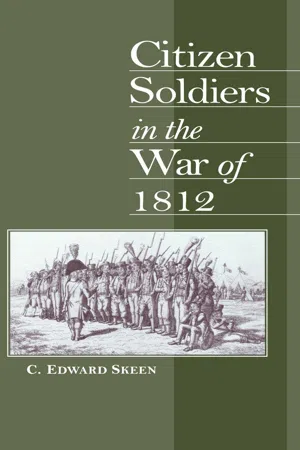
During the War of 1812, state militias were intended to be the primary fighting force. Unfortunately, while militiamen showed willingness to fight, they were untrained, undisciplined, and ill-equipped. These raw volunteers had no muskets, and many did not know how to use the weapons once they had been issued. Though established by the Constitution, state militias found themselves wholly unprepared for war. The federal government was empowered to use these militias to "execute the laws of the Union, suppress insurrections, and repel invasions;" but in a system of divided responsibility, it was the states' job to appoint officers and to train the soldiers. Edward Skeen reveals states' responses to federal requests for troops and provides in-depth descriptions of the conditions, morale, and experiences of the militia in camp and in battle. Skeen documents the failures and successes of the militias, concluding that the key lay in strong leadership. He also explores public perception of the force, both before and after the war, and examines how the militias changed in response to their performance in the War of 1812. After that time, the federal government increasingly neglected the militias in favor of a regular professional army.
- 224 pages
- English
- ePUB (mobile friendly)
- Available on iOS & Android
eBook - ePub
Citizen Soldiers in the War of 1812
About this book
Information
Topic
StoriaSubtopic
Storia militare e marittimaChapter 1
The Militia before the War of 1812
Two of England’s legacies for the American colonists were a fear of standing armies and a reliance upon citizen soldiers, or militiamen, for defense. The British generally left the local defense to the colonies, and they in turn placed responsibility for local defense on the colonial towns and the towns’ militia. By regarding every man as a trained, armed soldier prepared to respond to any emergency, the colonists sustained a belief that there was no need for a professional, standing army. Consequently, there was no organized intercolonial militia system, no central command, and no permanent commissariat.1
During the Revolutionary War numerous problems arose in the use of militia. Short enlistments limited their availability; they lacked discipline and training; and they were poorly armed and led. Early in the war General George Washington confessed that he felt a “want of confidence, in the generality of the Troops.” His experience confirmed him in his opinion, and his famous statement regarding the militiamen was often repeated: “[They] come in, you cannot tell how; go, you cannot tell when, and act, you cannot tell where, consume your provisions, exhaust your stores, and leave you at last in a critical moment.” So many problems arose that the Continental Congress moved cautiously to create a regular army, which played an important role in winning independence. Nevertheless, of the 395,858 men who served during the American Revolution, 164,087 were militiamen.2
After the war, Washington and other military leaders recommended maintaining a small national force as well as proposing plans to improve and perfect the state militia forces to create, essentially, a national militia. A common feature of all these proposals by Washington, Baron Friedrich von Steuben, Henry Knox, and Alexander Hamilton was to make the state militia systems uniform and interchangeable when they were called into duty by the national government. In order to achieve the goal of uniformity and interchangeability, the training had to be carried out under the auspices of the national government, and militiamen were to be classed by age, with the youngest given more training and kept in a higher state of readiness; not all men were to be trained. These proposals, however, were met by two major objections: the cost of the training elicited criticism, and there were fears that such training would create an elite militia force equivalent to a standing army. State leaders opposed the plans, and nothing was done.3
The militia clause of the Articles of Confederation (Article 6) explicitly forbade the states to maintain an army in time of peace, but every state was to keep a “well-regulated and disciplined” militia, armed and equipped, and “constantly ready for use.”4 Without any central administrative supervision, however, little was done during the Confederation period beyond the maintenance of thirteen unrelated militia systems.
In the Constitutional Convention it was conceded that a national force could be maintained, but the country would rely chiefly on the militia for defense. It was also agreed that the national government must be able to use state militias or else it would have to rely on a standing army. The resulting compromise was shared authority over the militia, an experiment in federalism. The federal government was authorized to call upon state militias “to execute the laws of the Union, suppress insurrections, and repel invasions,” and “to provide for organizing, arming, and disciplining the militia,” but the states had the reserved right to appoint the officers and train the militiamen according to the discipline prescribed by the federal government.5
In the debate over ratification of the Constitution, many Anti-Federalists expressed fears, to be reiterated many times in the future, that congressional control over arming, training, and organizing the state militia would jeopardize the liberty of the people. Some Anti-Federalists, however, contended that Congress would fail to arm the militia and would leave the population disarmed or, even worse, that the citizens would react to the neglect of the government by shirking the burden of militia duties. Others argued that federal control over discipline and classification might create a select militia that would in actuality be a standing army. Without extensive training for the whole populace, it was argued, the large body of the population would be powerless against such a force. Still others believed that state militias would be forced to serve for long periods and would be marched to all parts of the union to maintain and enforce national laws.6
Congress displayed a timidity at the outset regarding its role in providing for a well-regulated militia. The need for a viable national defense force was painfully obvious in the first years of the republic. Many problems, for example, plagued commanders using state militias in the Indian disturbances in the early 1790s. The government employed a mix of state militiamen, regulars, and six-month volunteers. The difficulties of organizing and establishing lines of command can readily be imagined, and the poorly equipped and undisciplined troops, notably those under the command of Arthur St. Clair, governor of the Northwest Territory, suffered a terrible defeat on November 4, 1791. The Indian victory prompted Congress to increase the authorized strength of the regular army (from 900 to 5,373), and it also provided the impetus for an act to organize state militias.7
Secretary of War Henry Knox proposed a plan, dated January 18, 1790, for the uniform organization of all state militias. He proposed dividing militiamen into three classes: an advanced corps composed of eighteen-to-twenty-year-old men; a main corps of men twenty-one to forty-five years of age; and a reserved corps embracing men from forty-six to sixty years of age. He argued that an annual appropriation of about $385,000 would be sufficient for the federal government to train the advanced corps of approximately 32,500 men for thirty days, which was, he noted, less than one-eighth of a dollar per capita. The main corps was to be mustered and trained at state expense four days per year; the reserved corps was to be mustered for inspection two days per year. Knox’s proposal was debated and tabled by Congress in both 1790 and 1791.8
In 1792, Congress finally produced a weakened version of Knox’s proposal, the Uniform Militia Act. The final version was the result of intense debate, and the deletions made in the original bill were necessary to secure its passage. Although Federalists tended to support a stronger bill, the outcome was not a party or sectional measure. Rather, states’ rights ideology, and not partisanship, apparently prevailed. Gone was Knox’s classification scheme. Instead, all able-bodied white male citizens between eighteen and forty-five were required to enroll and to furnish their own stand of arms (a musket and accouterments: bayonet, cartridge box and pouch, cartridges, powder, lead, priming wire and brush, and flints). Thus a duty was laid upon a large body of citizens that entailed an additional expense; it was a form of tax imposed upon all militiamen, many of whom could not afford to arm and equip themselves. The federal government, in effect, shifted the responsibility for arming the militia to the individual and made the states responsible for enforcement. Instead of appropriating federal funds for training (the expense of Knox’s plan may have been a factor for some congressmen), the law merely allowed states to organize their militia in their own fashion (which was a factor for congressmen concerned that states would lose control of their militia to the national government). Even worse from the standpoint of establishing a uniform militia, the law allowed state legislatures to form the divisions, brigades, and companies. For example, it recommended, rather than prescribed, that each brigade consist of four regiments “if the same be convenient.” The only uniform feature specified was that each state would have an adjutant general and each brigade a brigade inspector. The next year, Knox cited several difficulties and inconveniences caused by the Uniform Militia Act. Beyond the failure of militiamen to arm themselves, he noted that the states were not imposing penalties to enforce the law. Again, he suggested that Congress establish a select corps of militia through classification.9
Based upon the experience of using militia in the St. Clair expedition, General Anthony Wayne made almost no use of militia in his campaign against the Indians in 1793-1794; his only concession was using mounted volunteers from Kentucky, who performed well for him. The first significant use of the militia after the Uniform Militia Act was the suppression of the Whiskey Rebellion in 1794. President Washington called out more than 12,000 militiamen from four states, New Jersey, Pennsylvania, Maryland, and Virginia. Numerous problems arose, not the least of which was raising the militia. There was widespread sympathy with the rebels among the lower class, and the militia force eventually raised was composed of draftees and substitutes. One historian has characterized the force as “the flotsam of early American society.” The militiamen were unruly and destructive, and desertion rates were high. According to William Findley, who was a spokesman for moderate western Pennsylvanians during this crisis and later served as U.S. congressman, the conduct of the militiamen was such that they gave the militia a bad name. “In the late expedition,” he said, “the name militia was understood to have the same idea fixed to it as plebeian or lower order of citizens.” He added, “An army arranged in this manner never can have confidence within itself, nor embrace the confidence of their fellow citizens.” Secretary Knox complained that the War Department had to issue 10,000 weapons to the 15,000 militiamen who served in the Whiskey Rebellion.10
Almost from the beginning, presidents and governors made proposals to reform and improve the state militias. It soon became evident, however, that Congress was reluctant to adopt any reform proposal, and governors were rarely successful in improving the organization and efficiency of their state militia. Obviously, since utilization of militia was a means of national defense, the initiative had to come from the national level, but given the reluctance of congressmen to confront the situation, it is not difficult to explain why such initiatives failed. The militia myth was deeply embedded in the psyche of the Americans, as well as the belief in states’ rights and a distrust of the national government. Attempts to convert the militia into an efficient military force were met with deep suspicion.
State laws conforming to the Uniform Militia Act of May 8, 1792, restricted the national government’s use of state militia in many ways. For example, provisions in some state constitutions restricted service to the state unless the legislature consented to allow the militia to be used elsewhere. Another problem was that militiamen called into national service were limited to three months’ service in one year. Then, too, the states failed to eliminate perhaps the greatest defect of all, the use of substitutes to meet an individual’s obligations. Knox, among others, lamented that the wealthy and middle classes escaped the burden of militia duty by procuring substitutes from “the most idle and worthless part of the community.”11
The lack of preparedness and uniformity within the various state militias soon became evident. In his annual message of December 3, 1793, President Washington called upon Congress to correct the “imperfections” of the Uniform Militia Act. When nothing was done, he reminded Congress the next year of the “striking defects” in the militia law and suggested that “the devising and establishing of a well-regulated militia would be a genuine source of legislative honor and a perfect title to public gratitude.” He renewed his call in 1795, and in his last annual message in 1796, Washington plaintively reiterated his appeal for militia reform: “My solicitude to see the militia of the United States placed on an efficient establishment has been so often and so ardently expressed that I shall but barely recall the subject to your view on the present occasion.” One of Washington’s last acts as president was to veto a bill passed on February 22, 1797, dismissing two companies of light dragoons. He agreed that some cavalry, either militia or regular, was needed, and it was his opinion “that the latter will be less expensive and more useful than the former in preserving peace between the frontier settlers and the Indians.”12
Militia reform came before Congress in 1794, 1795, and 1796. David Cobb of Massachusetts, reporting for his House committee on the militia on March 24, 1794, concluded that “until further experience shall be had under the existing law, the committee are of [the] opinion that no amendment is necessary.” In 1795, a House committee headed by William Branch Giles of Virginia reported a bill on February 12 that proposed a substantial reform of the militia. Included was a classification scheme similar to the plan advanced earlier by Baron von Steuben. Able-bodied white males between twenty and forty were to be divided into two classes: the select corps, those between twenty and twenty-five, and the reserve corps, comprising those between twenty-five and forty. This corps would be trained by the national government, although the amount of time and cost was not calculated by the committee. Concerns were raised in the ensuing debate about the great expense and the inconvenience to those called for training. The plan was declared unconstitutional and against the will of the people. Supporters of the proposal repeatedly pointed to the failures of the present system. Eventually, the measure was postponed, but a thousand copies of the proposal were printed and distributed to the states.13
In the next Congress, the bill was reintroduced in December 1796, but it immediately ran into trouble when a motion was made to strip out the classification scheme. Robert Goodloe Harper, a Federalist representative from South Carolina, cited President Washington’s calls for militia reform and pointed to recent examples of raw and undisciplined militiamen incapable of performing their duties efficiently. “You must either give up the idea of an efficient military force, or you must adopt a mode similar to that now proposed,” he declared. Thomas Henderson of New Jersey insisted, however, that the bill did not conform to the republican principle that “military service ought to be as equally divided among its citizens as possible.” It was also unconstitutional, he argued, because the national government “had no power to call out people to train them for military service,” and it was too expensive. Robert Rutherford of Virginia contended that the national government “had nothing to do with the Militia in the several sovereign States . . . for the Government to enact Militia laws is against the express decision of the Union.”14
Harper, sensing the mood of the House, asked in exasperation, “Are we to let our Militia remain in its present situation, and throw our whole dependence on the Standing Army?” The question was referred to a committee headed by Henry Dearborn of Massachusetts. The House finally took up the militia reform bill on February 21. After perfunctory debate, the committee was discharged by a vote of 42-32, and militia reform in the Washington administration was dead.15
Despite the undoubted sincerity of many individuals on both sides of the militia reform issue, cynicism was developing about the militia. Charles Nisbet, president of Dickinson College in Carlisle, Pennsylvania, for example, wrote an English friend in 1792: “Our Leaders flatter the People by declaiming against standing Armies, and pretending to believe that the Militia is the best Security of a Nation.” Republican party leaders alleged that the Federalists proposed a militia system so burdensome and frightening that Congress would strengthen the regular army instead. In fact, Federalists generally believed regulars were superior to militia. What they wanted was both an effective regular force and an efficient militia system.16 On the other side, opponents of militia reform conceded weaknesses in the militia system but contended that if the federal government was truly to be a bulwark of liberty and preserve the people’s rights, then it could not be allowed to appropriate the states’ militia for its own use or to exercise control over the training of state militia. Classification raised the specter of professionalism. An efficient elite militia force might pose as much of a threat to the nation as a standing army.
The unreliability of the militia caused the Federalists to turn to other expedients during the crisis of 1798 when war with France loomed. President John Adams invited Congress on May 16, 1797, to consider revision of the militia laws, but he undoubtedly knew that little was likely to happen. Instead, the Federalists, especially the Hamiltonian wing of the party, pushed not only for an increase in the regular force but also for a volunteer force and a provisional army in lieu of dependence on the militia. Alth...
Table of contents
- Cover
- Title
- Copyright
- Dedication
- Contents
- List of Illustrations
- Acknowledgments
- Introduction
- 1. The Militia before the War of 1812
- 2. Congress and Military Mobilization
- 3. Militia Organization
- 4. The States and Militia Mobilization
- 5. The Militia and the War in the West
- 6. The Militia and the War on the Northern Front
- 7. The Atlantic Front and the Battle of Bladensburg
- 8. Federal-State Relations
- 9. War in the South and the Battle of New Orleans
- 10. The War’s End and the Decline of the Militia
- Notes
- Bibliographical Essay
- Index
Trusted by 375,005 students
Access to over 1.5 million titles for a fair monthly price.
Study more efficiently using our study tools.
Frequently asked questions
Yes, you can cancel anytime from the Subscription tab in your account settings on the Perlego website. Your subscription will stay active until the end of your current billing period. Learn how to cancel your subscription
No, books cannot be downloaded as external files, such as PDFs, for use outside of Perlego. However, you can download books within the Perlego app for offline reading on mobile or tablet. Learn how to download books offline
Perlego offers two plans: Essential and Complete
- Essential is ideal for learners and professionals who enjoy exploring a wide range of subjects. Access the Essential Library with 800,000+ trusted titles and best-sellers across business, personal growth, and the humanities. Includes unlimited reading time and Standard Read Aloud voice.
- Complete: Perfect for advanced learners and researchers needing full, unrestricted access. Unlock 1.5M+ books across hundreds of subjects, including academic and specialized titles. The Complete Plan also includes advanced features like Premium Read Aloud and Research Assistant.
We are an online textbook subscription service, where you can get access to an entire online library for less than the price of a single book per month. With over 1.5 million books across 990+ topics, we’ve got you covered! Learn about our mission
Look out for the read-aloud symbol on your next book to see if you can listen to it. The read-aloud tool reads text aloud for you, highlighting the text as it is being read. You can pause it, speed it up and slow it down. Learn more about Read Aloud
Yes! You can use the Perlego app on both iOS and Android devices to read anytime, anywhere — even offline. Perfect for commutes or when you’re on the go.
Please note we cannot support devices running on iOS 13 and Android 7 or earlier. Learn more about using the app
Please note we cannot support devices running on iOS 13 and Android 7 or earlier. Learn more about using the app
Yes, you can access Citizen Soldiers in the War of 1812 by C. Edward Skeen in PDF and/or ePUB format, as well as other popular books in Storia & Storia militare e marittima. We have over 1.5 million books available in our catalogue for you to explore.