1
Born with Purpose
The Strategic Thinking of Ssanyu Lukoma
I want to make Brown Kids Read a big thing to show kids that a Black girl can do this and that Black girls are important enough to be featured in literature.
—Ssanyu Lukoma, founder of Brown Kids Read
When she was just five years old, Ssanyu Lukoma fell in love with a book called Rosa, an inspiring children’s book about Rosa Parks written by poet, activist, and educator Nikki Giovanni. The children’s picture book recounts the day Rosa Parks refused to give up her seat for a white person on a segregated bus and describes how this launched the famous 1955 Montgomery Bus Boycott. The book gives background into Rosa Parks’s life and activism, as well as highlighting other women who made the movement possible.
“I was so in love with the story because I like to imagine that, if I were in Rosa’s position, I would make the same decision that she did,” Ssanyu says.1 Well into her teenage years, Ssanyu still has the book that made such an impact on her as a young girl. “I want to give it to my kids when I grow up, because I love that book so much.”
In December 2008, Ssanyu was three years old and rehearsing with the choir at her church. “But I wasn’t allowed to have a lyric sheet because only the big kids who could read were allowed to have one,” Ssanyu remembers. She was so disappointed that she determined that something would change. “We left for the holiday break, and I wanted to read so badly. So by the time we came back to choir in late January, I had learned how to read enough so that I could have a lyric sheet.” Over the span of six or seven weeks, she had taught herself to read. By that time Ssanyu had turned four. “Everyone in the choir was shocked and impressed,” she says with a smile. “That was the first time my mother knew that I was going to be an extremely avid reader.” Ever since then, she has had a passion for words and reading. “Not all readers are leaders, but all leaders are readers,” Harry S. Truman once said. In Ssanyu’s case, a passion for reading was the foundation of leadership.
I was first introduced to Ssanyu when a friend suggested I partner with a local organization for an event for my first book, Parable of the Brown Girl. The event was to be held at a local bookstore, and we decided that raising money for a nonprofit run by a young Black woman would help push our agenda of supporting Black girls. Besides, my friend told me, that way I’d get to connect to the founder of Brown Kids Read. “You just have to meet this young lady. She is sharp,” my friend said.
Ssanyu was just fourteen years old when we first met in a Starbucks on a cold fall day. I loved her immediately. She is witty and vibrant, with a bright and energetic smile. Ssanyu is the very embodiment of her name, which means “joy” or “gladness” and is of African Luganda origin. Ssanyu has a joyous and energetic persona. “I think that once somebody meets me, they can kind of get a feel for my personality,” she tells me. “A lot of people can tell I like to talk a lot and they can also tell I have a lot of high energy or I can be bossy at times. And it’s not like I try and hide those things!”
She is very comfortable around adults, and I felt as though we had known each other for years. In a short amount of time, she told me more about herself and what she does in her free time.
Ssanyu loves being a homeschooled student because she enjoys the freedom and flexibility that comes with it. At the same time, she is a very social person and misses being with her friends during the school day. Her favorite subject is literature or anything having to do with reading and writing. “Books create so many pathways,” she says. Ssanyu is a proud member of two organizations in addition to her own nonprofit: NJ Orators, through which she does competitive public speaking, and KiDz HuB Media Network, an organization that trains and mentors youth as junior broadcasters and journalists.
After some small talk, Ssanyu dove into her assessment of my book Parable of the Brown Girl and expressed appreciation for how she felt it represented her in some important ways. I was surprised. I didn’t expect her to have read the book and was flattered that she would have taken the time to read and share her thoughts. Then again, Ssanyu strikes me as someone who never comes to a meeting unprepared. While we were there for what was essentially a business meeting—figuring out a partnership between her nonprofit and my book launch—her infectious personality made me want to know more about her and, more specifically, what motivates her.
Ssanyu is the proud older sister to her young brother and sister. She works to better herself as a leader for them first. “They look up to me a lot,” she says about her siblings. “When I do different things, I want to make sure I am a good role model for them to look up to.”
Ssanyu fears for her siblings’ safety. In an era in which mass shootings are on the rise and violent white supremacy is at work, she worries. “All the things going on, like school shootings and Black men being killed in the street—it hurts,” she says with concern. “I get scared. My little brother is nine. I don’t want him to walk outside and be scared that he’s going to be holding a bag of candy and somebody is going to come and attack him just because of the color of his skin.”
For comfort and strength, Ssanyu turns to her faith in God. Ever since she was young, she and her family have been very active in her local church. “I feel like God placed me in that environment so that I was able to feel like nothing can stop me,” she says. In her words I hear her gratitude for the love and care and support of her church community. She sees God in the relationships she has been able to build there. “In Sunday school, we were just studying the Scripture ‘For I know the plans I have for you, . . . plans to prosper you and not to harm you, plans to give you hope and a future’ [Jeremiah 29:11 NIV]. That really touched me,” she says. “When I feel like I want to give up, I know that it hurts God when I have those thoughts because he gave me talent and he gave me gifts and he gave me a special purpose to do these things. And that’s why I keep pushing and I keep going.”
This persistence—and her commitment to use the gifts God has given her—has propelled Ssanyu to one of her greatest achievements: founding the organization Brown Kids Read. It’s an idea she thought of when she was just twelve years old.
Brown Kids Read
“The first time I thought of Brown Kids Read, it wasn’t supposed to be an organization,” she recalls. “It was just supposed to be a partnership with another nonprofit to do a fundraiser for them.”
The nonprofit, Double Dose, was led by Ssanyu’s friends, a set of twins who wrote a book together. At the time, Ssanyu was working with another author to turn her book into a party entertainment business. When Ssanyu heard that Double Dose was doing an event at Barnes and Noble, she pitched an idea to the twins: connecting their book launch with the party entertainment idea.
“We needed a name for it, since Barnes and Noble asks for the name of your event. So we came up with Brown Kids Read. Once I got to that event and I saw the kids buying the books and I saw the excitement on their faces, I was like, ‘I want to replicate this.’”
Ssanyu realized that a lot of the kids in her age group did not have the opportunity to read and learn about diverse literature. “My parents made an effort to give me books that portrayed Black women as strong and confident,” she says. “I grew up having a lot of diverse books. I grew up with a bookshelf full of books featuring people who looked like me. But several of my peers and friends didn’t have that opportunity. So I wanted to make sure that the next generation did not have that lack of diverse books. I wanted to make sure that they had access to them, which is very important.”
Ssanyu’s thoughts run parallel to a wider movement from We Need Diverse Books (WNDB), called #OwnVoices based on a hashtag that started on Twitter and by which people recommended books about diverse characters written by authors who are themselves from marginalized identities. The movement highlights the importance of representation by diverse authors. The hashtag started by calling attention to diversity in children’s literature, but it has since expanded to all literature. Alaina Leary, a Boston-based publishing professional, wrote about the importance of the #OwnVoices movement: “The reason that #OwnVoices creators are so important is because, as marginalized people, we’re the best authority on telling our own stories. It’s great that more people are talking about how to write authentic, sensitive stories outside their experience, and getting sensitivity readers involved, but it’s also important that marginalized people are able to tell their own stories.”2 (WNDB recently decided to discontinue using the #OwnVoices hashtag and instead will use specific descriptions that authors use for themselves and their characters.)
Ssanyu picked up on the same need for diverse literature before she knew anything about the Own Voices movement. She is intuitive—able to see the need for such books on her own. This is significant because it demonstrates that Black youth are not only aware of the lack of representation in literature; they are proactive in the solutions.
In an effort to make Brown Kids Read more marketable and appealing to kids, Ssanyu built on the concept of bringing books to life. The organization’s nonprofit status became official in November 2018. By the beginning of 2019, Ssanyu, with the help of her mother and father, had put on a series of community reading events, which exposed youth to new literature and at which local authors read excerpts and held giveaways. She eventually realized how difficult it is to get kids out on Saturdays to read. Weekends are the days that youth have off from school, and thus, anything resembling academics was a turnoff to some. Ssanyu was also competing against weekend commitments like sports and other extracurriculars. While this frustrated Ssanyu, she was determined to find a creative way to move forward. She came up with the concept of a pop-up bookstore: a traveling book display that she could take to local events. Her parents loaned her $2,000 to purchase books, and she began setting up the Brown Kids Read pop-up bookstore to display and sell books at various events. “That was another way to get kids excited,” she says. “They got to see a whole bunch of books with people that are featuring them and people who are from other countries and people that they didn’t know about.”
From there, the Brown Kids Read social media reach began to grow, and organizations began to contact Ssanyu for interviews, to support her work, and to get the word out about the organization. Brown Kids Read now offers a host of events throughout the year. Ssanyu continues to promote the importance of diverse books for youth through various Brown Kids Read initiatives, such as a book club for teenagers called Book Junkie Insider, in which teens “discuss relevant and thought-provoking books with an action plan in mind.” Ssanyu recently started the Book Junkie podcast, in which she converses with her friends and peers about young adult books. The website Brown Kids Read sells merchandise such as tote bags, journals, T-shirts, and travel mugs. Ssanyu also offers book reviews for the diverse literature she promotes, and shares her contagious love for books with her readers. In one review she writes, “When I began to read Slay, it felt like a mixture of The Hunger Games and The Hate U Give (both books I strongly recommend). I loved the concept and story because it’s uncommon to find black girls as main characters in Young Adult literature that are strong individuals and painted in a positive light.”3 The organization also offers young people the opportunity to read and review books of their choosing on the site. And from time to time, Brown Kids Read offers essay-writing contests for youth, with the opportunity to win cash prizes and other gifts.
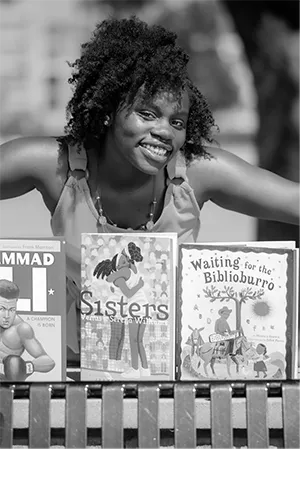
Along with these initiatives, the Brown Kids Read website offers books for sale. The site’s main page features a diverse array of illustrated brown faces on the covers. Above the books is a picture of Ssanyu, beaming with pride, her arms stretched wide to show the display of books.
Though lighthearted in nature, Ssanyu is very serious about the work she does and the young people she serves through her organization. Ssanyu has said time and time again that she wants the kids she serves to be excited: she wants them to be excited about books, and she believes that representation of diverse voices is the gateway to that excitement.
“I want to make Brown Kids Read a big thing to show kids that a Black girl can do this and that Black girls are important enough to be featured in literature,” she says. “Reading can be a great form of entertainment, and you can learn from it at the same time.”
Through Brown Kids Read, Ssanyu motivates young people to read books that feature children of color. She believes that by making reading fun and relatable, she can share her love of literature and inspire the next generation of readers. “God gave me purpose,” she says simply. “My purpose is to lead. My purpose is to inspire people.”
Strategic Leadership
Ssanyu Lukoma is a problem-solver. She prides herself on her ability to think critically. She reflects on all her endeavors, thinking about what she can do better the next time. Any time she has had challenges, she considers them teachable moments. “I am very good at seeing the logic in situations,” she says when I ask her to describe her leadership style. “I’m always trying to figure out what’s the most efficient way to do something or how we can solve a problem quickly.”
Ssanyu is a strategic leader: she has a goal in mind and enacts a careful and intentional plan in order to get to that goal. Ssanyu’s vision for Brown Kids Read is based on the female Black leaders she read about as a child; she in turn wants to make a difference by inspiring others. “I read about people like Rosa Parks, Katherine Johnson, and Ruby Bridges, who all inspired me to be like them—a world-changing female. I want to make a difference by inspiring kids to choose more diverse literature and making those books accessible to them.”4 According to Management Study Guide, an educational portal for students and corporations, strategic leadership refers to “a manager’s potential to express a strategic vision for the organization . . . and to motivate and persuade others to acquire that vision.”5 Strategic leaders create structures to equip their organization to achieve its goals, and Ssanyu did just that. She created a structure for Brown Kids Read that will maximize the organization’s ability to reach as many youth as possible and to expose them to diverse literature. She has created different avenues to do this, including community events, podcasts, book reviews, and other means.
But Ssanyu’s strategic leadership is not limited to these initial strategies. Strategic leaders consistently think about their organization’s long-term success while also keeping their focus on short-term stability. She is constantly reevaluating where her organization is and thinking up new processes and action plans to move toward the Brown Kids Read vision. ...