The use of computation and simulation has become an essential part of the scientific process. Being able to transform a theory into an algorithm requires significant theoretical insight, detailed physical and mathematical understanding, and a working level of competency in programming.
This upper-division text provides an unusually broad survey of the topics of modern computational physics from a multidisciplinary, computational science point of view. Its philosophy is rooted in learning by doing (assisted by many model programs), with new scientific materials as well as with the Python programming language. Python has become very popular, particularly for physics education and large scientific projects. It is probably the easiest programming language to learn for beginners, yet is also used for mainstream scientific computing, and has packages for excellent graphics and even symbolic manipulations.
The text is designed for an upper-level undergraduate or beginning graduate course and provides the reader with the essential knowledge to understand computational tools and mathematical methods well enough to be successful. As part of the teaching of using computers to solve scientific problems, the reader is encouraged to work through a sample problem stated at the beginning of each chapter or unit, which involves studying the text, writing, debugging and running programs, visualizing the results, and the expressing in words what has been done and what can be concluded. Then there are exercises and problems at the end of each chapter for the reader to work on their own (with model programs given for that purpose).
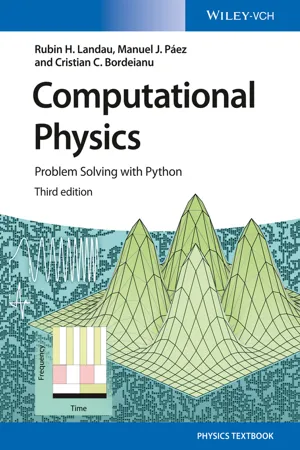
eBook - PDF
Computational Physics
Problem Solving with Python
- 647 pages
- English
- PDF
- Available on iOS & Android
eBook - PDF
Computational Physics
Problem Solving with Python
About this book
Information
Table of contents
- Cover
- Copyright page
- Dedication
- Contents
- Preface
- 1 Introduction
- 2 Computing Software Basics
- 3 Errors and Uncertainties in Computations
- 4 Monte Carlo: Randomness, Walks, and Decays
- 5 Differentiation and Integration
- 6 Matrix Computing
- 7 Trial-and-Error Searching and Data Fitting
- 8 Solving Differential Equations: Nonlinear Oscillations
- 9 ODE Applications: Eigenvalues, Scattering, and Projectiles
- 10 High-Performance Hardware and Parallel Computers
- 11 Applied HPC: Optimization, Tuning, and GPU Programming
- 12 Fourier Analysis: Signals and Filters
- 13 Wavelet and Principal Components Analyses: Nonstationary Signals and Data Compression
- 14 Nonlinear Population Dynamics
- 15 Continuous Nonlinear Dynamics
- 16 Fractals and Statistical Growth Models
- 17 Thermodynamic Simulations and Feynman Path Integrals
- 18 Molecular Dynamics Simulations
- 19 PDE Review and Electrostatics via Finite Differences and Electrostatics via Finite Differences
- 20 Heat Flow via Time Stepping
- 21 Wave Equations I: Strings and Membranes
- 22 Wave Equations II: Quantum Packets and Electromagnetic
- 23 Electrostatics via Finite Elements
- 24 Shocks Waves and Solitons
- 25 Fluid Dynamics
- 26 Integral Equations of Quantum Mechanics
- Appendix A Codes, Applets, and Animations
- Bibliography
- Index
- EULA
Trusted by 375,005 students
Access to over 1.5 million titles for a fair monthly price.
Study more efficiently using our study tools.
Frequently asked questions
Yes, you can cancel anytime from the Subscription tab in your account settings on the Perlego website. Your subscription will stay active until the end of your current billing period. Learn how to cancel your subscription
No, books cannot be downloaded as external files, such as PDFs, for use outside of Perlego. However, you can download books within the Perlego app for offline reading on mobile or tablet. Learn how to download books offline
Perlego offers two plans: Essential and Complete
- Essential is ideal for learners and professionals who enjoy exploring a wide range of subjects. Access the Essential Library with 800,000+ trusted titles and best-sellers across business, personal growth, and the humanities. Includes unlimited reading time and Standard Read Aloud voice.
- Complete: Perfect for advanced learners and researchers needing full, unrestricted access. Unlock 1.5M+ books across hundreds of subjects, including academic and specialized titles. The Complete Plan also includes advanced features like Premium Read Aloud and Research Assistant.
We are an online textbook subscription service, where you can get access to an entire online library for less than the price of a single book per month. With over 1.5 million books across 990+ topics, we’ve got you covered! Learn about our mission
Look out for the read-aloud symbol on your next book to see if you can listen to it. The read-aloud tool reads text aloud for you, highlighting the text as it is being read. You can pause it, speed it up and slow it down. Learn more about Read Aloud
Yes! You can use the Perlego app on both iOS and Android devices to read anytime, anywhere — even offline. Perfect for commutes or when you’re on the go.
Please note we cannot support devices running on iOS 13 and Android 7 or earlier. Learn more about using the app
Please note we cannot support devices running on iOS 13 and Android 7 or earlier. Learn more about using the app
Yes, you can access Computational Physics by Rubin H. Landau,Manuel J Páez,Cristian C. Bordeianu,Manuel J. Páez in PDF and/or ePUB format, as well as other popular books in Physical Sciences & Mathematical & Computational Physics. We have over 1.5 million books available in our catalogue for you to explore.