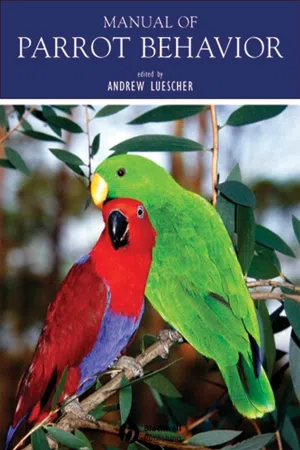
Manual of Parrot Behavior
About this book
This authoritative reference, the first of its kind, is a necessary addition to the library of any practitioner or behaviorist who sees avain companion animals. Because of their beauty, intelligence, playfulness and ability in mimicry, parrots are the most widely kept companion birds. It is estimated that more than half of the psittacine cases presented to clinicians are the result of behavioral problems-problems inherent to captivity.
Bringing together a host of international experts on avian behavior, Manual of Parrot Behavior explores the many facets of psittacine behavior, both normal and abnormal. The book not only provides readers with a solid understanding of the basic principles of psittacine behavior but also offers useful techniques of diagnosis and treatment for specific problems.
- Covers both normal and abnormal parrot behavior
- Offers practical techniques on diagnosis and treatment of behavior problems
- Written by a team of international experts on avian behavior
- A necessary addition to the library of any practitioner of behaviorist who sees avian companion animals
Frequently asked questions
- Essential is ideal for learners and professionals who enjoy exploring a wide range of subjects. Access the Essential Library with 800,000+ trusted titles and best-sellers across business, personal growth, and the humanities. Includes unlimited reading time and Standard Read Aloud voice.
- Complete: Perfect for advanced learners and researchers needing full, unrestricted access. Unlock 1.4M+ books across hundreds of subjects, including academic and specialized titles. The Complete Plan also includes advanced features like Premium Read Aloud and Research Assistant.
Please note we cannot support devices running on iOS 13 and Android 7 or earlier. Learn more about using the app.
Information
Table of contents
- Contents
- Contributors
- Preface
- 1 Classification and the Status of Wild Populations of Parrots
- 2 Behavior of Wild Amazona and Rhynchopsitta Parrots, with Comparative Insights
- 3 Parrot Conservation, Trade, and Reintroduction
- 4 Sensory Capacities of Parrots
- 5 Social Behavior of Psittacine Birds
- 6 Captive Parrot Nutrition: Interactions with Anatomy, Physiology, and Behavior
- 7 Comfort Behavior and Sleep
- 8 Parrot Reproductive Behavior, or Who Associates, Who Mates, and Who Cares?
- 9 Nest Box Preferences
- 10 Hand-Rearing: Behavioral Impacts and Implications for Captive Parrot Welfare
- 11 Behavioral Development of Psittacine Companions: Neonates, Neophytes, and Fledglings
- 12 Handler Attitude and Chick Development
- 13 Grey Parrot Cognition and Communication
- 14 Behavior Analysis and Parrot Learning
- 15 Behavior Classes in the Veterinary Hospital: Preventing Problems Before They Start
- 16 Clinical Evaluation of Psittacine Behavioral Disorders
- 17 Diagnostic Workup of Suspected Behavioral Problems
- 18 Aggressive Behavior in Pet Birds
- 19 Parrot Vocalization
- 20 Parrots and Fear
- 21 Problem Sexual Behaviors of Companion Parrots
- 22 Mate Trauma
- 23 Feather-Picking Disorder in Pet Birds
- 24 Psittacine Behavioral Pharmacotherapy
- 25 Behavior of Captive Psittacids in the Breeding Aviary
- 26 Housing and Management Considerations for Problem Prevention
- 27 Captive Parrot Welfare
- Index
