Quantitative Methods for Finance and Investments ensures that readers come away from reading it with a reasonable degree of comfort and proficiency in applying elementary mathematics to several types of financial analysis. All of the methodology in this book is geared toward the development, implementation, and analysis of financial models to solve financial problems.
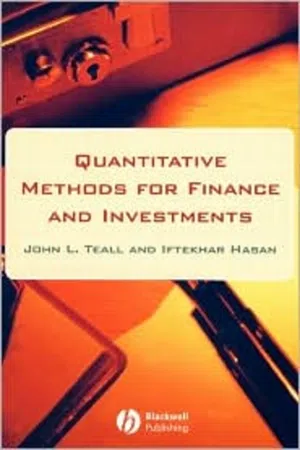
- 296 pages
- English
- PDF
- Available on iOS & Android
eBook - PDF
Quantitative Methods for Finance and Investments
Table of contents
- PREFACE
- ACKNOWLEDGMENTS
- C H A P T E R O N E INTRODUCTION AND OVERVIEW
- 1.1 THE IMPORTANCE OF MATHEMATICS IN FINANCE
- 1.2 MATHEMATICAL AND COMPUTER MODELING IN FINANCE
- 1.3 MONEY, SECURITIES, AND MARKETS
- 1.4 TIME VALUE, RISK, ARBITRAGE, AND PRICING
- 1.5 THE ORGANIZATION OF THIS BOOK
- C H A P T E R T W O A REVIEW OF ELEMENTARY MATHEMATICS: FUNCTIONS AND OPERATIONS
- 2.1 INTRODUCTION
- 2.2 VARIABLES, EQUATIONS, AND INEQUALITIES
- 2.3 EXPONENTS
- APPLICATION 2.1: INTEREST AND FUTURE VALUE (A more complete presentation of this material is provided in chapter 4)
- 2.4 THE ORDER OF ARITHMETIC OPERATIONS AND THE RULES OF ALGEBRA
- APPLICATION 2.2: INITIAL DEPOSIT AMOUNTS (A more complete presentation of this material is provided in chapter 4)
- 2.5 THE NUMBER e
- 2.6 LOGARITHMS (Background reading: sections 2.2 and 2.5)
- APPLICATION 2.3: THE TIME NEEDED TO DOUBLE YOUR MONEY (You may also wish to read related material in chapter 4)
- 2.7 SUBSCRIPTS
- 2.8 SUMMATIONS (Background reading: sections 2.3 and 2.7)
- APPLICATION 2.4: MEAN VALUES (You may also wish to read related material in section 5.1)
- 2.9 DOUBLE SUMMATIONS (Background reading: section 2.8)
- 2.10 PRODUCTS (Background reading: section 2.8)
- APPLICATION 2.5: GEOMETRIC MEANS (Background reading: application 2.4)
- APPLICATION 2.6: THE TERM STRUCTURE OF INTEREST RATES (Background reading: application 2.5)
- 2.11 FACTORIAL PRODUCTS (Background reading: section 2.10)
- APPLICATION 2.7: DERIVING THE NUMBER e (Background reading: section 2.5)
- 2.12 PERMUTATIONS AND COMBINATIONS (Background reading: section 2.11)
- EXERCISES
- APPENDIX 2.A AN INTRODUCTION TO THE EXCEL™ SPREADSHEET
- C H A P T E R T H R E E A REVIEW OF ELEMENTARY MATHEMATICS: ALGEBRA AND SOLVING EQUATIONS
- 3.1 ALGEBRAIC MANIPULATIONS (Background reading: section 2.4)
- APPLICATION 3.1: PURCHASE POWER PARITY
- APPLICATION 3.2: FINDING BREAK-EVEN PRODUCTION LEVELS
- APPLICATION 3.3: SOLVING FOR SPOT AND FORWARD INTEREST RATES (Background reading: sections 1.3 and 2.10, and application 2.6)
- 3.2 THE QUADRATIC FORMULA (Background reading: section 3.1)
- APPLICATION 3.4: FINDING BREAK-EVEN PRODUCTION LEVELS (Background reading: application 3.2)
- APPLICATION 3.5: FINDING THE PERFECTLY HEDGED PORTFOLIO
- 3.3 SOLVING SYSTEMS OF EQUATIONS THAT CONTAIN MULTIPLE VARIABLES (Background reading: section 3.1)
- APPLICATION 3.6: PRICING FACTORS
- APPLICATION 3.7: EXTERNAL FINANCING NEEDS (Background reading: section 3.3)
- 3.4 GEOMETRIC EXPANSIONS (Background reading: section 3.1)
- APPLICATION 3.8: MONEY MULTIPLIERS
- 3.5 FUNCTIONS AND GRAPHS (Background reading: section 2.3)
- APPLICATION 3.9: UTILITY OF WEALTH
- EXERCISES
- APPENDIX 3.A SOLVING SYSTEMS OF EQUATIONS ON A SPREADSHEET (Background reading: section 3.3 and appendix 2.A)
- C H A P T E R F O U R THE TIME VALUE OF MONEY
- 4.1 INTRODUCTION AND FUTURE VALUE
- 4.2 SIMPLE INTEREST (Background reading: sections 2.4, 2.7, and 4.1)
- 4.3 COMPOUND INTEREST (Background reading: sections 2.7, 3.1, and 4.2)
- 4.4 FRACTIONAL PERIOD COMPOUNDING OF INTEREST
- APPLICATION 4.1: APY AND BANK ACCOUNT COMPARISONS
- 4.5 CONTINUOUS COMPOUNDING OF INTEREST (Background reading: sections 2.5 and 4.4)
- 4.6 ANNUITY FUTURE VALUES (Background reading: sections 2.8, 3.4, and 4.3)
- APPLICATION 4.2: PLANNING FOR RETIREMENT (Background reading: sections 2.5, 3.1, and 4.5)
- 4.7 DISCOUNTING AND PRESENT VALUE (Background reading: section 4.3)
- Deriving the present-value formula
- 4.8 THE PRESENT VALUE OF A SERIES OF CASH FLOWS (Background reading: sections 2.8 and 4.7)
- 4.9 ANNUITY PRESENT VALUES (Background reading: sections 3.4, 4.6, and 4.8)
- Deriving the present-value annuity formula
- APPLICATION 4.3: PLANNING FOR RETIREMENT, PART II (Background reading: application 4.2 and section 4.9)
- APPLICATION 4.4: VALUING A BOND
- 4.10 AMORTIZATION (Background reading: section 4.9)
- APPLICATION 4.5: DETERMINING THE MORTGAGE PAYMENT
- 4.11 PERPETUITY MODELS (Background reading: section 4.9)
- 4.12 SINGLE-STAGE GROWTH MODELS (Background reading: sections 4.9 and 4.11)
- APPLICATION 4.6: STOCK VALUATION MODELS
- 4.13 MULTIPLE-STAGE GROWTH MODELS* (Background reading: section 4.12)
- EXERCISES
- APPENDIX 4.A TIME VALUE SPREADSHEET APPLICATIONS
- C H A P T E R F I V E RETURN, RISK, AND CO-MOVEMENT
- 5.1 RETURN ON INVESTMENT (Background reading: section 2.8 and application 2.4)
- APPLICATION 5.1: FUND PERFORMANCE (Background reading: sections 2.8 and 5.1 and application 2.4)
- 5.2 GEOMETRIC MEAN RETURN ON INVESTMENT (Background reading: sections 2.10 and 5.1 and application 2.5)
- APPLICATION 5.2: FUND PERFORMANCE, PART II (Background reading: section 5.2 and application 5.1)
- 5.3 INTERNAL RATE OF RETURN (Background reading: sections 4.7, 4.8, and 4.9)
- 5.4 BOND YIELDS
- 5.5 AN INTRODUCTION TO RISK
- 5.6 EXPECTED RETURN (Background reading: sections 2.8 and 5.5)
- 5.7 VARIANCE AND STANDARD DEVIATION
- 5.8 HISTORICAL VARIANCE AND STANDARD DEVIATION
- 5.9 COVARIANCE
- 5.10 THE COEFFICIENT OF CORRELATION AND THE COEFFICIENT OF DETERMINATION
- EXERCISES
- APPENDIX 5.A RETURN AND RISK SPREADSHEET APPLICATIONS
- C H A P T E R S I X ELEMENTARY PORTFOLIO MATHEMATICS
- 6.1 AN INTRODUCTION TO PORTFOLIO ANALYSIS (Background reading: sections 5.1 and 5.5)
- 6.2 PORTFOLIO RETURN (Background reading: sections 2.8, 5.5, and 6.1)
- 6.3 PORTFOLIO VARIANCE (Background reading: sections 2.9, 5.7–5.10, and 6.2)
- 6.4 DIVERSIFICATION AND EFFICIENCY
- 6.5 THE MARKET PORTFOLIO AND BETA
- 6.6 DERIVING THE PORTFOLIO VARIANCE EXPRESSION (Background reading: section 6.3)
- EXERCISES
- C H A P T E R S E V E N ELEMENTS OF MATRIX MATHEMATICS
- 7.1 AN INTRODUCTION TO MATRICES
- APPLICATION 7.1: PORTFOLIO MATHEMATICS (Background reading: sections 2.9, 6.2, 6.3, and 7.1)
- 7.2 MATRIX ARITHMETIC (Background reading: sections 2.9 and 7.1)
- APPLICATION 7.2: PORTFOLIO MATHEMATICS, PART II (Background reading: application 7.1 and section 7.2)
- APPLICATION 7.3: PUT–CALL PARITY (Background reading: section 7.2)
- 7.3 INVERTING MATRICES (Background reading: sections 3.3 and 7.2)
- 7.4 SOLVING SYSTEMS OF LINEAR EQUATIONS (Background reading: sections 1.3, 3.3, and 7.3)
- APPLICATION 7.4: EXTERNAL FUNDING REQUIREMENTS (Background reading: section 7.5 and application 3.7)
- APPLICATION 7.5: COUPON BONDS AND DERIVING YIELD CURVES (Background reading: sections 4.8, 4.9, and 7.4 and applications 2.6 and 4.4)
- APPLICATION 7.6: ARBITRAGE WITH RISKLESS BONDS (Background reading: application 7.5)
- APPLICATION 7.7: FIXED INCOME PORTFOLIO DEDICATION (Background reading: application 7.6)
- APPLICATION 7.8: BINOMIAL OPTION PRICING (Background reading: section 7.4 and application 7.3)
- 7.5 SPANNING THE STATE SPACE (Background reading: sections 7.3 and 7.4)
- APPLICATION 7.9: USING OPTIONS TO SPAN THE STATE SPACE (Background reading: section 7.5 and application 7.8)
- EXERCISES
- APPENDIX 7.A MATRIX MATHEMATICS ON A SPREADSHEET (Background reading: sections 7.3, 7.4, and 7.5 and appendix 3.A)
- C H A P T E R E I G H T DIFFERENTIAL CALCULUS
- 8.1 FUNCTIONS AND LIMITS (Background reading: sections 2.2 and 3.5)
- APPLICATION 8.1: THE NATURAL LOG (Background reading: sections 2.5, 2.11, 4.4, 4.5, and 8.1 and application 2.7)
- 8.2 SLOPES, DERIVATIVES, MAXIMA, AND MINIMA (Background reading: section 8.1)
- 8.3 DERIVATIVES OF POLYNOMIALS (Background reading: section 8.2)
- APPLICATION 8.2: MARGINAL UTILITY (Background reading: section 8.3 and application 3.9)
- APPLICATION 8.3: DURATION AND IMMUNIZATION (Background reading: sections 4.8, 4.9, 5.4, and 8.3 and application 4.4)
- APPLICATION 8.4: PORTFOLIO RISK AND DIVERSIFICATION (Background reading: sections 6.1, 6.4, 6.5 and 8.2)
- 8.4 PARTIAL AND TOTAL DERIVATIVES (Background reading: section 8.3)
- 8.5 THE CHAIN RULE, PRODUCT RULE, AND QUOTIENT RULE (Background reading: sections 8.3 and 8.4)
- APPLICATION 8.5: PLOTTING THE CAPITAL MARKET LINE (Background reading: sections 6.4, 7.4, and 8.5)
- 8.6 LOGARITHMIC AND EXPONENTIAL FUNCTIONS (Background reading: sections 2.5, 2.6, 8.1, and 8.2)
- 8.7 TAYLOR SERIES EXPANSIONS (Background reading: sections 2.11 and 8.3)
- APPLICATION 8.6: CONVEXITY AND IMMUNIZATION (Background reading: section 8.7 and application 8.4)
- 8.8 THE METHOD OF LAGRANGE MULTIPLIERS (Background reading: sections 7.4 and 8.4)
- APPLICATION 8.7: OPTIMAL PORTFOLIO SELECTION (Background reading: sections 6.3, 6.4, and 8.7)
- EXERCISES
- APPENDIX 8.A DERIVATIVES OF POLYNOMIALS (Background reading: sections 2.12 and 8.3)
- APPENDIX 8.C PORTFOLIO RISK MINIMIZATION ON A SPREADSHEET (Background reading: section 8.8, application 8.8, and appendix 7.C)
- C H A P T E R N I N E INTEGRAL CALCULUS
- 9.1 ANTIDIFFERENTIATION AND THE INDEFINITE INTEGRAL (Background reading: section 8.3)
- 9.2 RIEMANN SUMS (Background reading: section 9.1)
- 9.3 DEFINITE INTEGRALS AND AREAS (Background reading: sections 9.1 and 9.2)
- APPLICATION 9.1: CUMULATIVE DENSITIES (Background reading: sections 2.4 and 9.3)
- APPLICATION 9.2: EXPECTED VALUE AND VARIANCE (Background reading: sections 5.6, 5.7, and 9.2 and application 9.1)
- APPLICATION 9.3: VALUING CONTINUOUS DIVIDEND PAYMENTS (Background reading: sections 4.5, 4.8, 9.2, and 9.3)
- APPLICATION 9.4: EXPECTED OPTION VALUES (Background reading: section 9.3 and application 7.8)
- 9.4 DIFFERENTIAL EQUATIONS
- APPLICATION 9.5: SECURITY RETURNS IN CONTINUOUS TIME (Background reading: section 9.4 and application 9.3)
- APPLICATION 9.6: ANNUITIES AND GROWING ANNUITIES (Background reading: section 9.4 and application 9.5)
- EXERCISES
- APPENDIX 9.A RULES FOR FINDING INTEGRALS
- APPENDIX 9.B RIEMANN SUMS ON A SPREADSHEET (Background reading: section 9.2)
- C H A P T E R T E N ELEMENTS OF OPTIONS MATHEMATICS
- 10.1 AN INTRODUCTION TO STOCK OPTIONS
- 10.2 BINOMIAL OPTION PRICING: ONE TIME PERIOD (Background reading: section 10.1 and application 7.8)
- 10.3 BINOMIAL OPTION PRICING: MULTIPLE TIME PERIODS (Background reading: section 10.2)
- 10.4 THE BLACK–SCHOLES OPTION PRICING MODEL (Background reading: section 10.3)
- 10.5 PUTS AND VALUATION (Background reading: sections 10.1 and 10.4 and application 7.9)
- 10.6 BLACK–SCHOLES MODEL SENSITIVITIES (Background reading: sections 8.4, 8.5, and 10.4)
- 10.7 ESTIMATING IMPLIED VOLATILITIES (Background reading: sections 8.6 and 10.6)
- EXERCISES
- REFERENCES
- A P P E N D I X A SOLUTIONS TO EXERCISES
- A P P E N D I X B THE Z-TABLE
- A P P E N D I X C NOTATION
- A P P E N D I X D GLOSSARY
- INDEX
Trusted by 375,005 students
Access to over 1.5 million titles for a fair monthly price.
Study more efficiently using our study tools.
Frequently asked questions
Yes, you can cancel anytime from the Subscription tab in your account settings on the Perlego website. Your subscription will stay active until the end of your current billing period. Learn how to cancel your subscription
No, books cannot be downloaded as external files, such as PDFs, for use outside of Perlego. However, you can download books within the Perlego app for offline reading on mobile or tablet. Learn how to download books offline
Perlego offers two plans: Essential and Complete
- Essential is ideal for learners and professionals who enjoy exploring a wide range of subjects. Access the Essential Library with 800,000+ trusted titles and best-sellers across business, personal growth, and the humanities. Includes unlimited reading time and Standard Read Aloud voice.
- Complete: Perfect for advanced learners and researchers needing full, unrestricted access. Unlock 1.5M+ books across hundreds of subjects, including academic and specialized titles. The Complete Plan also includes advanced features like Premium Read Aloud and Research Assistant.
We are an online textbook subscription service, where you can get access to an entire online library for less than the price of a single book per month. With over 1.5 million books across 990+ topics, we’ve got you covered! Learn about our mission
Look out for the read-aloud symbol on your next book to see if you can listen to it. The read-aloud tool reads text aloud for you, highlighting the text as it is being read. You can pause it, speed it up and slow it down. Learn more about Read Aloud
Yes! You can use the Perlego app on both iOS and Android devices to read anytime, anywhere — even offline. Perfect for commutes or when you’re on the go.
Please note we cannot support devices running on iOS 13 and Android 7 or earlier. Learn more about using the app
Please note we cannot support devices running on iOS 13 and Android 7 or earlier. Learn more about using the app
Yes, you can access Quantitative Methods for Finance and Investments by John Teall,Iftekhar Hasan in PDF and/or ePUB format, as well as other popular books in Business & Finance. We have over 1.5 million books available in our catalogue for you to explore.