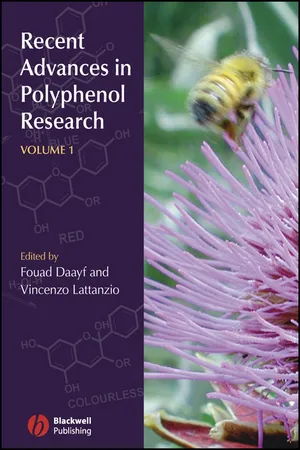
Recent Advances in Polyphenol Research, Volume 1
eBook - PDF

Recent Advances in Polyphenol Research, Volume 1

  1. 422 pages
  2. English
  3. PDF
  4. Available on iOS & Android
eBook - PDF

Recent Advances in Polyphenol Research, Volume 1

About this book

Polyphenols are the second most abundant class of substances in nature, and include tannins and flavonoids, many of which have extremely important antioxidant properties which have now been shown to have a key role in the prevention of cancer in humans.

This important book covers polyphenol chemistry, biosynthesis and genetic manipulation, ecology and plant physiology, food and nutritional aspects and the effects of polyphenols on health. Included within the contents are cutting edge chapters on biotic and abiotic stress in plants, safety and toxicity in foods, functionality and nutraceutical benefits in nutrition, and aspects of pharmaceutical and cosmetic discovery and development.

Sponsored by Groupe Polyphenols, this landmark book has been edited by Professor Fouad Daayf and Professor Vincenzo Lattanzio, who have drawn together an impressive list of internationally respected contributing authors, each providing a comprehensive review of the current situation regarding each important subject covered.

Recent Advances in Polyphenol Research is an important publication which will be of great use to chemists, biochemists, plant scientists, pharmacognosists and pharmacologists, food scientists and nutritionists. Libraries in all universities and research establishments where these subjects are studied and taught should have copies of this book on their shelves.

Trusted by 375,005 students

Access to over 1.5 million titles for a fair monthly price.

Study more efficiently using our study tools.

Information

Year
2009
Print ISBN
9781405158374
Edition
1
eBook ISBN
9781444302417

Table of contents

  1. Contributors
  2. Preface
  3. Chapter 1 Plant Phenolics – Secondary Metabolites with Diverse Functions
  4. 1.1 Secondary metabolism in the interactions between plants and their environment
  5. 1.2 Function and use of plant phenolics
  6. 1.2.1 UV sunscreens
  7. 1.2.2 Phenolics as signal compounds
  8. 1.2.3 Phenolics as pigments
  9. 1.2.4 Phenolics and plant growth
  10. 1.2.5 Phenolics and plant defense
  11. 1.2.5.1 Fungal pathogens
  12. 1.2.5.2 Phenolics and plant–insect interactions
  13. 1.2.6 Plant phenolics and health
  14. 1.3 Note
  15. 1.4 References
  16. Chapter 2 Lignification: are Lignins Biosynthesized via simple Combinatorial Chemistry or via Proteinaceous Control and Template Replication?
  17. 2.1 Introduction
  18. 2.2 The current theory
  19. 2.3 Is there a need for a new theory?
  20. 2.3.1 The challenge hypothesis (proteinaceous control and template replication)
  21. 2.3.2 Has the challenge hypothesis become a theory?
  22. 2.4 Are criticisms of the current theory valid?
  23. 2.4.1 Lignification as a biochemical anomaly
  24. 2.4.2 The • • -ether frequency anomaly
  25. 2.4.3 ‘Obligatory’ linkages?
  26. 2.5 Is there anything wrong with the dirigent hypothesis?
  27. 2.5.1 Monomer substitution
  28. 2.5.1.1 Has monomer substitution been disproven?
  29. 2.5.1.2 Malleability of lignification: what makes a good monolignol substitute?
  30. 2.5.2 ‘Well-defined primary structure’
  31. 2.5.2.1 Sequencing of lignin oligomers
  32. 2.5.2.2 Monomer-independent sequences
  33. 2.5.2.3 The ‘urgent need to sequence lignin primary structure’
  34. 2.5.3 Lignins’ racemic nature
  35. 2.5.3.1 The ‘number of isomers’ problem
  36. 2.5.4 Comments on template replication
  37. 2.5.5 Polymer branching
  38. 2.6 Why the new hypothesis is not in contention
  39. 2.7 Is lignification a biochemical anomaly?
  40. 2.7.1 Ferulate dehydrodimerization is combinatorial
  41. 2.7.2 Polysaccharide primary structure is NOT absolutely dictated
  42. 2.8 Summary comments on the dirigent/replication hypothesis
  43. 2.9 Conclusions
  44. 2.10 Notes
  45. 2.11 References
  46. Chapter 3 Flavonoid–Protein Binding Processes and their Potential Impact on Human Health
  47. 3.1 Introduction
  48. 3.2 Biologically relevant chemical properties of flavonoids
  49. 3.3 Binding processes prior to absorption
  50. 3.4 Binding processes involved in flavonoid bioavailability
  51. 3.4.1 Absorption and conjugation
  52. 3.4.2 Transport in plasma
  53. 3.4.3 Tissue distribution and cellular metabolism
  54. 3.5 Binding processes involved in the potential health effects of flavonoids
  55. 3.5.1 Inhibition of enzymes involved in ROS production
  56. 3.5.2 Modulation of the redox properties of flavonoids by binding to proteins
  57. 3.5.3 Inhibition of protein kinases
  58. 3.5.4 Inhibition of cytochrome P450 enzymes
  59. 3.5.5 Regulation of gene expression
  60. 3.6 Conclusion
  61. 3.7 References
  62. Chapter 4 Methods for Synthesizing the Cocoa-Derived Oligomeric Epi-Catechins – Observations on the Anticancer Activity of the Cocoa Polyphenols
  63. 4.1 Introduction
  64. 4.2 Synthesis of procyanidins
  65. 4.2.1 General chemical properties of cocoa procyanidins
  66. 4.2.2 Earlier synthetic work
  67. 4.2.3 The synthesis of benzyl-protected building blocks
  68. 4.2.4 Inter-flavan bond formation using benzyl-protected building blocks
  69. 4.2.5 Establishment of inter-flavan bond stereochemistry
  70. 4.2.6 Further developments
  71. 4.3 Anticancer activity
  72. 4.4 Acknowledgments
  73. 4.5 References
  74. Chapter 5 Gene Discovery and Metabolic Engineering in the Phenylpropanoid Pathway
  75. 5.1 Introduction
  76. 5.2 Biosynthesis and functions of isoflavones
  77. 5.3 Dietary sources of isoflavones
  78. 5.4 Metabolic engineering of isoflavones
  79. 5.4.1 Metabolic engineering by ectopic expression of IFS
  80. 5.4.2 Structural biology-assisted design and metabolic engineering with an artificial bifunctional IFS enzyme
  81. 5.5 Gene discovery in the proanthocyanidin biosynthetic pathway
  82. 5.5.1 Structural genes for PA biosynthesis
  83. 5.5.2 Regulatory genes for PA biosynthesis
  84. 5.6 Metabolic engineering of PAs in plants
  85. 5.7 Glycosyltransferases for modification of phenylpropanoid compounds – in-vitro biochemistry and in-vivo function
  86. 5.7.1 UGTs active with non-flavonoid phenolic compounds
  87. 5.7.2 Glycosylation of flavonoid compounds
  88. 5.7.3 Problems for the functional annotation of UGTs
  89. 5.8 Concerted strategies for metabolic engineering
  90. 5.9 References
  91. 5.10 Abbreviation list of the pathway genes
  92. Chapter 6 Recent Advances in the Molecular Biology and Metabolic Engineering of Flavonoid Biosynthesis in Ornamental Plants
  93. 6.1 Introduction
  94. 6.2 Metabolic engineering of flavonoid production in flowers
  95. 6.2.1 Engineering yellow flower colors
  96. 6.2.2 Engineering blue flower colors
  97. 6.3 Anthocyanic vacuolar inclusions
  98. 6.4 Regulation of anthocyanin biosynthesis
  99. 6.5 Concluding comments
  100. 6.6 References
  101. Chapter 7 Recent Advances in the Field of Anthocyanins – Main Focus on Structures
  102. 7.1 Introduction
  103. 7.2 Anthocyanidins
  104. 7.3 Anthocyanidin equilibrium forms
  105. 7.4 New anthocyanin glycosides
  106. 7.5 New anthocyanin acylglycosides
  107. 7.6 Flavonoid complexes including at least one anthocyanidin subunit
  108. 7.7 Metalloanthocyanins
  109. 7.8 Biosynthesis and molecular biology
  110. 7.9 Anthocyanin localization in plant cells
  111. 7.10 Acknowledgments
  112. 7.11 Notes
  113. 7.12 References
  114. Chapter 8 Salicylic Acid and Induced Plant Defenses
  115. 8.1 Induced resistance and phenolics
  116. 8.2 The biosynthesis of SA
  117. 8.3 The network of signaling and the action of SA
  118. 8.4 Conclusions
  119. 8.5 Acknowledgment
  120. 8.6 References
  121. Chapter 9 Phenols and the Onset and Expression of Plant Disease Resistance
  122. 9.1 Introduction
  123. 9.2 Biosynthetic origins of defense-associated phenolic compounds
  124. 9.3 Phenolic compounds as preformed defenses
  125. 9.3.1 Resistance of onion bulbs
  126. 9.3.2 Fusarium wilt of carnation
  127. 9.3.3 Mango fruit and Alternaria
  128. 9.3.4 Regulation of preformed antifungal compounds by phenols in avocado
  129. 9.3.5 Chlorogenic acid and the infection of stone fruit by Monilinia
  130. 9.4 Active defense
  131. 9.5 Localized defenses
  132. 9.5.1 Phenolic phytoalexins
  133. 9.5.2 Phenolic structural defenses
  134. 9.5.3 Plant phenols and induced disease resistance
  135. 9.6 Responses of the induced plant
  136. 9.6.1 Induced resistance in green bean and C. lindemunthianum
  137. 9.6.2 Acibenzolar-S-methyl mediated induced resistance
  138. 9.6.3 Plant growth-promoting rhizobacteria and induced resistance
  139. 9.6.4 Silicon as a modulator of defense and phenolic compounds
  140. 9.7 Chemical induction of phenolic compounds and resistance
  141. 9.7.1 Structural phenolic compounds and induced resistance
  142. 9.7.2 Antioxidant activity of phenolic compounds and plant defense
  143. 9.8 Phenols and defense: a multitude of roles
  144. 9.9 Acknowledgment
  145. 9.10 References
  146. Chapter 10 Bioactivity, Absorption, and Metabolism of Anthocyanins
  147. 10.1 Introduction
  148. 10.1.1 Structural characteristics
  149. 10.2 Bioactivity
  150. 10.2.1 Antioxidant activity
  151. 10.2.2 Anti-inflammatory effects
  152. 10.2.3 Anti-atherogenic effects
  153. 10.2.4 Anticarcinogenic effects
  154. 10.2.5 Antibacterial and antiviral activity
  155. 10.2.6 Neuroprotective effects
  156. 10.2.7 Prevention of obesity
  157. 10.2.8 Gastric protective effects
  158. 10.2.9 Improvement of vision
  159. 10.3 Absorption of anthocyanins
  160. 10.3.1 Variability of absorption
  161. 10.3.1.1 Variations in dosage
  162. 10.3.1.2 Chemical structure of the anthocyanins
  163. 10.3.1.3 Food matrix
  164. 10.3.1.4 Analytical methodology
  165. 10.3.2 Elimination
  166. 10.3.3 The concentration of anthocyanins in human blood and urine is very low
  167. 10.3.4 Suggested mechanisms of anthocyanin absorption
  168. 10.3.5 Structural transformations of anthocyanins
  169. 10.4 Metabolism of anthocyanins
  170. 10.4.1 Human studies
  171. 10.4.2 Animal studies
  172. 10.4.2.1 Rat studies
  173. 10.4.2.2 Pig studies
  174. 10.4.3 Potential mechanisms of anthocyanin metabolism
  175. 10.5 Conclusions
  176. 10.6 References
  177. Chapter 11 Bioavailability, Metabolism, and Bioactivity of Food Ellagic Acid and Related Polyphenols
  178. 11.1 Introduction
  179. 11.2 Ellagitannins and ellagic acid as examples of bioactive polyphenols
  180. 11.3 Evaluation of antioxidant activity in vitro
  181. 11.4 Biological activity associated with ellagitannin-rich food intake; clinical studies
  182. 11.5 Questions arising after the demonstration of the large antioxidant activity in vitro and the biological activity associated with the intake of ellagitannin-rich food
  183. 11.5.1 Bioavailability and metabolism of ellagitannins and ellagic acid and distribution of the metabolites in different tissues
  184. 11.5.2 Evaluation of the biological activity of ellagitannin metabolites produced in vivo
  185. 11.6 Conclusion
  186. 11.7 Acknowledgments
  187. 11.8 References
  188. Chapter 12 Multiplicity of Phenolic Oxidation Products in Apple Juices and Ciders, from Synthetic Medium to Commercial Products
  189. 12.1 Introduction
  190. 12.2 Preparation and characterization of the caffeoylquinic acid o-quinone solution
  191. 12.3 Incubation of caffeoylquinic acid o-quinone in model solutions
  192. 12.3.1 Incubation of caffeoylquinic acid o-quinone with caffeoylquinic acid
  193. 12.3.2 Incubation of caffeoylquinic acid o-quinone with ( ••) -epicatechin
  194. 12.4 LC-MS analysis of oxidation products in commercial apple beverages
  195. 12.5 Conclusions
  196. 12.6 Acknowledgments
  197. 12.7 References
  198. Chapter 13 Phytoestrogens in Drug Discovery for Controlling Steroid Biosynthesis
  199. 13.1 Introduction
  200. 13.2 Aromatase
  201. 13.2.1 Natural phytoestrogens as aromatase inhibitors
  202. 13.2.1.1 Anti-aromatase activity of phytoestrogens in human placental microsome-based assays
  203. 13.2.1.2 Anti-aromatase activity of phytoestrogens in cell-based assays
  204. 13.2.1.3 Anti-aromatase activity of phytoestrogens in recombinant-enzyme assays
  205. 13.2.1.4 The anti-aromatase activity of various phytoestrogens
  206. 13.2.2 The structure–activity relationship of phytoestrogens
  207. 13.2.3 Phytoestrogens as lead compounds for aromatase inhibition
  208. 13.3 17B-Hydroxysteroid dehydrogenases and their inhibition by phytoestrogens
  209. 13.3.1 17B-HSD type 1
  210. 13.3.1.1 Binding of phytoestrogens to 17 • -HSD1
  211. 13.3.2 17B-HSD types 2 and 4
  212. 13.3.3 Fungal 17B -HSDcl
  213. 13.3.3.1 Binding of phytoestrogens to 17 B -HSDcl
  214. 13.3.4 17B -HSD type 3
  215. 13.3.5 17B -HSD type 5
  216. 13.3.6 Phytoestrogens as lead compounds for 17B -HSD inhibitors
  217. 13.4 Conclusions
  218. 13.5 Acknowledgments
  219. 13.6 References
  220. Chapter 14 Recent Advances in the Chemical Synthesis and Biological Activity of Phenolic Metabolites
  221. 14.1 Introduction
  222. 14.2 The different sites of generation of phenolic metabolites
  223. 14.2.1 The saliva
  224. 14.2.2 The stomach
  225. 14.2.3 The small intestine
  226. 14.2.4 The colon
  227. 14.2.5 The liver
  228. 14.2.6 Metabolism at the target tissues or cells
  229. 14.3 Nature of the metabolites of phenolic compounds
  230. 14.3.1 Flavone and flavonol metabolites
  231. 14.3.2 Flavanonone and flavanonol metabolites
  232. 14.3.3 Flavan 3-ol metabolites
  233. 14.3.4 Ellagic tannin metabolites
  234. 14.3.5 Lignan metabolites
  235. 14.3.6 Isoflavone metabolites
  236. 14.3.7 Hydroxycinnamic acid metabolites
  237. 14.3.8 Curcumin metabolites
  238. 14.3.9 Resveratrol metabolites
  239. 14.4 The chemical synthesis of phenolic conjugates
  240. 14.4.1 The preparation of O-glucuronides
  241. 14.4.2 The preparation of O-sulfates
  242. 14.5 The biological properties of phenolic conjugates
  243. 14.5.1 Antioxidant properties
  244. 14.5.1.1 Flavonol conjugates
  245. 14.5.1.2 Flavone conjugates
  246. 14.5.1.3 Flavanone conjugates
  247. 14.5.1.4 Flavan 3-ol conjugates
  248. 14.5.1.5 Isoflavone conjugates
  249. 14.5.1.6 The case of the 7-O-conjugates
  250. 14.5.2 Pro-oxidant properties
  251. 14.5.3 Interaction with signaling cascades
  252. 14.5.4 Enzyme inhibition
  253. 14.5.4.1 Aldose reductase
  254. 14.5.4.2 B -glucuronidase
  255. 14.5.4.3 Xanthine oxidase
  256. 14.5.4.4 Glycerol 3-phosphate dehydrogenase
  257. 14.5.4.5 Cyclooxygenase-2
  258. 14.5.5 Effect on vascular function and angiogenesis
  259. 14.5.6 Non-covalent binding to proteins
  260. 14.5.7 Activity of microbial and tissular metabolites
  261. 14.6 The cellular transport of phenolic conjugates
  262. 14.6.1 Cellular efflux
  263. 14.6.2 Cellular uptake
  264. 14.7 Conclusions
  265. 14.8 References
  266. Chapter 15 Polyphenols and Gene Expression
  267. 15.1 Introduction
  268. 15.2 The effects of polyphenols on the expression of genes underlying detoxification mechanisms
  269. 15.3 Polyphenols and the expression of genes underlying cancer-relevant processes
  270. 15.4 The impact of polyphenols on the expression of genes underlying atherosclerosis-relevant processes
  271. 15.5 References
  272. Index

Frequently asked questions

Yes, you can cancel anytime from the Subscription tab in your account settings on the Perlego website. Your subscription will stay active until the end of your current billing period. Learn how to cancel your subscription
No, books cannot be downloaded as external files, such as PDFs, for use outside of Perlego. However, you can download books within the Perlego app for offline reading on mobile or tablet. Learn how to download books offline
Perlego offers two plans: Essential and Complete
  • Essential is ideal for learners and professionals who enjoy exploring a wide range of subjects. Access the Essential Library with 800,000+ trusted titles and best-sellers across business, personal growth, and the humanities. Includes unlimited reading time and Standard Read Aloud voice.
  • Complete: Perfect for advanced learners and researchers needing full, unrestricted access. Unlock 1.5M+ books across hundreds of subjects, including academic and specialized titles. The Complete Plan also includes advanced features like Premium Read Aloud and Research Assistant.
Both plans are available with monthly, semester, or annual billing cycles.
We are an online textbook subscription service, where you can get access to an entire online library for less than the price of a single book per month. With over 1.5 million books across 990+ topics, we’ve got you covered! Learn about our mission
Look out for the read-aloud symbol on your next book to see if you can listen to it. The read-aloud tool reads text aloud for you, highlighting the text as it is being read. You can pause it, speed it up and slow it down. Learn more about Read Aloud
Yes! You can use the Perlego app on both iOS and Android devices to read anytime, anywhere — even offline. Perfect for commutes or when you’re on the go.
Please note we cannot support devices running on iOS 13 and Android 7 or earlier. Learn more about using the app
Yes, you can access Recent Advances in Polyphenol Research, Volume 1 by Fouad Daayf,Vincenzo Lattanzio in PDF and/or ePUB format, as well as other popular books in Biological Sciences & Botany. We have over 1.5 million books available in our catalogue for you to explore.