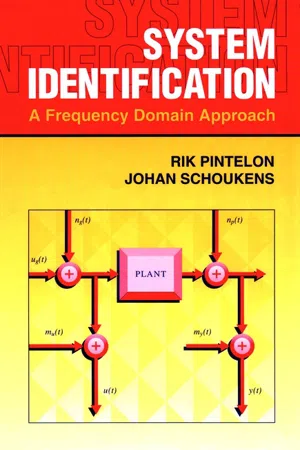
Electrical Engineering System Identification A Frequency Domain Approach How does one model a linear dynamic system from noisy data? This book presents a general approach to this problem, with both practical examples and theoretical discussions that give the reader a sound understanding of the subject and of the pitfalls that might occur on the road from raw data to validated model. The emphasis is on robust methods that can be used with a minimum of user interaction. Readers in many fields of engineering will gain knowledge about:
* Choice of experimental setup and experiment design
* Automatic characterization of disturbing noise
* Generation of a good plant model
* Detection, qualification, and quantification of nonlinear distortions
* Identification of continuous- and discrete-time models
* Improved model validation tools
and from the theoretical side about:
* System identification
* Interrelations between time- and frequency-domain approaches
* Stochastic properties of the estimators
* Stochastic analysis
System Identification: A Frequency Domain Approach is written for practicing engineers and scientists who do not want to delve into mathematical details of proofs. Also, it is written for researchers who wish to learn more about the theoretical aspects of the proofs. Several of the introductory chapters are suitable for undergraduates. Each chapter begins with an abstract and ends with exercises, and examples are given throughout.
- 644 pages
- English
- PDF
- Available on iOS & Android
eBook - PDF
About this book
Information
Table of contents
- Contents
- Preface
- Acknowledgments
- List of Operators and Notational Conventions
- List of Symbols
- List of Abbreviations
- CHAPTER 1 An Introduction to Identification
- CHAPTER 2 Measurements of Frequency Response Functions
- CHAPTER 3 Frequency Response Function Measurements in the Presence of Nonlinear Distortions
- CHAPTER 4 Design of Excitation Signals
- CHAPTER 5 Models of Linear Time-Invariant Systems
- CHAPTER 6 An Intuitive Introduction to Frequency Domain Identification
- CHAPTER 7 Estimation with Known Noise Model
- CHAPTER 8 Estimation with Unknown Noise Model
- CHAPTER 9 Model Selection and Validation
- CHAPTER 10 Basic Choices in System Identification
- CHAPTER 11 Guidelines for the User
- CHAPTER 12 Applications
- CHAPTER 13 Some Linear Algebra Fundamentals
- CHAPTER 14 Some Probability and Stochastic Convergence Fundamentals
- CHAPTER 15 Properties of Least Squares Estimators with Deterministic Weighting
- CHAPTER 16 Properties of Least Squares Estimators with Stochastic Weighting
- CHAPTER 17 Identification of Semilinear Models
- CHAPTER 18 Identification of Invariants of (Over)Parameterized Models
- REFERENCES
- SUBJECT INDEX
- REFERENCE INDEX
- ABOUT THE AUTHORS
Trusted by 375,005 students
Access to over 1.5 million titles for a fair monthly price.
Study more efficiently using our study tools.
Frequently asked questions
Yes, you can cancel anytime from the Subscription tab in your account settings on the Perlego website. Your subscription will stay active until the end of your current billing period. Learn how to cancel your subscription
No, books cannot be downloaded as external files, such as PDFs, for use outside of Perlego. However, you can download books within the Perlego app for offline reading on mobile or tablet. Learn how to download books offline
Perlego offers two plans: Essential and Complete
- Essential is ideal for learners and professionals who enjoy exploring a wide range of subjects. Access the Essential Library with 800,000+ trusted titles and best-sellers across business, personal growth, and the humanities. Includes unlimited reading time and Standard Read Aloud voice.
- Complete: Perfect for advanced learners and researchers needing full, unrestricted access. Unlock 1.5M+ books across hundreds of subjects, including academic and specialized titles. The Complete Plan also includes advanced features like Premium Read Aloud and Research Assistant.
We are an online textbook subscription service, where you can get access to an entire online library for less than the price of a single book per month. With over 1.5 million books across 990+ topics, we’ve got you covered! Learn about our mission
Look out for the read-aloud symbol on your next book to see if you can listen to it. The read-aloud tool reads text aloud for you, highlighting the text as it is being read. You can pause it, speed it up and slow it down. Learn more about Read Aloud
Yes! You can use the Perlego app on both iOS and Android devices to read anytime, anywhere — even offline. Perfect for commutes or when you’re on the go.
Please note we cannot support devices running on iOS 13 and Android 7 or earlier. Learn more about using the app
Please note we cannot support devices running on iOS 13 and Android 7 or earlier. Learn more about using the app
Yes, you can access System Identification by Rik Pintelon,Johan Schoukens in PDF and/or ePUB format, as well as other popular books in Biological Sciences & System Theory. We have over 1.5 million books available in our catalogue for you to explore.