Are you a teacher of musical theatre who struggles to plan and construct lessons? Are you looking for a structured approach to teaching musical theatre to students of all abilities? Do you know your Ivor Novello from your Stephen Sondheim?
Despite being one of the most popular forms of performance study, Musical Theatre is often the most difficult to teach due to its part-practical and part-academic approach. With few books on the market directly aimed at teachers, it can be a challenging and daunting task to devise a course of study that takes in the history of the form as well as considering the wider aspects that come together to make a successful musical.
A Teacher's Guide to Musical Theatre enables teachers to plan and deliver courses in Musical Theatre with confidence and flair. The unique structure of the chapters guides teachers through key facts and concepts in musical theatre history and offers practical in-class activities for students. From topics for class discussion and essay assignments to journal entries and portfolios to sample test questions, this book is full of practical advice from experienced teachers in the field which make it the idea companion for teachers and instructors on diploma and degree-level courses, as well as those devising courses in part-time performing arts schools.
Devised to provide sufficient engaging and inspirational material for an initial term or semester, the book establishes the principles of teaching this relatively new subject and encourages teachers to extend much further into the subject. From The Mikado to Hamilton and everything in between, this book breaks down decades of history into appropriately sized lessons, designed to give students a rounded survey of the subject and an understanding of how musicals work. Offering expert guidance to those with varied fields of expertise and practical experience but limited teaching experience, this book is the only existing guide to structured and stimulating practice.
- 160 pages
- English
- ePUB (mobile friendly)
- Available on iOS & Android
eBook - ePub
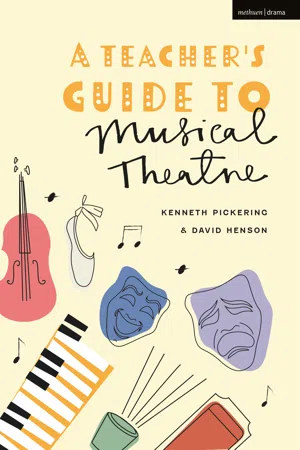
A Teacher’s Guide to Musical Theatre
About this book
Information
Lesson Twelve
The Burning of the Boats – The Musical Is Alive and Well
Lesson themes
Students and teachers often confine themselves to using and learning about Musicals which have become well-known through their success in the commercial Theatre and/or on film. The results are often little more than an attempt to recreate the glamour of the original performance and to imitate the various forms of recording that become available. However, a glance at the listings of Theatre activity in major towns and cities will reveal that not only are the majority of productions Musicals, but that ‘fringe’, ‘off-Broadway’ and community productions are increasingly exploring new, original and fascinating Musicals which may never reach conventional universal recognition. Such works are often the life-blood of Theatre if it is to survive and reward exploration and serious consideration. The creation of new and original work is the main theme of this lesson.
Teaching objectives
•To make students aware of the broadest possible concept of Musical Theatre
•To inspire students to create their own work for the Theatre
•To provide insights into the creation of a new Musical
•To encourage critical thinking about Musical Theatre
•To help students understand more fully the roles of writer and composer.
Key facts, teacher’s notes and in-class activities for students
Stage one: Widening horizons
Task 1
Ask your students to read the following Theatre review of a new Musical very carefully and comment on it. It is likely that neither you nor they will ever have heard of this work but (and this is an important learning point), that does not mean that it is of any lesser quality than some which may become widely known. Use the simple test of asking them ‘what do you now know about this Musical that you did not know when you came into class today?’:
The Burning of the Boats
A Musical Theatre piece with music by David Burridge and book and lyrics by Martin Riley.
This engaging production was both an act of celebration and defiance: celebration of just what can be achieved when a community of performers forgets about professional or amateur status and simply co-operates in defiance of the dismal legacy of the Department of Education, who have done their best to crush any creativity in young people!
The Burning of the Boats tells the story of a Deal smuggling family and their plight when, in 1784 the then Prime Minister, William Pitt the younger, ordered the burning of boats on the beach in an attempt to eradicate illegal contraband. (I wonder what his solution to the current political situation would be?) The performance brought together a cast of fine actor/singers with children’s choirs, adult choirs and the superb Revelation Strings with guest wind and percussion players. These huge forces were marshalled brilliantly by director Matthew Sharp and musical director David Burridge.
A sports hall is not necessarily the most sympathetic environment in which to stage a show but, in this case, it provided the size and sense of adventure for such an ambitious and varied production. On the central stage the compelling story was acted out with real sensitivity and focus and we were drawn into the desperate plight of the poor and the pathos of a pair of young lovers who preferred to flee for a better life than stay to perpetuate their families’ illegal way of making a living. The strong, operatic moments were beautifully handled both vocally and theatrically.
Supporting the main action was the singing chorus: even though they had to contend with difficult acoustics and sightlines, they brought a richness and sense of vibrant musical colour to the performance and the playing of the orchestra was invariably exhilarating and dramatic. This was the second time that this cleverly crafted piece had public performances: its first appearance was at the Deal Festival a few years ago and it certainly deserves to be seen and heard over and over again. Such a celebration of the power of the arts to enrich lives has never been more needed nor more lovingly presented.
Teacher’s notes
Once you have discussed the general impression that this review has had on your students you may well need to use some probing questions to discover what facts may be eluding both them and you. We might well ask ‘what makes someone want to write a Musical?’ Clearly there is always the possibility of commercial success but, in statistical terms, this is rare and so there are usually other motivating factors. In order to understand more about the creation of a new Musical we need to establish a context for its original writing and that is the purpose of the following section.
Stage two: Establishing context
Key facts: We list some useful information about The Burning of the Boats here:
1Deal is a small town on the South East coast of the United Kingdom. The narrow stretch of ocean that separates it from France is known as ‘The Downs’ and there are treacherous sand banks lying off-shore.
2Until the late nineteenth century, when the shingle deposits became excessive, Deal was a major mooring place for the British Navy and much of the commerce of the town was carried out by small boats ferrying goods and mariners back and forwards from the ships at anchor.
3Deal once had more taverns, inns and drinking places than any other small town in England.
4In recent years Deal not only lost its naval connections; it also lost its two other major sources of employment: the Royal Marines’ School of Music (which provided highly skilled professional musicians to the armed forces) and a busy coal mine which extended some miles under the sea and was worked largely by miners who had migrated from the North of England.
5Deal is now well-known as a weekend retreat for artists who have acquired and renovated attractive cottages in areas that were once ‘run down’ and inhabited by people (often fishermen and their families) with low incomes. Music halls, taverns, Mission halls and brothels have become fashionable places to live.
6The composer of The Burning of the Boats is a graduate of the Royal Marines’ School of Music and is now the musical director of a project known as The Big Reveal, which specializes in bringing instrumental and vocal music to communities and young people in the South East of England. His orchestra is known as ‘Revelation Strings’. ...
Table of contents
- Cover
- Half-Title Page
- Title Page
- Contents
- Acknowledgements
- Introduction
- Lesson One: The Elements of Musical Theatre
- Lesson Two: Just Speak the Words! Acting in Musical Theatre
- Lesson Three: ‘Playing the Dots’
- Lesson Four: ‘I Could Have Danced All Night!’
- Lesson Five: Where Did It All Start?
- Lesson Six: ‘Pogroms in the East’ – Europe Comes to the USA
- Lesson Seven: ‘The Biz’ – Theatre Examines Itself
- Lesson Eight: Chorus Time – ‘Do You Hear the People Sing?’
- Lesson Nine: Patter to Rap
- Lesson Ten: Book, Music and Lyrics
- Lesson Eleven: Rebellion and Censorship
- Lesson Twelve: The Burning Of The Boats – The Musical is Alive and Well
- Answers to Sample Test Questions
- Sources and Resources
- Musical Theatre: Online Resources
- Copyright
Trusted by 375,005 students
Access to over 1.5 million titles for a fair monthly price.
Study more efficiently using our study tools.
Frequently asked questions
Yes, you can cancel anytime from the Subscription tab in your account settings on the Perlego website. Your subscription will stay active until the end of your current billing period. Learn how to cancel your subscription
No, books cannot be downloaded as external files, such as PDFs, for use outside of Perlego. However, you can download books within the Perlego app for offline reading on mobile or tablet. Learn how to download books offline
Perlego offers two plans: Essential and Complete
- Essential is ideal for learners and professionals who enjoy exploring a wide range of subjects. Access the Essential Library with 800,000+ trusted titles and best-sellers across business, personal growth, and the humanities. Includes unlimited reading time and Standard Read Aloud voice.
- Complete: Perfect for advanced learners and researchers needing full, unrestricted access. Unlock 1.5M+ books across hundreds of subjects, including academic and specialized titles. The Complete Plan also includes advanced features like Premium Read Aloud and Research Assistant.
We are an online textbook subscription service, where you can get access to an entire online library for less than the price of a single book per month. With over 1.5 million books across 990+ topics, we’ve got you covered! Learn about our mission
Look out for the read-aloud symbol on your next book to see if you can listen to it. The read-aloud tool reads text aloud for you, highlighting the text as it is being read. You can pause it, speed it up and slow it down. Learn more about Read Aloud
Yes! You can use the Perlego app on both iOS and Android devices to read anytime, anywhere — even offline. Perfect for commutes or when you’re on the go.
Please note we cannot support devices running on iOS 13 and Android 7 or earlier. Learn more about using the app
Please note we cannot support devices running on iOS 13 and Android 7 or earlier. Learn more about using the app
Yes, you can access A Teacher’s Guide to Musical Theatre by Kenneth Pickering,David Henson in PDF and/or ePUB format, as well as other popular books in Media & Performing Arts & Music. We have over 1.5 million books available in our catalogue for you to explore.