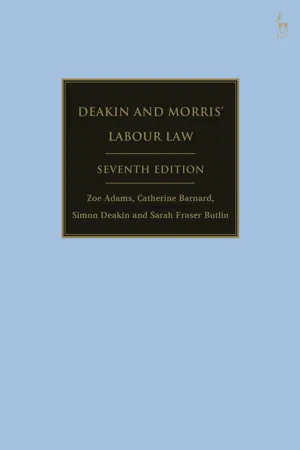
Deakin and Morris' Labour Law, a work cited as authoritative in the higher appellate courts of several jurisdictions, provides a comprehensive analysis of current British labour law which explains the role of different legal and extra-legal sources in its evolution, including collective bargaining, international labour standards, and human rights. The new edition, while following the broad pattern of previous ones, highlights important new developments in the content of the law, and in its wider social, economic and policy context. Thus the consequences of Brexit are considered along with the emerging effects of the Covid-19 crisis, the increasing digitisation of work, and the implications for policy of debates over the role of the law in constituting and regulating the labour market. The book examines in detail the law governing individual employment relations, with chapters covering the definition of the employment relationship; the sources and regulation of terms and conditions of employment; discipline and termination of employment; and equality of treatment. This is followed by an analysis of the elements of collective labour law, including the forms of collective organisation, freedom of association, employee representation, internal trade union government, and the law relating to industrial action. The seventh edition of Deakin and Morris' Labour Law is an essential text for students of law and of disciplines related to management and industrial relations, for barristers and solicitors working in the field of labour law, and for all those with a serious interest in the subject. This title is included in Bloomsbury Professional's Employment Law online service.
eBook - ePub
Deakin and Morris' Labour Law
- 1,328 pages
- English
- ePUB (mobile friendly)
- Available on iOS & Android
eBook - ePub
Deakin and Morris' Labour Law
About this book
Information
1
Introduction: History, Sources, and Institutions of Labour Law
1.1Labour Law: The Scope and Nature of the Subject
1.1Labour Law as a Discipline
1.2The Structure of this Book
1.3Historical Development
1.4Collective Organisation and the Common Law
1.9Collective Bargaining and Social Legislation
1.15The Employment Relationship
1.19State Corporatism, Incomes Policies and Collective Bargaining
1.22Labour Market Flexibility and Deregulation
1.31Pragmatic Reconstruction? Labour Law under ‘New Labour’
1.36Labour Law under Coalition and Conservative Governments after 2015
1.37Sources of Labour Law
1.38The Common Law
1.39Legislation
1.40Codes of Practice
1.41Collective Bargaining
1.42Works Rules, Custom and Practice, and Documentation Issued by Employers
1.43Self-regulatory Codes of Conduct
1.44European Union Law
1.47ILO Conventions and Recommendations
1.48Council of Europe Standards: The ECHR and RESC
1.49UN Standards: The UDHR, ICESR and ICCPR
1.50Labour Standards and Private International Law
1.56Institutions of Labour Law
1.57Employment Tribunals
1.58The Employment Appeal Tribunal
1.59Reforming the Tribunal System
1.60The Central Arbitration Committee
1.61The Advisory, Conciliation and Arbitration Service (ACAS)
1.62The Certification Officer
1.63The Equality and Human Rights Commission (EHRC)
1.64The Gangmasters and Labour Abuse Authority (GLAA)
1.65The Director of Labour Market Enforcement
Labour Law: The Scope and Nature of the Subject
Labour Law as a Discipline
1.1The discipline of labour law is defined in part by its subject-matter, in part by an intellectual tradition. Its immediate subject-matter consists of the rules which govern the employment relationship. However, a broader perspective would see labour law as the normative framework for the existence and operation of the principal institutions of the labour market: the business enterprise, trade unions, employers’ associations, and, in its capacity as regulator and as employer, the state. The starting point for analysis is the existence of the employment relationship as a distinct economic and legal category. Labour law stems from the idea of ‘the subordination of the individual worker to the capitalist enterprise’;1 it is above all the law of dependent labour, and hence is specific to those categories of economic relationship which in some way involve the exchange of personal service or services for remuneration. Labour law is concerned with how these relationships are constituted, a role which in common law systems is accorded primarily to contract, and with how they are regulated, a role shared by the common law and social legislation, but also by extra-legal sources such as collective bargaining and workplace custom and practice. Its scope accordingly extends from the individual to the collective, from the contract of employment to relations between the institutions of organised labour and capital, and to the conduct and resolution of conflicts between them.
The intellectual tradition to which we referred sees labour law as a unified discipline which has outgrown its diverse origins in the law of obligations and in the regulatory intervention of the state. As a subject with its own doctrinal unity and structure, it spans the divides between common law and legislation and between private law and public law. In Britain, as elsewhere in Europe, it has established itself as one of the principal branches of legal studies.2 The view that labour law is more than just the sum of its parts is derived initially from the writings of German jurists in the early decades of the twentieth century, who saw the subject as the embodiment of social policy in action. This view, which at its broadest implied that labour law should embrace ‘sociology, social policy and the theory of business organisation’,3 came to influence the study of labour law in Britain through the writings of Sir Otto Kahn-Freund, who, having been a labour court judge in the Germany of the Weimar Republic, lived and taught in Britain from the 1930s. His conception of the subject stressed the functional inter-dependence of the positive law with extra-legal sources of regulation, in particular collective bargaining: his contribution ‘revolutionised the study, the teaching and the very character of labour law in Britain’.4 This perspective remains valid today, notwithstanding the enormous changes which have taken place in the form and content of labour law since Kahn-Freund elaborated his theory of the subject in writings of the 1950s,5 which were to have a major impact not just on scholarship but also on the courts6 and on the formulation of public policy in this area.7
Although the notion of labour law as the normative framework for the institutions of the labour market has commanded increasing attention in recent years,8 it should be borne in mind that other, closely-related areas of law are also important determinants of labour market outcomes. These include social security law, company law, the law of taxation, health and safety law, pensions law, asylum and immigration law, the law of public procurement, and data protection law. Because each of these is a specialised field in its own right, we do not cover their labour market aspects here but will refer to them where there is an overlap with a labour law issue. Whatever the case may be for labour law being folded into a wider category of ‘labour market law’9 or law governing economically unequal relationships,10 these alternative paradigms do not yet offer a unifying set of principles or concepts that are capable of organising a doctrinal field of the kind which ‘labour law’ continues to represent.
Following the tradition begun by the German sozialjuristen, many British labour law scholars have attempted to integrate into their work the insights of other social science disciplines. The influence of industrial sociology has been most widely felt, in large part because of the close links which have long existed between labour law and the study of industrial or employment relations. More recently, growing use has been made of labour economics, feminist legal theory, and political theory.11 The principal aim of this book is to analyse the conceptual and doctrinal structure of labour law and to examine its application to concrete problems of the kind which frequently arise in practice, rather than to present labour law from the viewpoint of another social science discipline. We have taken this approach in the belief that a thorough explication of labour law doctrine is essential, in order for labour law to be understood both as a juridical and as a social and economic phenomenon. While this is not a work of empirical, interdisciplinary, or other socio-legal research, it will be, we hope, of relevance to those legal sub-disciplines, and of value to social scientists generally working on themes related to labour markets, employment relations, and the capitalist enterprise.
The Structure of this Book
1.2Certain divisions of the legal material which forms labour law have become generally accepted. A broad division is taken to exist between ‘individual labour law’, the law relating in a narrow sense to the relationship of employer and employee, and ‘collective labour law’, or the law which is concerned with collective bargaining, trade union organisation, and industrial action. In practice, the ‘individual’ and ‘collective’ aspects of the subject are closely interlinked and, we would suggest, cannot be adequately considered in isolation from one another. For example, in analysing the individual employment relationship, it is necessary to take into account the influence of norms which are derived from collective sources, in particular collective bargaining.12 Conversely, the contract of employment plays a fundamental role in relation to the economic torts and other aspects of the law governing industrial action.13
We also take the view that an appreciation of the historical development of the labour law system is essential to an understanding of its current form and content. This is particularly so with regard to the interrelationship between the principal sources of labour law, namely the common law, social legislation, and extra-legal sources including collective bargaining and workplace custom and practice. We therefore preface our analysis of the substantive law with this introductory chapter. The next section of this chapter examines from a historical perspective some core themes of labour law in Britain. We then go on to look at sources and institutions of labour law. Here we examine in greater detail the relationship between formal sources of law, in particular the common law and legislation, and what we term ‘voluntary’ sources, of which collective bargaining is the most significant. This chapter also explains the nature of institutions which are particular to labour law, including the employment tribunal system and forms of administrative intervention in employment relations. We also outline the role of EU law within labour law and consider the influence of other international labour standards.
The rest of the book is devoted to the study of areas of substantive legal doctrine. Chapter 2 analyses the law governing the formation and constitution of the employment relationship. Chapters 3 and 4 then examine the contents of that relationship: chapter 3 is concerned with the law governing terms and conditions of employment, and chapter 4 with the subject of discipline and termination of employment. Chapter 5 is devoted to the analysis of equal treatment in employment. Chapter 6 provides an overview of the law relating to collective organisation and freedom of association on the part of both workers and employers, and thereby provides a fr...
Table of contents
- Cover
- Title Page
- Foreword
- Preface
- Contents
- Table of Abbreviations
- Table of Cases
- Table of Statutes
- 1. Introduction: History, Sources, and Institutions of Labour Law
- 2. The Employment Relationship
- 3. Terms of Employment and Working Conditions
- 4. Discipline and Termination of Employment
- 5. Equality in Employment
- 6. Collective Organisation and Freedom of Association
- 7. Collective Bargaining, Trade Union Recognition, and Statutory Information and Consultation Rights
- 8. Trade Unions and their Members
- 9. Industrial Action
- Bibliography
- Index
- Copyright Page
Trusted by 375,005 students
Access to over 1.5 million titles for a fair monthly price.
Study more efficiently using our study tools.
Frequently asked questions
Yes, you can cancel anytime from the Subscription tab in your account settings on the Perlego website. Your subscription will stay active until the end of your current billing period. Learn how to cancel your subscription
No, books cannot be downloaded as external files, such as PDFs, for use outside of Perlego. However, you can download books within the Perlego app for offline reading on mobile or tablet. Learn how to download books offline
Perlego offers two plans: Essential and Complete
- Essential is ideal for learners and professionals who enjoy exploring a wide range of subjects. Access the Essential Library with 800,000+ trusted titles and best-sellers across business, personal growth, and the humanities. Includes unlimited reading time and Standard Read Aloud voice.
- Complete: Perfect for advanced learners and researchers needing full, unrestricted access. Unlock 1.5M+ books across hundreds of subjects, including academic and specialized titles. The Complete Plan also includes advanced features like Premium Read Aloud and Research Assistant.
We are an online textbook subscription service, where you can get access to an entire online library for less than the price of a single book per month. With over 1.5 million books across 990+ topics, we’ve got you covered! Learn about our mission
Look out for the read-aloud symbol on your next book to see if you can listen to it. The read-aloud tool reads text aloud for you, highlighting the text as it is being read. You can pause it, speed it up and slow it down. Learn more about Read Aloud
Yes! You can use the Perlego app on both iOS and Android devices to read anytime, anywhere — even offline. Perfect for commutes or when you’re on the go.
Please note we cannot support devices running on iOS 13 and Android 7 or earlier. Learn more about using the app
Please note we cannot support devices running on iOS 13 and Android 7 or earlier. Learn more about using the app
Yes, you can access Deakin and Morris' Labour Law by Zoe Adams, Catherine Barnard, Simon Deakin, Sarah Fraser Butlin in PDF and/or ePUB format, as well as other popular books in Law & Labour & Employment Law. We have over 1.5 million books available in our catalogue for you to explore.