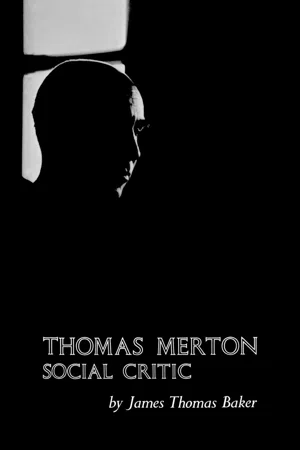
Thomas Merton: Social Critic organizes and critically analyzes the social thought of the Cistercian monk who has become an internationally known symbol of the spiritual element in man. The author evaluated all of Merton's writings, published and unpublished, then discussed his interpretations with Merton personally. The result is a perceptive relation of Merton's social thought to its genesis in his own life experiences and contemplation, a faithful rendering of Merton's thought on the problems of our time.
Merton, the author makes clear, called for a spiritual, social, and religious union. It was a poetic and sometimes unimplemented solution to alienation and division, a valid and authentic, if at times limited, response to the contemporary chaos. This study will be greeted by a strong reaction from Mertonians everywhere.
- 184 pages
- English
- ePUB (mobile friendly)
- Available on iOS & Android
eBook - ePub
About this book
Information
Topic
Theology & ReligionSubtopic
Religious BiographiesChapter One
The Pilgrim’s Progress
Thomas Merton was born on January 31, 1915, in Prades, a French village lying in the Pyrenees Mountains near the Spanish border. His parents, both artists, had met in Paris and had come to the south of France to paint. His father was Owen Merton, a New Zealander of Welsh extraction; his mother, Ruth Jenkins, was the daughter of a successful publisher on Long Island. Merton always attributed his own adult personality to his parents who were, he said, captives in the world but not captives of it. In his autobiography he wrote: “I inherited from my father his way of looking at things and some of his integrity and from my mother some of her dissatisfaction with the mess the world is in, and some of her versatility. From both I got capacities for work and vision and enjoyment and expression that ought to have made me some kind of a King, if the standards the world lives by were the real ones.”1
The young Thomas was properly baptized, his father being a devoted if sometimes negligent Anglican, but he was not taken to church during his early childhood because his mother openly despised formal religion, attending only Quaker services occasionally. She believed that church traditions would corrupt her son, and although he sometimes asked to be taken to that mysterious place where the bells were ringing on Sunday morning, she consistently refused his pleas. He later speculated that had his mother lived he would doubtless have become a nice skeptic: an author, editor, or professor in a small, progressive liberal arts college.2
As the Great War in Europe intensified, Owen Merton fled with his wife and son to America where he became a gardener in Flushing, Long Island, five miles from his father-in-law’s home in Douglaston. There in 1918 Thomas’s only brother, John Paul, was born. John Paul was to be the last child born to the Merton family, for Mrs. Merton, shortly thereafter, was hospitalized with inoperable cancer. As soon as his wife entered the hospital, Owen Merton moved with his two sons to Douglaston and took a job as organist in the local Episcopal church, at the same time continuing to paint and do gardening as well as to play the piano at the town movie house. For the first time young Thomas attended church regularly with his father. He would later remember coming out of the services each Sunday with little more than the feeling that he had done something that needed doing, but he always felt grateful for this bit of religion that he received during his mother’s illness. His only real religious training during this time consisted of learning the Lord’s Prayer from his grandmother Merton, who had come to America from New Zealand for a visit.
With his mother’s death Thomas’s life began to break up, and he was not to know again a completely settled and secure existence until he became a monk. His father, now free to travel and devote all his time to painting, first took Thomas with him to Bermuda, painted there for several months, returned to New York where he had a successful exhibit, and then left Thomas with his grandparents while he went to paint in France.
During these next few months spent with his American grandparents, Thomas got part of his education from the flickering, yellow-lighted movies that were still being made and shown on Long Island and from the cheap reprints of popular novels, methodically produced by his grandfather’s publishing firm. His religious training in Douglaston, he said, was typical of the semitolerant religious theology of the upper-middle class at that time. The general attitude was that all religions were “more or less praiseworthy on purely natural or social grounds”—all religions, that is, except Roman Catholicism. The Roman Catholic Church was thought to be synonymous with Tammany Hall, and Tammany Hall was in turn thought to be synonymous with all sorts of corruption. Merton later explained that the vague and evil thing called Catholicism lived in the dark corners of his mind along with other spooks like death, and he remembered, “I did not know precisely what the word meant. It only conveyed a kind of cold and unpleasant feeling.”3
Owen Merton, having achieved a measure of fame in a successful London exhibit, returned to New York in 1925 and announced that he would take Thomas with him to Europe where he would eventually attend school in England. The artist and his son arrived in Paris in August 1925 and set out immediately for the south of France where they settled in Saint Antonin, an ancient city originally established by the Romans, and built a house with a large studio below and two bedrooms above. For several months the two of them lived together in this house; from there they took long walks through the hills and lived the free life of independent men. While his father painted, Thomas would wander through a countryside so steeped in Catholic history that he seemed to enter into the Sacraments just by breathing the air; he came to love the cathedral in Saint Antonin and the ruins of the old abbey, and he would say much later that his contemplative life, like his physical life, began in the south of France.4
After several months of attending a lycée in nearby Mountauban, Thomas was taken by his father to England and enrolled in the Ripley Court School, where he studied until he was fourteen years of age. During these four years he went through what he called his first religious phase, becoming a devout Anglican, attending church regularly, and praying before meals and bed. Fifteen years later, having become a Catholic monk, he would remember this period with mixed emotions: “Prayer is attractive enough when it is considered in a context of good food, and sunny joyous country churches, and the green English countryside. And, as a matter of fact, the Church of England means all this. It is a class religion, the cult of a special society and group, not even of a whole nation, but of the ruling minority in a nation.”5
In the autumn of 1929 he was admitted to the Oakham school, an English public school. During his first year at Oakham his father died of a malignant brain tumor, leaving him an orphan, but his American grandfather, fearing bankruptcy in those years of the great depression, gave him an insurance policy sufficient to pay all his expenses and make him financially independent for the next few years. And so he was set free to do as he pleased with neither parental nor financial hindrances, an enviable situation for a boy of seventeen, but the years of freedom that lay ahead proved to be exceedingly unhappy ones.
One reason for his unhappiness was his loss of faith, for the years at Oakham gradually made him despise the Church of England, which was the only kind of religion that he knew. He came to hate the Anglican church because of its embarrassing ties with and support of the British aristocracy, and he found especially distasteful the theology that grew out of this relationship. For example, he remembered that in what he called characteristic Anglican fashion the chaplain at Oakham interpreted the word charity in I Corinthians 13 as “gentlemanliness.” Every time the apostle Paul said charity the chaplain said gentlemanliness, or at least gave it that definition. Thus he would conclude that even if a young Englishman should speak with the tongue of angels and were not a gentleman he would be as sounding brass and a tinkling cymbal. Merton, already showing signs of his later humor, recalled, “I will not accuse him of finishing the chapter with ‘Now there remain faith, hope, and gentlemanliness, and the greatest of these is gentlemanliness . . .’ although it was the logical term of his reasoning.”6
Merton filled the vacuum caused by his loss of faith with the study of literature and languages, being particularly attracted by the works of James Joyce, D. H. Lawrence, T. S. Eliot, Ernest Hemingway, and Evelyn Waugh. But the two writers who most influenced his early thinking and literary style were William Blake and Gerard Manley Hopkins. He had read Blake as a child, but he now rediscovered him in all his symbolic majesty. He was most impressed by Blake’s antipathy toward false piety and religiosity, the scandals of the Anglican faith which Merton was in the process of condemning, and by Blake’s admiration for the man who genuinely loves God. He discovered Hopkins while in a hospital bed. During his last year at Oakham he visited Germany to make the traditional walk down the Rhine but was soon hospitalized with blood poisoning; while convalescing he was given a book of Hopkins’s poetry and soon became a loyal devotee of this great Catholic writer to whom he has been compared in recent years.
In January 1933 Merton passed his entrance examinations and was accepted as a student at Cambridge University. Since he would not enter Cambridge until the autumn term he decided to tour Italy during the spring and summer and to spend most of his time in Rome. This trip proved to be a decisive experience, although he did not recognize it as such at the time, for he experienced a kind of conversion both to a culture and to a religion, a conversion which he would at first dismiss as the foolishness of adolescence but one to which he would return after many years of wandering.
When he first arrived in Rome he spent most of his time visiting museums and searching through the ruins of the classical Roman age. But he was soon attracted to the churches, both old and new, and in this way discovered a completely different Rome—one that his schooling had not taught him—Christian Rome. Especially impressed by the Byzantine mosaics in the early churches, he began reading the Bible each night in order to understand the artistic representations in the churches that he visited by day. He also began praying in each of the churches, and after overcoming the initial embarrassment of praying in public, an embarrassment which most Protestants but few Catholics understand, he found this practice most rewarding.
One night in his hotel room, after a day of prayer and study, he seemed to feel the presence of his father with him and responded to this mystical experience by praying. After a few minutes the emotion passed, but he kept the memory of his father in his heart and continued to pray whenever he had the opportunity. His visits to the Roman churches thereafter became even more significant to him, and following a visit to the Trappist monastery Tré Fontane he confided to an acquaintance that he would someday like to become a monk like those he had just seen.7
He sailed from Rome that summer to visit his family on Long Island. While in America he visited several types of churches, intent upon discovering a spiritual home in which to continue the religious quest begun in Rome, but in each instance he was disappointed. He concluded that the Episcopal priest of the church where his father had been organist had abandoned Christian theology for discussions of literature and politics, and although he expressed admiration for the Quaker silence he concluded that in their testimonial services they simply substituted lay inanities for clerical ones. Despite his experiences in the churches of Rome, he apparently did not seriously consider becoming a Catholic, still thinking of the Catholic church in America as somehow the ally of Tammany Hall and failing to make the connection between the churches of Rome and the Roman Catholic Church.8
By the time he returned to England and entered Cambridge his religious zeal had diminished and his “conversion” was forgotten. Although he had planned to pursue a strenuous course of studies to prepare himself for British diplomatic service, he soon became dissipated and unhappy and came to hate Cambridge. He later said that the one valuable thing he received from his single year at that British university was a thorough acquaintance with Dante, whom he always thereafter considered the greatest of all Catholic poets. He was therefore pleased when, at the end of his first year at Cambridge and after a scandal led his British guardian to refuse further responsibility for him, his grandfather asked him to give up his plans for a career in the diplomatic corps and come to live in New York. He gladly left England forever in November 1934 and would ever after demonstrate a decidedly anti-British bias in his writings.
Upon arriving in New York with no definite plans or goal in life, his first project was to find himself. During his first few months in New York he seemed to be searching frantically for his place in a society which was new to him, and he seemed determined to find a philosophy of life, no matter what it might be. He first became an admirer of communism, seeing every available Russian movie and expressing deep admiration for the progress which Russia had made under communism. Despite the scenes of the Kremlin and Red Square, which he later admitted contained the world’s ugliest buildings, he hungrily swallowed the party line presented by these movies and loyally believed that Russia, where artists were said to be free from the dictates of bourgeois tastes, was truly the home of the arts. He came to believe that the intolerable conditions of the modern world were the products of materialistic capitalism and that the world could be cleansed only by capitalism’s demise. Communism was an appealing philosophy to an unhappy young man like Merton, for it permitted him to blame his failures and unhappiness on society and reject all personal responsibility for them.9
Upon entering Columbia University in January 1935, Merton came into contact with a number of Communists, the first he had ever met. He found that the Columbia Communists were primarily undergraduates, not faculty members as the Hearst papers were claiming, and that their voice was much louder than their size merited because they controlled the school paper, The Spectator. But he joined the Young Communist League, perhaps because of its unpopularity, taking the party name Frank Swift. He even attended a Communist outing at the Park Avenue apartment of a member whose parents were away for the weekend, but the irony of this situation and the usual dullness of the meetings combined to drive him out of active membership after about three months.
He then joined the National Students League, the campus Socialist organization, and one of his first tasks was to picket the Casa Italiana with a sign condemning Italy’s actions in Ethiopia. He said later that even at the time he realized the futility of this demonstration but considered it a public confession of faith, a protest against all war. In fact, he had become a Socialist primarily because the Socialists were emphasizing pacifism that year, and he was a pacifist. Along with several hundred other students he attended a Socialist rally on campus and signed the Oxford Pledge, promising that he would never participate in any war, but his faith in socialism was somewhat shaken the following year when the leaders of that rally went to Spain to fight with the Communists against the fascist general Francisco Franco.
During these early years at Columbia it was only his cynicism that saved Merton from becoming, as Eric Hoffer would say, a true believer in communism or socialism. He was desperately searching for a faith, a philosophy of life, a purpose, but each of the options that he examined had a fatal flaw which Merton’s perceptive mind quickly brought to light. He was a wary searcher after meaning in life, a young man who was looking for something to believe in but who would look long and hard before making a commitment.
Despite his failure to find a faith and his disillusionment with communism and socialism, Merton’s early years at Columbia were a time of great personal growth. Years after graduation, when he could reflect upon the various influences that had molded his life, he would place Columbia at the top of the list. In a manuscript explaining his philosophy of education, he said that Columbia had given him the most precious gift any man could receive: a good education. He believed that the purpose of education is to help the student “define himself authentically and spontaneously in relation to his world” and that a university’s primary task is to help its students discover themselves. The university, he said, should help the student save his soul from the “hell of meaninglessness, of obsession, of complex artifice, of systematic lying, of criminal evasions and neglects, of self-destructive futilities,” and Columbia had done this for him. Most of all Columbia had taught him the value of unsuccess. Instead of adapting him to the downtown New York world, he said, Columbia lobbed him “half conscious” into Greenwich Village where he occasionally came to his senses and continued to learn. Columbia also strongly influenced the development of Thomas Merton the contemplative:
The thing I always liked best about Columbia was the sense that the University was, on the whole, glad to turn me loose in its library, its classrooms, and among its distinguished faculty, and let me make what I liked out of it all. I did. And I ended up by being turned on like a pin ball machine by Blake, Thomas Aquinas, Augustine, Eckhart, Coomaraswamy, Traherne, Hopkins, Maritain, and the sacraments of the Catholic Church. After which I came to the monastery in which (this is public knowledge) I have continued to be the same kind of maverick and have in fact ended as a hermit who is also fully identified with the peace movement, with Zen, with a group of Latin American hippie poets, etc. etc.10
Columbia apparently helped to create the personality that would one day be the world’s most outspoken monk since Martin Luther and the most conspicuous recluse since Simeon Stylites.
During his undergradu...
Table of contents
- Cover
- Half title
- Title
- Dedication
- Copyright
- Contents
- Preface
- Chapter One The Pilgrim’s Progress
- Chapter Two The World & Thomas Merton
- Chapter Three The Social Ethics of Contemplation
- Chapter Four The Battle of Gog & Magog
- Chapter Five The Grim Reaper of Violence
- Chapter Six Catholicism in the Modern World
- Selected Bibliography
- Notes
- Index
Trusted by 375,005 students
Access to over 1.5 million titles for a fair monthly price.
Study more efficiently using our study tools.
Frequently asked questions
Yes, you can cancel anytime from the Subscription tab in your account settings on the Perlego website. Your subscription will stay active until the end of your current billing period. Learn how to cancel your subscription
No, books cannot be downloaded as external files, such as PDFs, for use outside of Perlego. However, you can download books within the Perlego app for offline reading on mobile or tablet. Learn how to download books offline
Perlego offers two plans: Essential and Complete
- Essential is ideal for learners and professionals who enjoy exploring a wide range of subjects. Access the Essential Library with 800,000+ trusted titles and best-sellers across business, personal growth, and the humanities. Includes unlimited reading time and Standard Read Aloud voice.
- Complete: Perfect for advanced learners and researchers needing full, unrestricted access. Unlock 1.5M+ books across hundreds of subjects, including academic and specialized titles. The Complete Plan also includes advanced features like Premium Read Aloud and Research Assistant.
We are an online textbook subscription service, where you can get access to an entire online library for less than the price of a single book per month. With over 1.5 million books across 990+ topics, we’ve got you covered! Learn about our mission
Look out for the read-aloud symbol on your next book to see if you can listen to it. The read-aloud tool reads text aloud for you, highlighting the text as it is being read. You can pause it, speed it up and slow it down. Learn more about Read Aloud
Yes! You can use the Perlego app on both iOS and Android devices to read anytime, anywhere — even offline. Perfect for commutes or when you’re on the go.
Please note we cannot support devices running on iOS 13 and Android 7 or earlier. Learn more about using the app
Please note we cannot support devices running on iOS 13 and Android 7 or earlier. Learn more about using the app
Yes, you can access Thomas Merton by James Thomas Baker in PDF and/or ePUB format, as well as other popular books in Theology & Religion & Religious Biographies. We have over 1.5 million books available in our catalogue for you to explore.