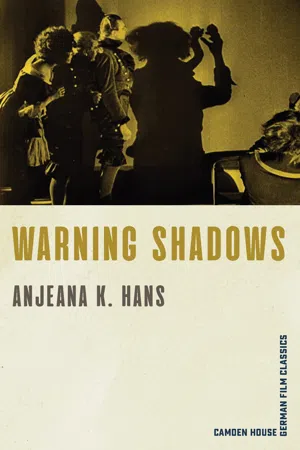
Warning Shadows
About this book
Artur Robison's Warning Shadows - in German simply Schatten, shadows - premiered in 1923 to critical acclaim. This story of a fateful dinner party at which a flirtatious wife, her jealous husband, and their guests are entertained by a traveling illusionist who deals in shadow play and hypnosis was extolled by one critic as superior to Wegener's Golem, Lubitsch's Passion, even Murnau's Nosferatu and Wiene's The Cabinet of Dr. Caligari. Yet where those films became mainstays of film history, Warning Shadows was long unknown: only recently, with the release of a restored version on DVD, has it begun to get its due. One of the few silent movies to eschew intertitles, it was an attempt to create a "pure film, " drawing on the qualities of cinema that made it not an heir to literature or theater but a unique and autonomous art form. Staging a story of desire, adultery, and violence, Robison's film also engaged with discourses at the heart of Weimar culture, from changing gender norms to hysteria and hypnosis to the construction of spectatorship. Seen this way, Warning Shadows is both a gripping narrative of infidelity and jealousy and a film inherently about film.
Information
Table of contents
- Front Cover
- Contents
- Acknowledgments
- Introduction: A Little-Known Movie
- The Making of the Movie
- Defining Film: Art Form or Public Danger?
- A Film “Full of Eroticism”
- Projections within Projections
- The Illusionist: Magic, Control, and Art
- Spectators Become Actors
- Hypnotism: Therapy and Spectacle
- “This Magical Therapy”
- What Lies Beneath: Gender and Violence
- The Hypnotic Screen
- The Other Projection: The Chinese Shadow Play
- Conclusion: A More Complex History
- Credits
- Notes
Frequently asked questions
- Essential is ideal for learners and professionals who enjoy exploring a wide range of subjects. Access the Essential Library with 800,000+ trusted titles and best-sellers across business, personal growth, and the humanities. Includes unlimited reading time and Standard Read Aloud voice.
- Complete: Perfect for advanced learners and researchers needing full, unrestricted access. Unlock 1.4M+ books across hundreds of subjects, including academic and specialized titles. The Complete Plan also includes advanced features like Premium Read Aloud and Research Assistant.
Please note we cannot support devices running on iOS 13 and Android 7 or earlier. Learn more about using the app