Abortion is a contentious issue in social life but it has rarely been subjected to careful scrutiny in the social sciences. While the legalization of abortion has brought it into the public domain, it still remains a sensitive topic in many cultures, often hidden from view and rarely spoken about, consigned to a shadowy existence.
Drawing on reports gathered from hospital settings and in-depth interviews with women who have had abortions, Luc Boltanski sets out to explain the ambiguous status of this social practice. Abortion, he argues, has to remain in the shadows, for it reveals a contradiction at the heart of the social contract: the principle of the uniqueness of beings conflicts with the postulate of their replaceable nature, a postulate without which no society would achieve demographic renewal.
This leads Boltanski to explore the way human beings are engendered and to analyze the symbolic constraints that preside over their entry into society. What makes a human being is not the foetus as such, ensconced within the body, but rather the process by which it is taken up symbolically in speech - that is, its symbolic adoption. But this symbolic adoption presupposes the possibility of discriminating among embryos that are indistinguishable. For society, and sometimes for individuals, the arbitrary character of this discrimination is hard to tolerate. The contradiction is made bearable, Boltanski shows, by a grammatical categorization: the "project" foetus - adopted by its parents, who use speech to welcome the new being and give it a name - is juxtaposed to the "tumoral" foetus, an accidental embryo that will not be the object of a life-forming project.
Bringing together grammar, narrations of life experience and an historical perspective, this highly original book sheds fresh light on a social phenomenon that is widely practised but poorly understood.
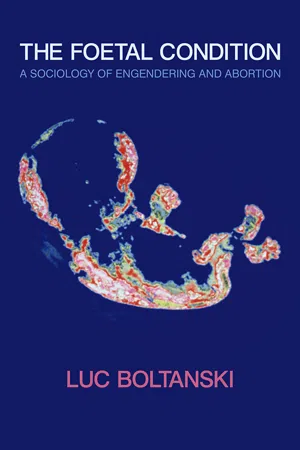
- 338 pages
- English
- PDF
- Available on iOS & Android
eBook - PDF
About this book
Information
Table of contents
- Title
- Copyright
- Contents
- Introduction
- 1 The Anthropological Dimensions of Abortion
- 2 The Two Constraints on Engendering
- 3 Understandings
- 4 The Parental Project
- 5 Constructing Foetal Categories
- 6 The Justification of Abortion
- 7 The Experience of Abortion
- Conclusion: Forgetting Abortion
- Notes
- Works Cited
- Index
Trusted by 375,005 students
Access to over 1.5 million titles for a fair monthly price.
Study more efficiently using our study tools.
Frequently asked questions
Yes, you can cancel anytime from the Subscription tab in your account settings on the Perlego website. Your subscription will stay active until the end of your current billing period. Learn how to cancel your subscription
No, books cannot be downloaded as external files, such as PDFs, for use outside of Perlego. However, you can download books within the Perlego app for offline reading on mobile or tablet. Learn how to download books offline
Perlego offers two plans: Essential and Complete
- Essential is ideal for learners and professionals who enjoy exploring a wide range of subjects. Access the Essential Library with 800,000+ trusted titles and best-sellers across business, personal growth, and the humanities. Includes unlimited reading time and Standard Read Aloud voice.
- Complete: Perfect for advanced learners and researchers needing full, unrestricted access. Unlock 1.5M+ books across hundreds of subjects, including academic and specialized titles. The Complete Plan also includes advanced features like Premium Read Aloud and Research Assistant.
We are an online textbook subscription service, where you can get access to an entire online library for less than the price of a single book per month. With over 1.5 million books across 990+ topics, we’ve got you covered! Learn about our mission
Look out for the read-aloud symbol on your next book to see if you can listen to it. The read-aloud tool reads text aloud for you, highlighting the text as it is being read. You can pause it, speed it up and slow it down. Learn more about Read Aloud
Yes! You can use the Perlego app on both iOS and Android devices to read anytime, anywhere — even offline. Perfect for commutes or when you’re on the go.
Please note we cannot support devices running on iOS 13 and Android 7 or earlier. Learn more about using the app
Please note we cannot support devices running on iOS 13 and Android 7 or earlier. Learn more about using the app
Yes, you can access The Foetal Condition by Luc Boltanski in PDF and/or ePUB format, as well as other popular books in Social Sciences & Sociology. We have over 1.5 million books available in our catalogue for you to explore.