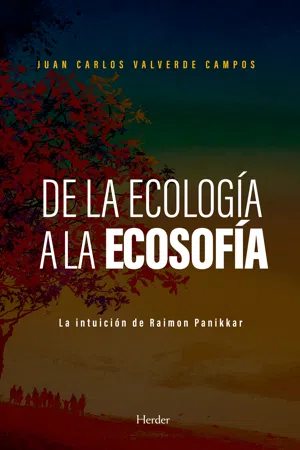
La crisis medioambiental ha perturbado la vida del ser humano y todas sus actividades. La teología no se ha interesado en esta cuestión sino hasta hace poco, y ha respondido a los reproches por esa indiferencia con una renovada teología de la creación. Este libro es fruto de una investigación sobre la propuesta de Raimon Panikkar llamada "ecosofía", una aproximación al campo de la ecología desde una nueva teología trinitaria.En estas páginas se aborda lo que Panikkar llamó la "intuición cosmoteándrica", que establece una relación estrecha y constitutiva entre Dios, el Hombre y el Mundo. Esta intuición implica prestar una particular atención a la sabiduría, pues es solo a través de una transformación radical del ser humano, y no de la tecnología, que se producirá el cambio. Es urgente y necesario, entonces, que la ecología camine de la mano de la ecosofía y en este contexto, el ser humano debe cultivar las virtudes que le permitan reencontrarse con las otras dimensiones de la realidad.Esta obra se desarrolla como prolongación del pensamiento de Panikkar y ofrece una nueva aproximación que contiene dos corolarios fundamentales: una ética y una teología política ecosóficas.
- 392 pages
- English
- ePUB (mobile friendly)
- Available on iOS & Android
eBook - ePub
About this book
Information
Topic
PhilosophySubtopic
Philosophy of ReligionREFERENCIAS BIBLIOGRÁFICAS
1.a. LIBROS DE ORDEN GENERAL
1. Anati, E. (2003), Aux origines de l’art, París, Fayard.
2. Arterbury, A. E. (2005), Entertaining Angels. Early Christian Hospitality in its Mediterranean Setting, Sheffield, Sheffield Phoenix Press.
3 Báez, F. (2013), Los primeros libros de la humanidad, Madrid, Forcola.
4. Bailly, M. A. (1963), Dictionnaire grec-français, París, Hachette.
5. Benz, E. (1964), «I fondamenti cristiani della tecnica occidentale», en E. Castelli (ed.), Tecnica e casistica, Roma, Istituto di Studi Filosofici, pp. 241-263.
6. Camus, A. (2013), El hombre rebelde, Madrid, Alianza.
7. Chantraine, P. (2009), Dictionnaire étymologique de la langue grecque. Histoire des mots, París, Klincksieck.
8. Eliade, M. (1952), Images et symboles. Essai sur le symbolisme magico-religieu, París, Gallimard [trad. cast.: Imágenes y símbolos. Ensayos sobre el simbolismo mágico-religioso, Madrid, Taurus, 21974].
9. Eliade, M. (1972), Le Yoga, París, Payot, 1983 [trad. cast.: El yoga: inmortalidad y libertad, México, FCE, 1998].
10. Freud, S. (1913), Obras completas, vol. 9: Tótem y tabú y otros ensayos, Barcelona, Orbis, 1988.
11. Gleick, J. (2012). Caos: la creación de una ciencia, Barcelona, Crítica.
12. Lebeau, A. (2005), L’engrenage de la technique, París, Gallimard.
13. Leroi-Gourhan, A. (1964), Le Geste et la Parole, vol. I: Technique et langage, París, Albin Michel.
14. Marchal, J. (1996), Jamais deux sans trois. Le Grand Troisième dans les relations humaines, París, ALTESS.
15. Martin, R. (1951), Recherches sur l’agora grecque. Études d’histoire et d’architecture urbaines, París, Éditions de Boccard.
16. North, C. R. (1962), Interpreter’s Dictionary of the Bible: An Illustrated Encyclopedia, Nueva York, Abingdon Press.
17. Poupard, P. (ed). (1984), Dictionnaire des religions, t. 2, París, PUF.
18. Rinpoché, S. (2015), El libro tibetano de la vida y de la muerte, Barcelona, Urano.
1.b. ARTÍCULOS
1. Huxley, A. (1962), «Achieving a Perspective on the Technological Order», Technology and Culture 3 (4), pp. 643-646.
1.c. DOCUMENTOS ELECTRÓNICOS
ONU, Rapport Bruntland, 4-8-1987; disponible en: http://www.diplomatie.gouv.fr/fr/sites/odyssee-developpement-durable/files/5/rapport_brundtland.pdf.
2. OBRAS DE RAIMON PANIKKAR CONSULTADAS
2.a. LIBROS
1. Panikkar, R. (1961), Ontonomía de la Ciencia. Sobre el sentido de la ciencia y sus relaciones con la filosofía, Madrid, Gredos.
2. Panikkar, R. (1963), Humanismo y cruz, Madrid, Rialp [incluido en: Obras completas de Raimon Panikkar, t. III: Cristianismo, Barcelona, Herder, en preparación].
3. Panikkar, R. (1969), L’homme qui devient Dieu, París, Aubier.
4. Panikkar, R. (1973), The Trinity and the Religious Experience of Man: Icon, Person, Mystery, Nueva York, Londres, Orbis Book & Darton, Longman & Todd [versión cast.: La Trinidad: una experiencia humana primorial, Madrid, Siruela, 1998; edición actualizada incluida en: Obras completas de Raimon Panikkar, t. VIII: Visión trinitaria y cosmoteándrica: Dios-Hombre-Cosmos, Barcelona, Herder, 2016, pp. 83-185].
5. Panikkar, R. (1979), Culto y secularización, Madrid, Marova [edición actualizada incluida en: Obras completas de Raimon Panikkar, vol. IX.1: Mito, símbolo y culto, Barcelona, Herder, 2018, pp. 437-578].
6. Panikkar, R. (1985), Le dialogue intrareligieux, París, Aubier [versión cast. actualizada incluida en: Obras completas de Raimon Panikkar, vol. VI.2: Diálogo intercultural e interreligioso, Barcelona, Herder, 2017, pp. 28-179].
7. Panikkar, R. (1990a), Anima mundi-vita hominis-spiritus Dei. Alcuni aspetti di una spiritualità, Città di Castello, L’Altrapagina [versión cast. reelaborada incluida en: Obras completas de Raimon Panikkar, t. VIII: Visión trinitaria y cosmoteándrica: Dios-Hombre-Cosmos, Barcelona, Herder, 2016, pp. 367-439].
8. Panikkar, R. (1990b), Sobre el diálogo intercultural, Salamanca, San Esteban.
9. Panikkar, R. (1994a), El Cristo desconocido del hinduismo, Madrid, Grupo Libro 88 [incluido en: Obras completas de Raimon Panikkar, t. VII: Hinduismo y cristianismo, Barcelona, Herder, en preparación].
10. Panikkar, R. (1994b), Ecosofía. Para una espir...
Table of contents
- CUBIERTA
- PORTADA
- CRÉDITOS
- ÍNDICE
- PRESENTACIÓN
- INTRODUCCIÓN
- SOBRE RAIMON PANIKKAR
- PRIMERA PARTE. LA INTUICIÓN COSMOTEÁNDRICA
- INTRODUCCIÓN
- I CRISIS DE LA HISTORIA Y CRISIS ECOLÓGICA
- II PRESUPUESTOS Y FUNDAMENTOS
- III LA PROPUESTA PANIKKARIANA
- SEGUNDA PARTE. APORTES Y DESARROLLOS DE LA INTUICIÓN DE RAIMON PANIKKAR
- INTRODUCCIÓN
- IV PROPUESTA DE ÉTICA ECO-TEO-SÓFICA
- V UNA ALTERNATIVA A LA POLÍTICA MODERNA LA POLÍTICA ECO-TEO-SÓFICA
- CONCLUSIÓN
- REFERENCIAS BIBLIOGRÁFICAS
- INFORMACIÓN ADICIONAL
Trusted by 375,005 students
Access to over 1.5 million titles for a fair monthly price.
Study more efficiently using our study tools.
Frequently asked questions
Yes, you can cancel anytime from the Subscription tab in your account settings on the Perlego website. Your subscription will stay active until the end of your current billing period. Learn how to cancel your subscription
No, books cannot be downloaded as external files, such as PDFs, for use outside of Perlego. However, you can download books within the Perlego app for offline reading on mobile or tablet. Learn how to download books offline
Perlego offers two plans: Essential and Complete
- Essential is ideal for learners and professionals who enjoy exploring a wide range of subjects. Access the Essential Library with 800,000+ trusted titles and best-sellers across business, personal growth, and the humanities. Includes unlimited reading time and Standard Read Aloud voice.
- Complete: Perfect for advanced learners and researchers needing full, unrestricted access. Unlock 1.5M+ books across hundreds of subjects, including academic and specialized titles. The Complete Plan also includes advanced features like Premium Read Aloud and Research Assistant.
We are an online textbook subscription service, where you can get access to an entire online library for less than the price of a single book per month. With over 1.5 million books across 990+ topics, we’ve got you covered! Learn about our mission
Look out for the read-aloud symbol on your next book to see if you can listen to it. The read-aloud tool reads text aloud for you, highlighting the text as it is being read. You can pause it, speed it up and slow it down. Learn more about Read Aloud
Yes! You can use the Perlego app on both iOS and Android devices to read anytime, anywhere — even offline. Perfect for commutes or when you’re on the go.
Please note we cannot support devices running on iOS 13 and Android 7 or earlier. Learn more about using the app
Please note we cannot support devices running on iOS 13 and Android 7 or earlier. Learn more about using the app
Yes, you can access De la ecología a la ecosofía by Juan Carlos Valverde Campos in PDF and/or ePUB format, as well as other popular books in Philosophy & Philosophy of Religion. We have over 1.5 million books available in our catalogue for you to explore.