The Business of Less
eBook - ePub

The Business of Less

The Role of Companies and Households on a Planet in Peril

  1. 160 pages
  2. English
  3. ePUB (mobile friendly)
  4. Available on iOS & Android
eBook - ePub

The Business of Less

The Role of Companies and Households on a Planet in Peril

About this book

The Business of Less rewrites the book on business and the environment.

For the last thirty years, corporate sustainability was synonymous with the pursuit of 'eco-efficiency' and 'win-win' opportunities. The notion of 'eco-efficiency' gives us the illusion that we can achieve environmental sustainability without having to question the pursuit of never-ending economic growth. The 'win-win' paradigm is meant to assure us that companies can be protectors of the environment whilst also being profit maximizers. It is abundantly clear that the state of the natural environment has further degraded instead of improved. This book introduces a new paradigm designed to finally reconcile business and the environment. It is called 'net green', which means that in these times of ecological overshoot businesses need to reduce total environmental impact and not just improve the eco-efficiency of their products. The book also introduces and explains the four pollution prevention principles 'again', 'different', 'less', and 'labor, not materials'. Together, 'net green' and the four pollution prevention principles provide a road map, for businesses and for every household, to a world in which human prosperity and a healthy environment are no longer at odds.

The Business of Less is full of anecdotes and examples. This brings its material to life and makes the book not only very accessible, but also hugely applicable for everyone who is worried about the fate of our planet and is looking for answers.
Frequently asked questions

Yes, you can cancel anytime from the Subscription tab in your account settings on the Perlego website. Your subscription will stay active until the end of your current billing period. Learn how to cancel your subscription.
No, books cannot be downloaded as external files, such as PDFs, for use outside of Perlego. However, you can download books within the Perlego app for offline reading on mobile or tablet. Learn more here.
Perlego offers two plans: Essential and Complete
  • Essential is ideal for learners and professionals who enjoy exploring a wide range of subjects. Access the Essential Library with 800,000+ trusted titles and best-sellers across business, personal growth, and the humanities. Includes unlimited reading time and Standard Read Aloud voice.
  • Complete: Perfect for advanced learners and researchers needing full, unrestricted access. Unlock 1.4M+ books across hundreds of subjects, including academic and specialized titles. The Complete Plan also includes advanced features like Premium Read Aloud and Research Assistant.
Both plans are available with monthly, semester, or annual billing cycles.
We are an online textbook subscription service, where you can get access to an entire online library for less than the price of a single book per month. With over 1 million books across 1000+ topics, we’ve got you covered! Learn more here.
Look out for the read-aloud symbol on your next book to see if you can listen to it. The read-aloud tool reads text aloud for you, highlighting the text as it is being read. You can pause it, speed it up and slow it down. Learn more here.
Yes! You can use the Perlego app on both iOS or Android devices to read anytime, anywhere — even offline. Perfect for commutes or when you’re on the go.
Please note we cannot support devices running on iOS 13 and Android 7 or earlier. Learn more about using the app.
Yes, you can access The Business of Less by Roland Geyer in PDF and/or ePUB format, as well as other popular books in Economics & Business General. We have over one million books available in our catalogue for you to explore.

Information

Publisher
Routledge
Year
2021
eBook ISBN
9781000427608

1 WHY LESS?

DOI:10.4324/9781003163060-01
In January 1991, Professor Roland Clift settled into his window seat and took in the view of Santa Barbara, California, nestled between the Santa Ynez Mountains and the Pacific Ocean below him. A conference called “The Emerging Pollution Prevention Paradigm” had just finished, and he was flying back to London, deep in thought. From high above, it looked like humankind and nature were in perfect harmony, but Professor Clift knew that the ground truth was different. It was nearly thirty years ago that Rachel Carson had published Silent Spring – the book that warned of the indiscriminate use of pesticides like DDT, helped start the modern environmental movement, and had the chemical industry up in arms. DDT was now banned in many countries, but as a chemical engineer, Professor Clift knew that DDT was only one of countless chlorinated organic compounds that were accumulating in the environment. As he looked out into the seemingly endless expanse of the Pacific Ocean, Clift knew that minor course corrections were not enough. He took a hearty sip of his gin and tonic and nodded to himself. Right there and then, Roland Clift decided to resign as head of the Chemical Engineering Department at the University of Surrey in the UK, establish the Centre for Environmental Strategy, and dedicate the rest of his career to the pursuit of sustainability. Once he was back in England, Professor Clift spent eighteen months finding the funds to start the Centre. By the time the Earth Summit in Rio de Janeiro was underway in June 1992, the Centre for Environmental Strategy was about to open for business. The timing could not have been better. In Rio, 172 governments, hundreds of non-governmental organizations (NGOs), and thousands of individuals came together to “rethink economic development and find ways to stop polluting the planet and depleting its natural resources.”1
The Earth Summit was proof that environmentalism was finally leaving its niche existence and going mainstream. It also galvanized an overwhelming amount of governmental and corporate activity on environmental sustainability, including commissions, roundtables, councils, one-off reports, annual reports, environmental performance indicators, and sustainable development goals (simply called SDGs by the in-crowd). It even created entirely new professions, from green supply chain managers to chief sustainability officers. Within twenty years after Rio, the environment had turned from a penniless pursuit to a smart career move, from Greenpeace activism in Birkenstock sandals and hemp shirts to environmental accounting at PricewaterhouseCoopers (PwC) in Boss suits and Ralph Lauren ties. Each time I’m being complimented on my clever career choice, I have to stop myself from pointing out that when I made this choice it was anything but clever.
It is astonishing how much things have changed since Professor Clift quit his position in 1991. In the same year, a handful of idealists at the University of Stuttgart, who all shared a passion for a then obscure environmental analysis method called life cycle assessment (LCA), started a small consultancy. Less than twenty years later, neither LCA nor the consultancy were obscure anymore. In 2009, the Wall Street Journal even profiled one of their directors in an article titled ‘Hot Job: Calculating Products’ Pollution’.2 In the same year, LCA was listed by Time Magazine as one of ‘10 Ideas Changing the World Right Now’.3 Ten years after that, the consultancy was acquired by Sphera, a leading provider of integrated sustainability and risk management services. Many companies now have groups of in-house LCA experts themselves, and even more have sustainability staff. It is hard to find a multinational corporation that does not declare its deep commitment to environmental sustainability or an issue of The Economist or Harvard Business Review without an article on business and the environment.
Yet, despite the countless efforts and activities, humankind has not come any closer to living sustainably. On the contrary, things continue to get worse. Reading the Global Environmental Outlook (GEO) reports, published by the United Nations Environmental Program (UNEP), feels a bit like watching Groundhog Day. In 2012, the press release of GEO-5 was titled “World remains on unsustainable track despite hundreds of internationally agreed goals and objectives.”4 In 2019, the press release for GEO-6 read “damage to the planet is so dire that people’s health will be increasingly threatened unless urgent action is taken.”5 Here are some of the headlines describing the state of the environment in GEO-6: A major species extinction event is unfolding. Ecosystem integrity and functions are declining. Coral reefs are being devastated. Land degradation and desertification have increased. In most regions, freshwater quality has worsened significantly since 1990. Consumption rates and linear activities (extract-make-use-dispose) have increased resource exploitation beyond the recovery ability of ecological systems. The food system is increasing pressure on local ecosystems and the global climate. I’ll stop here. You get the idea. Since the signing of the Rio Declaration, the Agenda 21, the Forest Principles, and the Conventions on Climate Change and Biodiversity in 1992, glaciers and remnant forests have been disappearing at increasing speeds, while biodiversity and animal populations have been declining rapidly. We are clearly better at passing declarations and resolutions than implementing them. This is particularly true when it comes to climate change.
Anthropogenic climate change is generated when human-caused emissions into air absorb the infrared radiation from the earth and radiate part of it right back at it, thus disturbing the radiation balance of our planet. This heat-trapping mechanism is called greenhouse effect, and the emissions that cause it are called greenhouse gases (GHGs). The most important anthropogenic GHG is carbon dioxide (CO2), which is released when fossil fuels are burned, certain industrial processes are run, or when land is deforested or otherwise degraded. International negotiations with the aim to combat anthropogenic climate change led to the Kyoto Protocol in 1997. Let history be the judge of whether the Kyoto Protocol was a political failure or not, but so far it certainly failed to reduce global GHG emissions. In its successor, the 2015 Paris Agreement, 195 national governments agreed to the “long-term goal of keeping global average temperature to well below 2°C above pre-industrial levels” and “to aim to limit the increase to 1.5°C.”
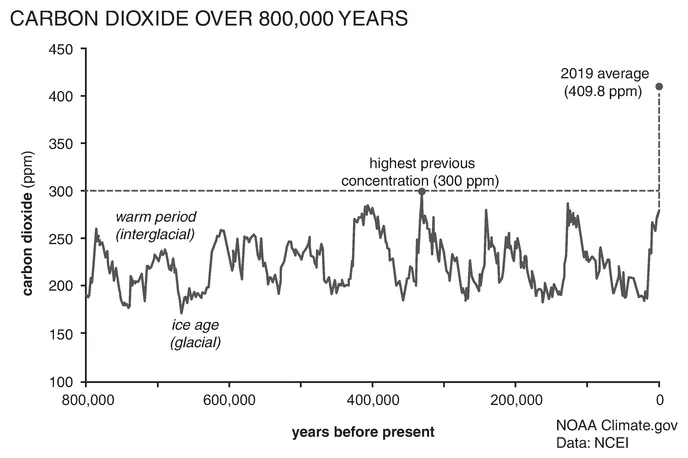
Climate data suggest that it might be too late for these goals already. According to the National Oceanic and Atmospheric Administration (NOAA) of the U.S. Department of Commerce, 2014–2020 were the seven warmest years since recordkeeping began, and global average temperature appears to have reached 1°C above pre-industrial levels already.6 Global annual mean atmospheric CO2 concentration now exceeds 410 parts per million (ppm).7 Atmospheric CO2 concentration is the single most important indicator for monitoring anthropogenic climate change. Its preindustrial level was 280 ppm, and according to ice core measurements, it has not exceeded 300 ppm during the last 800,000 years.8
Four years have passed since the initial draft of this chapter, so I keep having to update it with more bad news. It is now January 2021, exactly thirty years after Roland Clift’s fateful flight, and I am writing this final version at my desk at the University of California, Santa Barbara, with the Pacific Ocean visible through my office window on the left. California is trying to recover from the worst fire season it ever had; so is Australia.9 The American Southwest is in the iron grip of a persistent drought, but so is Germany.10 The year 2020 may be remembered as the year that climate change finally became an undeniable reality for most.
Figure 1.1 Atmospheric CO2 concentration
Source: (Image source: NOAA)11
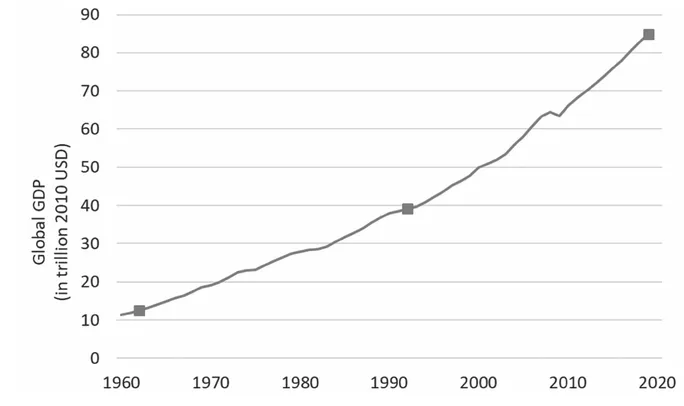
How can this dismal environmental record since the Rio Conference be reconciled with all the governmental and corporate sustainability efforts mentioned earlier? The short answer is growth. According to the World Bank, global gross domestic product (GDP) has more than doubled between 1992 and 2019, from 39 to 85 trillion 2010 USD.12 Be aware that for comparability all GDP values in this book are given in constant 2010 USD, since we want to compare the purchasing power of GDP not their nominal values. The nominal values get much smaller as you go back in time, since in 1962 one dollar bought much more than one dollar in 1992 and even more than one dollar today. For example, in 1962 the price of a McDonald’s hamburger was 15 cents. But back to the growth in global GDP. So, adjusted for inflation, the economic value of all goods and services produced annually today is over twice as much as it was in 1992. Let’s pause for a minute to take this in.
At the beginning of the 1990s, the United Nations (UN) became so worried about humankind’s trajectory that, in their own words, “the UN sought to help Governments rethink economic development and find ways to halt the destruction of irreplaceable natural resources and pollution of the planet.”13 There were good reasons for this sentiment. The thirty years since Silent Spring was published in 1962 had seen phenomenal economic growth, and the environmental consequences were impossible to ignore. In 1962, global GDP (in constant 2010 USD) was 13 trillion. In the thirty years between 1962 and 1992, it had thus tripled to 39 trillion. While the social benefits of this growth were undeniable, they were also distributed very unevenly. More importantly for this book, such enormous economic growth had created enormous environmental pressures. ‘Rethinking economic development’ seemed indeed called for.
By everyone’s account the Rio Conference was a huge wake-up call and a tremendous success. An entire encyclopedia could be filled with the governmental and corporate sustainability activities that have been undertaken and commitments that have been made since. Yet today, nearly thirty years after Rio, the world also produces goods and services every year that have well over twice the economic value of all goods and services provided during the year the Earth Summit took place. So, in tandem with all our environmental sustainability efforts we more than doubled annual economic output. This may have been a great thing for producers and consumers alike, but it was unlikely to be good news for the environment, which was already deemed in peril nearly thirty years ago.
Figure 1.2 Global gross domestic product (GDP)14
One positive development worth pointing out at this point is that the environmental impact per unit of GDP has been decreasing, at least for a number of important environmental indicators. This phenomenon is known as ‘decoupling’ between environmental impact and economic output. For example, the carbon intensity of the global economy, measured in grams of CO2 emitted per dollar GDP produced has decreased considerably since 1992, from 560 to 420 grams of CO2 per 2010 USD.15 Just seen on its own, this is a success story; a prime example and show case of decoupling. But by now you are probably already multiplying the carbon intensities of economic output with the global GDP numbers from the previous section in order to obtain global annual CO2 emissions.
I’m afraid your calculations are correct; between 1992 and 2019, global CO2 emissions went from 22 to 36 billion metric tons per year. With the global...

Table of contents

  1. Cover
  2. Half Title
  3. Title Page
  4. Copyright Page
  5. Dedication Page
  6. Table of Contents
  7. Preface
  8. Acknowledgments
  9. 1 Why less?
  10. 2 A brief history of business and the environment
  11. 3 It’s not easy being green when you’re color blind
  12. 4 The problem with eco-efficiency
  13. 5 Why win-win won’t work
  14. 6 The business of less
  15. 7 Again
  16. 8 Different
  17. 9 Less
  18. 10 Labor, not materials
  19. 11 Net green for business
  20. 12 Net green for households
  21. Index