Caroline Bartlett Crane's robust vision of women's work and her national impact as America's Housekeeper highlights the gendered nature of being a sociologist, a woman, and doing sociology. Contemporary sociologists are disconnected from their female predecessors. Like Sisyphus, each generation of sociologists is condemned to push the boulder of women's knowledge and experience back to the top of the patriarchal mountain of the discipline. Although women in sociology like Caroline Bartlett Crane, the subject of this book, have been brilliant social analysts and powerful public figures for over a century, their work is repeatedly ignored, forgotten, and lost. I hope that we can stop rolling this boulder up the mountain of male ignorance and control and see the world and new horizon from the mountaintop. Linda Rynbrandt's book helps anchor that boulder by analyzing sociology from a new location. Rynbrandt's perspective examines sociology through the work and life of Caroline Bartlett Crane, historical analysis, the political economy of the home, the gendered landscape of the Progressive Era, and feminist thought. Rynbrandt initiates this series on Women and Sociological Theory with an exciting subject and an innovative perspective connecting the past, present, and future.
eBook - ePub
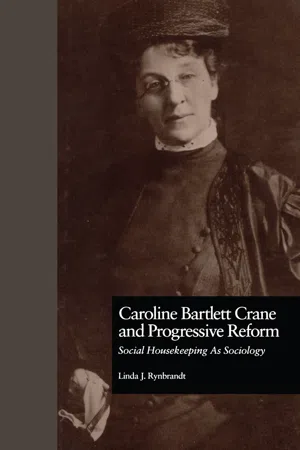
Caroline Bartlett Crane and Progressive Reform
Social Housekeeping As Sociology
- 192 pages
- English
- ePUB (mobile friendly)
- Available on iOS & Android
eBook - ePub
About this book
Information
CHAPTER 1
“Lost Women” in Social Thought and Action
DOI: 10.4324/9781315861111-1
INTRODUCTION
Progressivism and feminism were intertwined as social movements.
Nancy S. Dye, 1991
Some differences are playful; some are poles of world historical systems of domination. Epistemology is about knowing the difference.
Donna Haraway, 1990
Caroline Bartlett Crane was a trailblazer; a pioneer in sociology, municipal sanitation, religion, and the woman movement. Despite her national renown in the Progressive Era, she is largely forgotten today. Her sad historical fate is not unusual. The history of women and social change has long been “ignored, misrepresented, or repressed” because politics and social protest have traditionally been interpreted almost exclusively from the masculine perspective (West and Blumberg, 1990, p. 4). Now, however, there is an emerging feminist analysis of social reform and protest which has led to new theoretical and methodological approaches to the issue. The inclusion of formerly hidden women in the political analysis of social change illustrates the feminist contention that the “personal is political” and the political is personal (Rowbotham, 1997, p. 379).
Invisible Women in Sociology and Social Reform
Using the archival data of Unitarian minister and Progressive Era reformer Caroline Bartlett Crane (1858–1935), I investigate the relationship between Progressive Era (ca. 1890–1920) social reform and the origins of American sociology with a view to the vital contributions of women in these endeavors. Until recently, the role of women has been virtually invisible in accounts of Progressive reform. While this is no longer the case, considerable questions remain concerning what women accomplished, why they participated in social reform and how they succeeded in placing their social ideals within the center of a political system in which they were marginal (Tilly and Gurin, 1990; Frankel and Dye, 1991).
I examine the origins of American sociology at the University of Chicago and observe the claims that were advanced by the first generation of sociologists to legitimate the social construction of the discipline of sociology. Professional sociologists and social activists, though with different strategies and tactics, attempted to create a new and unique ideology. Within these milieux, I focus on Caroline Bartlett Crane, a student in the sociology department of the University of Chicago in 1896, to illustrate how the larger goals and vision of the pioneers of academic sociology were accomplished, not only in academe, but also in the so-called real world at the local level.
This research also addresses Crane’s role in the mobilization of “club-women” for the purposes of municipal reform at the local and national levels. I illustrate the dialectics of praxis in social reform, and assess the reform efforts of Progressive women in the little researched area of municipal sanitation. In order to address recent critiques of white middle-class Progressive women reformers, I utilize Crane’s private as well as her professional papers, to examine the personal motivations and inspirations behind the public actions and accomplishments. Finally, I analyze the relationship between images, ideology and agency in order to observe how women changed society from the political margins, and discuss the implications of political and social reform efforts in the past for contemporary political concerns.
Not only were women nearly invisible in conventional accounts of the Progressive period, but the role of women in the origins of the social sciences has also been obscured (Deegan, 1988, 1991; Platt, 1992; McDonald, 1994, 1995). In this study, I endeavor to address these questions and redress past oversights with a sociohistorical examination of the gendered nature of agency and structure in the Progressive Era. This makes it possible to recognize and acknowledge a legacy of women and reform in the past for women concerned with social thought and action today.
In addition, I contend that an investigation of the relationship between politics and the academy in the Progressive Era offers lessons for feminists, and others, interested in reconnecting social knowledge and social action today (Hartman and Messer-Davidow, 1991; Maynard and Purvis, 1994).
THEORETICAL/METHODOLOGICAL FRAME FOR TEXT
Feminist Debates: Epistemology/Methodology
Although this work is centered on an explicit feminist theoretical and methodological base, this approach is problematic. There is no consensus that a feminist theory/method is even possible. Sociologist Janet Chafetz promotes one definition of feminist theory. According to Chafetz a theory may be considered “feminist if it can be used to challenge, counteract, or change a status quo that disadvantages or devalues women” (quoted in Wallace, 1989, p. 10). Judith Grant (1993) contends that there is no one feminist theory, but feminist theory is multicentered and undefinable, divided according to its attachment to one of several male theories, making it a kind of a bandage on the misogynist canon of Western social thought (p. 1). Barbara Ryan (1992, p. 154) argues, as well, that there is no one feminist theory or movement. She contends that since the movement developed from several ideological perspectives, feminism has always consisted of diverse orientations. This is both a strength and a weakness for the women’s movement, and makes the issue of differences a major challenge for feminism in the present, just as it has been in the past.
Contesting views abound concerning feminist theory. Sociologist Charles Lemert (1994) contends that “feminist thought [is] the single most creative and challenging source of social thought there is (p. ix).” He argues that it can no longer be seen as preoccupied exclusively with women’s interests; as it has always been at odds with academic discourse and against the unspoken authority of mainstream social thought, feminist theory entails nothing less than a rethinking of authority. Lemert states that feminist theory today is not any one thing and offers an explanation why, accordingly, it is so intimidating to those who have read it just a little or not at all. Still, he insists it is one of the most important fields of social theory today (pp. x-xi).1
Trends and Debates in Feminist Theory
Many women (and men) a hundred years ago privileged differences between men and women. The second wave of feminist thought in the feminist thinking of the mid-1960s focused on the denial of differences (among women and between women and men). This perspective, in turn, evolved to a view that privileged gender differences again. The original focus of the second wave was on androgyny and/or women’s common identity of oppression under patriarchy (e.g., de Beauvoir, 1953; Millett, 1970; Firestone, 1970). This gave way, in a sizable segment of feminist thought, to a rejection of androgyny and led to a woman-centered perspective that viewed female/male differences not as the cause of women’s oppression, but rather as the seeds of women’s liberation (Eisenstein, 1983, p. xi).
However, the “undiffererentiated, undertheorized sisterhood” (Snitow, 1990. p. 16) of the second wave soon gave way to other differences, when lesbians, radical women and minority women expressed their rejection of a feminist movement dominated by educated, white, heterosexual women. If this were not enough, the sex-wars over the issue of pornography erupted in the feminist movement in the early 1980s. Conflicts developed around the axis of identity/difference, theory/methods, liberal/radical, academe/politics and equality/essentialism. These concerns mirror conflicts faced by women in the past who were influential in the foundations of modern feminism (Cott, 1987).
Equality versus difference is probably the oldest debate in feminist thought. It has haunted feminists from the first women’s movement in the last century, and is still problematic today. Feminists debated the issue when the Equal Rights Amendment (ERA) was first advanced in 1923, and women still question whether equality with men means equity for women (Cott, 1987). The question was a serious factor in the defeat of the ERA in 1982 (Mansbridge, 1986), and the debate continues today both between feminists and antifeminists, and within the women’s movement, as well. Much of this debate rests on the question of whether women are essentially different from men, and therefore due special privileges. Do they require exclusive protection, or should they be treated as equals in society and before the law? Women in the Progressive Era played with images of gender differences to both facilitate and oppose social reform.
Gender
In an important effort to define gender for contemporary feminist scholarship, historian Joan W. Scott (1986), suggests that gender be understood as a social rather than a biological depiction. She emphasizes the social construction of gender, and notes the power relationships implicit in the dynamics of gender. Crane’s era exemplifies tensions and transitions in gender roles, and Scott’s contentions regarding the situated and political nature of the concept of gender help clarify these changing symbols and beliefs regarding gender in the Progressive period.
Scott questions: “[W]hy (and since when) have women been invisible as historical subjects, when we know they participated in the great and small events of human history” (p. 1074). She concludes that:
political processes will determine which outcome prevails … political in the sense that different actors and different meanings are contending with one another for control. We can write the history of that process only if we recognize that man and woman are at once empty and overflowing categories. Empty because they have no ultimate, transcendent meaning. Overflowing because even when they appear to be fixed, they still contain within them alternative, denied, or suppressed definitions.
Political history has, in a sense, been enacted on the field of gender. It is a field that seems fixed yet whose meaning is contested and in flux, (ibid.)
Crane struggled with this same issue a century ago. In a speech before the American Congress of Liberal Religions, Crane (1894) noted:
When a child, I sometimes amused myself, foolishly enough, by repeating some familiar word or name over and over, until it was emptied of all real significance and became filled with some curious and perhaps uncanny meaning which its mere sound suggested to my fancy. Some such foolishness, I think, the world is now practicing upon the word “woman,” until the appellation that but just now conveyed an idea familiar enough to the world, has become the symbol for a great unknown quantity unknown—but not unknowable, if the world can help it. From her obscurity as a seldom commented upon member of the genus homo, she has been suddenly evoked by the spirit of the Nineteenth Century which discovered her, and invited everywhere to define herself sharply against the back-ground of the regnant sex; and it may be confessed that she has responded with no undue coyness or reluctance, (p. 18)
Although many women assumed that social change would result from the rhetoric of progress for women promoted by the Chicago World’s Fair in 1893, in reality Crane argued that women were still defined as the “other” and relegated to prescribed roles in society. Crane suggested that the category “woman” was both overdetermined and overlooked in society. For example, she chided her fellow clergy when she sarcastically noted:
The proposed nearer and more helpful fellowship in the thought and work of humanity is thus inaugurated by assigning one half of humanity to the pleasant and placating task of talking about itself for a few minutes before beginning the discussion of the subject for which the convention is called—after which that one half of humanity has no part nor recognition whatever in this council for uniting the culture and religious forces of the world…. I ask pardon. The ladies are permitted to give a reception in honor of the Congress, and to provide suitable refreshment for those who have gallantly and quite cheerfully borne the toils of thought and debate for them. (p. 19)
The debate over the category “woman” continues. Ann Snitow (1990) reflects on the divide in feminist thought and action between the need to recognize a common identity as woman and the need to abolish the category. She argues that the tensions between the need to “act as women and needing an identity not overdetermined by our gender … is as old as Western feminism” (p. 9). Critics of the social (de)constructionists have questioned whether they have undermined their own categories. What, they ask, is left to study if there is no category called “women” (p. 16). Snitow argues, however, that the tensions regarding differences in feminist thought are a dynamic force that links women. She believes that the “dynamic feminist divide is about difference; [yet] it dramatizes women’s differences from each other … and the necessity of our sometimes making common cause” (p. 30). Crane and women in the Progressive Era often faced and debated these same issues, and Crane’s archival papers offer intriguing insights into this continuous dilemma for feminist theorists.
Theory and Practice
The debate between theory and practice has also been a long-standing problem in the movement. Although feminist theorists have long stressed the necessity of a feminist theory (now theories) for feminist political action, many activists have viewed theory as esoteric at best, and useless at worst. Needless to say, the effort to integrate theory and practice has met with only partial success. Early socialist feminists and radical feminists attempted to incorporate theory with action, but with mixed, generally disappointing results. Presently, theory and action remain, for the most part, separate. Feminist theory has become entrenched in academe, where it has little impact on the feminist movement. Progressive women reformers, such as Crane, offer lessons concerning the relationship between social thought and action today.
Catherine MacKinnon (1993) argues that the contemporary feminist movement’s focus on consciousness-raising (CR), which emphasized the commonalities between women, created a new political practice and type of theory: “a form of actions carried out through words” (p. 369). However, feminist philosopher Nancy Tuana (1993, pp. 281–282) cautions that the critique of the concept of women is the paradox at the heart of feminism. She asks how feminists can recognize the importance of differences between women without losing sight of what they have in common, and she insists that feminists must abandon the quest for a unitary theory: one theory or method is not enough.2
Beyond the theory or theories debate in feminist work, there is also contention regarding methods. Shulamit Reinharz (1992) insists on feminist methods rather than a feminist method. She contends:
Instead of orthodoxy, feminist research practices must be recognized as a plurality. Rather than there being a “woman’s way of knowing,” or a “feminist way...
Table of contents
- Cover
- Half Title
- Series Page
- Title Page
- Copyright Page
- Contents
- Series Editor’s Foreword
- Preface
- Chapter 1: “Lost Women” in Social Thought and Action
- Chapter 2: The Life and Times of Caroline Bartlett Crane
- Chapter 3: Salvation, Sanitation and the Social Gospel
- Chapter 4: Images, Ideology and Networks in Progressive Reform
- Chapter 5: “America’s Housekeeper” Fights for Pure Food
- Chapter 6: Building the Progressive Dream: Designs for Reform
- Chapter 7: Public Visions and Private Nightmares
- Chapter 8: Conclusion: Beyond Women Lost and Found
- Appendix A: Feminist Theories/Methods and Sociology
- Appendix B: Methods
- Bibliography
- Index
Trusted by 375,005 students
Access to over 1.5 million titles for a fair monthly price.
Study more efficiently using our study tools.
Frequently asked questions
Yes, you can cancel anytime from the Subscription tab in your account settings on the Perlego website. Your subscription will stay active until the end of your current billing period. Learn how to cancel your subscription
No, books cannot be downloaded as external files, such as PDFs, for use outside of Perlego. However, you can download books within the Perlego app for offline reading on mobile or tablet. Learn how to download books offline
Perlego offers two plans: Essential and Complete
- Essential is ideal for learners and professionals who enjoy exploring a wide range of subjects. Access the Essential Library with 800,000+ trusted titles and best-sellers across business, personal growth, and the humanities. Includes unlimited reading time and Standard Read Aloud voice.
- Complete: Perfect for advanced learners and researchers needing full, unrestricted access. Unlock 1.5M+ books across hundreds of subjects, including academic and specialized titles. The Complete Plan also includes advanced features like Premium Read Aloud and Research Assistant.
We are an online textbook subscription service, where you can get access to an entire online library for less than the price of a single book per month. With over 1.5 million books across 990+ topics, we’ve got you covered! Learn about our mission
Look out for the read-aloud symbol on your next book to see if you can listen to it. The read-aloud tool reads text aloud for you, highlighting the text as it is being read. You can pause it, speed it up and slow it down. Learn more about Read Aloud
Yes! You can use the Perlego app on both iOS and Android devices to read anytime, anywhere — even offline. Perfect for commutes or when you’re on the go.
Please note we cannot support devices running on iOS 13 and Android 7 or earlier. Learn more about using the app
Please note we cannot support devices running on iOS 13 and Android 7 or earlier. Learn more about using the app
Yes, you can access Caroline Bartlett Crane and Progressive Reform by Linda J. Rynbrandt in PDF and/or ePUB format, as well as other popular books in Social Sciences & North American History. We have over 1.5 million books available in our catalogue for you to explore.