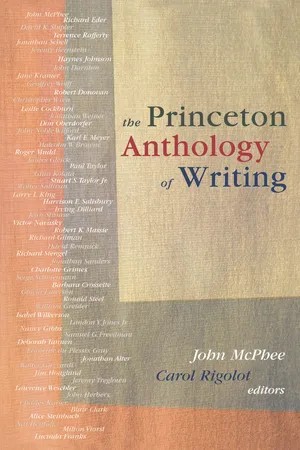
In 1957--long before colleges awarded degrees in creative nonfiction and back when newspaper writing's reputation was tainted by the fish it wrapped--Princeton began honoring talented literary journalists. Since then, fifty-nine of the finest, most dedicated, and most decorated nonfiction writers have held the Ferris and McGraw professorships. This monumental volume harbors their favorite and often most influential works. Each contribution is rewarding reading, and collectively the selections validate journalism's ascent into the esteem of the academy and the reading public.
Necessarily eclectic and delightfully idiosyncratic, the fifty-nine pieces are long and short, political and personal, comic and deadly serious. Students will be provoked by William Greider's pointed critique of the democracy industry, eerily entertained by Leslie Cockburn's fraternization with the Cali cartel, inspired by David K. Shipler's thoughts on race, unsettled by Haynes Johnson's account of Bay of Pigs survivors, and moved by Lucinda Frank's essay on a mother fighting to save a child born with birth defects. Many of the essays are finely crafted portraits: Charlotte Grimes's biography of her grandmother, Blair Clark's obituary for Robert Lowell, and Jane Kramer's affecting story of a woman hero of the French Resistance.
Other contributions to savor include Harrison Salisbury on the siege of Leningrad, Landon Jones on the 1950s, Christopher Wren on Soviet mountaineering, James Gleick on technology, Gloria Emerson on Vietnam, Gina Kolata on Fermat's last theorem, and Roger Mudd on the media. Whether approached chronologically, thematically, randomly, or, as the editors order them, more intuitively, each suggests a perfect evening reading.
Designed for students as well as general readers, The Princeton Anthology of Writing splendidly attests to the elegance, eloquence, and endurance of fine nonfiction.
eBook - ePub
The Princeton Anthology of Writing
Favorite Pieces by the Ferris/McGraw Writers at Princeton University
- 392 pages
- English
- ePUB (mobile friendly)
- Available on iOS & Android
eBook - ePub
The Princeton Anthology of Writing
Favorite Pieces by the Ferris/McGraw Writers at Princeton University
About this book
Information
Publisher
Princeton University PressYear
2021Print ISBN
9780691086811
9780691086804
eBook ISBN
9780691236865
John McPhee is a New Yorker staff writer and author of more than 25 books. Since 1975 he has been a Ferris Professor of Journalism at Princeton, teaching a writing course called The Literature of Fact. This piece about Plymouth Rock is in the collection Irons in the Fire (The Noonday Press, Farrar, Straus and Giroux, 1997).
Travels of the Rock
Plymouth Rock is a glacial erratic at rest in exotic terrane. When Mayflower, an English merchant ship, approached the rock, in 1620, the rock, like the ship, had recently been somewhere else. Heaven knew where. Some geologists have said that the rock is Laurentian granite, from north of the St. Lawrence River (Loring, 1920). Most American geologists have preferred a provenance closer to home: Cape Ann, for example, north of Boston (Carnegie Institution, 1923); or the region of Cohasset, south of Boston (Shimer, 1951); or even the bed of Plymouth Bay (Mather, 1952). Wherever the boulder came from, it was many times larger in 1620 than it is today.
It was also in one piece. In 1774, the rock was split in two, horizontally, like a bagel. There were those who feared and those who hoped that the break in the rock portended an irreversible rupture between England and the American colonies. If so, the lower half was the Tory half, for it stayed behind, while the upper part was moved from the harborside to Liberty Pole Square for the specific purpose of stirring up lust for independence. Scarce was independence half a century old when a new portentous split occurred, in the upper, American, rock. It broke, vertically, into two principal parts, shedding fragments to the side. Eventually, the two halves of the upper part were rejoined by common mortar, containing glacial pebbles from countless sources, and the rock as a whole was reconstructed. The upper part was returned to the waterfront, where a thick filling of mortar was slathered on the lower part, and Plymouth Rock—with its great sutured gash appearing like a surgical scar—was reassembled so that it would be, to whatever extent remained possible, a simulacrum of the landmark that was there in 1620.
In the course of the twentieth century, the mortar did not hold. Pebbles fell out. Chunks. Despite a canopy over the rock (McKim, Mead & White, 1921), water got into the great crack, froze, and wedged against the bonding force with pressures as high as two thousand pounds per square inch. The rock could not stay whole, and on August 7, 1989, in an item disseminated by the Associated Press, the Massachusetts Department of Environmental Management announced that the oldest symbol of the New World was in dire need of a mason.
IN THE British merchant marine, Mayflowers were numerous. The one that approached the landmark in Plymouth Bay that December was twelve or so years old, and had, for the most part, carried wine to England from Bordeaux. Her new assignment was equally commercial. When she sailed from Devon, she was under instructions to go to the mouth of the Hudson River, where her passengers, under a seven-year contract with investors in London, would warehouse timber, furs, and fish. She was meant to land on New York rock, but she missed. After a crossing of nine stormy weeks, she came upon Cape Cod. She dropped anchor in the cape’s sheltered bay and spent a month there while a number of passengers, including William Bradford, went ashore to reconnoitre the cape’s resources. In the woods one day, Bradford noticed a sapling bent over like a dancer touching the ground. Acorns were strewn beneath the sapling. Bradford moved close, too close, and “it gave a sudden jerk up, and he was immediately caught by the leg” (Mourt, 1622). The noose that caught him was state of the art by English standards, and so was the rope. In their searches the explorers found stored corn in buried baskets, which they took for their own use. They opened the grave of a child. “About the legs and other parts of it was bound strings and bracelets of fine white beads; there was also by it a little bow, about three quarters long, and some other odd knacks. We brought sundry of the prettiest things away with us, and covered the corpse up again.” Before the sun had set four times, “arrows came flying amongst us.”
In a small sloop, a scouting party sailed west, into a gale that broke the boat’s rudder and shattered the mast. Nonetheless, they found what is now Plymouth Harbor, climbed to the high defendable ground behind it, discovered a sweet brook and deserted fields. This was not the “rockbound coast” that poetry and fiction would claim it to be. The shore was sandy. It was a beach. It was a long strand of wave-sorted till with almost no rocks of any size. A most notable exception was a big boulder of more than two hundred tons, alternately washed and abandoned by the cycle of the tides—a rock so prominently alone that from across water it would have looked like a house.
Bradford, Carver, Standish, Winslow, Howland, and the others—the exploring party—sailed back to Cape Cod to inform the Mayflower company that they had chosen a site for the plantation. They learned that Bradford’s wife, Dorothy, had gone over the side of the ship and had drowned. She was one of four who died before the ship reached Plymouth. To get ashore on the cape, the people had to wade in several feet of water. Temperatures were often below the freeze point. Rain and spray formed ice on their clothing. Most of the children as well as the adults had colds, coughs, pneumonic symptoms that plunged into scurvy. On that gray water under gray sky—under wind and through snow—the land around them must have seemed less than promised. Dorothy Bradford was an apparent suicide. There had been a hundred and two passengers in all. One by one, across the next few months, forty-seven more would die.
A few days before Christmas, the ship entered Plymouth Harbor and approached the site near the mouth of the brook, the landmark rock below the foot of the hill. Most of the people lived on the ship until the end of March, routinely coming and going to trap or hunt or work on the initial construction. The brook, entering the bay, had cut a channel in the otherwise shallow water. The channel turned north, paralleled the shore, and ran close to the seaward side of the great rock. For two hundred years, oceangoing vessels would use this channel.
AFTER THE theory of continental glaciation was developed and accepted, in the nineteenth century, geologists reviewing the story of Plymouth took pleasure in pointing out that the rock had travelled, too: “The Pilgrims’ Rock is . . . itself an older pilgrim than those who landed on it” (Adams, 1882). “Plymouth Rock is a bowlder from the vicinity of Boston, having accomplished its pilgrimage long before the departure of the Mayflower from Holland” (Wright, 1905, “The Ice Age in North America and Its Bearings Upon the Antiquity of Man”).
A headline in the New York Times of October 25, 1923, said:
PLYMOUTH ROCK CANADIAN
What followed was a summary of confident assertions emanating from the Geology Department of the University of Rochester. The news caused the Acting Governor of Massachusetts to schedule hearings. The news caused Charles E. Munroe, the chairman of the Committee on Explosives Investigations, of the National Research Council, in Washington, to write a “PERSONAL—Confidential” letter to Robert Lincoln O’Brien, the editor of the Boston Herald, seeking his assistance in developing an investigation that would yield “more complete knowledge of the rock” and, fortuitously, “trace its origin to some other locality than Canada, thus greatly relieving the minds and assuaging the feelings of many, not only within New England but without.”
What Munroe wanted was a piece of the rock. He wanted to place a hand specimen in the hand of Henry S. Washington, petrologist, geologist, geochemist, of the Carnegie Institution’s Geophysical Laboratory. O’Brien, in turn, put the request to Arthur Lord, the president of the Pilgrim Society, in Plymouth. Lord replied that the rock had been studied by geologists and identified as syenite. Syenite? said Munroe to Henry Washington. Where could that be from? Montreal, said Henry Washington. Or half a dozen places in Ontario. He also identified possible sources in Vermont, New Hampshire, Maine, and Massachusetts, including Cape Ann. Cape Ann was the likeliest of this lot. Large boulders glacially transported are seldom moved very far.
When the theory of plate tectonics congealed in the late nineteen-sixties, it opened corridors of thought that have led to a complete revision of the geologic history of New England, where, it now appears, there is enough alien rock to effect the total detonation of the late chairman of the Committee on Explosives Investigations if he were here to hear about it. The short travels of glacial boulders are ignored by these new insights. In present theory, New England’s very bedrock has come from overseas.
In Reston. Virginia, not long ago, at the headquarters of the United States Geological Survey, E-an Zen invited me to have a look at a snapshot taken from a space shuttle a hundred and sixty miles above Plymouth. The picture was nine inches high and eighteen wide. It had been made with a Large Format Camera. As with the old view cameras from the era of Mathew Brady, the negative was as large as the print. With a casual glance, you could see at once the region the picture covered. You could see Lake George, in the Adirondacks. You could see Vermont lakes, the Connecticut River, Narragansett Bay, and Cape Cod. But the picture was of such small scale—from eight hundred and forty-five thousand feet—that most of it seemed to the unaided eye a swirl of white patches in varying abstracts of gray. It covered, after all, at least twenty-four thousand square miles. Zen handed me a Hastings Triplet, a ten-power lens that geologists hold close to outcrops and specimens in order to study crystals. He put his finger on the edge of Massachusetts Bay, and said, “Look there.” I leaned close to the photograph, as if it were a rock, and saw stripes at the head of a runway at Logan Airport. Moving the lens down the coast, I saw the breakwater in Plymouth Harbor. I saw Town Brook, Town Wharf, State Pier, and Coles Hill. I did not see Plymouth Rock, because of the canopy above it. On the shore of a Vermont lake I saw a small outcrop called White Rock, which I knew from childhood. Zen also had a picture that reached from Montreal to the Maine coast. I saw the house of a friend of mine on Mount Desert Island. I saw a fourteen-acre island in Lake Winnipesaukee, where I fish for chain pickerel in the fall. I saw smoke drifting away from the weather station at the summit of Mt. Washington.
After I put down the hand lens and leaned back, Zen asked if I could discern in the unmagnified pictures variations in texture from one area to another. I said I could. The country east of the Penobscot River, for example, differed from the country to the west as, say, burlap differs from tweed. Most variations were more subtle. On those pictures, from that altitude, the differences were no greater than the differences that sometimes occur on the surface of a calm lake. But the differences were there. New England appeared to consist of several swaths, as much as a hundred miles wide and more or less parallel to the seacoast. Zen was sporting a pleased grin. The large-format photographs seemed to illustrate conclusions he had reached from paleomagnetic, petrologic, structural, and seismic data interpreted in the light of plate tectonics, and in no way refuted by paleontology. Placing a finger on each side of the Penobscot River, he said those differing textural bands were exotic terranes.
As plate theorists reconstruct plate motions backward through time, they see landmasses now represented by Europe and Africa closing together with North America during the Paleozoic Era. These were the assembling motions that produced the great continent Pangaea. Much more recently, western Pangaea split apart to form the Atlantic Ocean, which is young, and is widening still. The ocean that was closed out in the making of Pangaea—the older ocean, the ancestral Atlantic, which used to be approximately where the Atlantic is now—is commonly called Iapetus, since Iapetus was the father of Atlas, and plate theorists, in studied humility, thus record their debt to mythology. The collision, as Zen and others see it in the rock they study and the data they otherwise collect, was not a simple suture of the two great sides. There were islands involved, and island arcs—Madagascars, New Zealands, Sumatras, Japans. “They were large islands in an ocean of unspecified size,” he said. “Islands like Newfoundland.” Some of them may have amalgamated while still standing off in the ocean. Some not. In one way or another, they were eventually laminated into Pangaea, and slathered like mortar between the huger bodies of rock.
A couple of hundred million years later, as the Atlantic opened, bits and pieces of original America stuck to Europe and rode east. The Outer Hebrides, for example, are said to derive from the northern North American continental core.
HEBRIDES CANADIAN
The converse was true as well. Stuck to North America, fragments of Europe stayed behind. Baltimore, for example. Nova Scotia. A piece of Staten Island. The part of Massachusetts that includes Plymouth and Boston is now understood to derive from overseas. If from Europe, part of New England could be part of Old England, a New Old England in an Old New England or an Old Old England in a New New England. The Mayflower people landed where they left.
AROUND eight one morning in mid-November of 1989, Paul Choquette, of South Dartmouth, Massachusetts, who had been selected only three days earlier as Mason to the Rock, arrived in Plymouth under considerable pressure to get the repair work done well before Thanksgiving, which was eight days away. He showed up in a U-Haul truck with Nebraska license plates and this message emblazoned on the sides: “ONE-WAY & LOCAL/ADVENTURE IN MOVING.” Choquette was a trim man in his forties, with green eyes, dense brown hair, a loose, lean frame, and the serious look of a concentrating golfer. There was, as well, resemblance to a golfer in his roomily draped wine-red sweater, in his striped collar hanging free, less so in his bluejeans and his white running shoes. He had with him his entire family and then some. He had Jonathan, Jennifer, Elizabeth, and Tim—his children, twelve to twenty-one. He had his brother-in-law, Richard Langlois, and Richard’s six-year-old, Ian, who said, “Why is this important? There’s no such thing as Pilgrims.”
Mark Cullinan, the chief engineer of the Department of Environmental Management, remarked that Choquette’s task would be something like taking the tonsils out of the President of the United States—a relatively minor operation that nonetheless required someone of more than ordinary skill in the art. Moreover, the work would be accomplished with a lot of people watching: the public and the media, not to mention Paul Botelho, Cullinan’s assistant chief engineer; Ruth Teixeira, the Region I regional engineer; Ronald Hirschfeld, a geotechnical consulting engineer; Chris Green, a landscape architect of the Office of Cultural and Historic Landscapes of the Department of Environmental Management; Peter O’Neil, the departmental press secretary; Shelley Beeby, the deputy commissioner of communications; and Donald Matinzi, of Plymouth, the park supervisor.
This was a day of chilling, intermittently heavy rain, and no one was sorry to be standing inside the McKim, Mead & White portico, which is locally known as the cage. It’s a bit like a Bernese bear pit. Granite walls enclose the rock on three sides. The fourth side, through iron grillwork, is open to the sea. The entablature is supported on twelve tall columns, and is six feet thick, or thick enough to block rain. Under it, visitors stand behind iron railings looking down at the rock on its patch of beach.
The rock has become fairly round and has a diameter varying from five and a half to six and a half feet. Early in the eighteenth century, it was measured for purposes of a town plat, with the resulting description that the “Grate Rock yt lyeth below Ye sd Way from ye stone at ye foot of The hill neare the Southerly Corner of John Ward’s land is :30: foot in width” (Plymouth Records, 1715-16). What you see now weighs only four tons. The lower, buried part is larger. Spring tides climb into the cage and far up the rock. Nor’easters drive seas against it as well. When trucks go by on Water Street, the rock shakes.
The rock is filled with xenoliths—alien and black. They are stones, cobbles, hunks of older rock that fell into the larger mass while it was still molten or, if cooler than that, sufficiently yielding to be receptive. The xenoliths are like raisins in a matrix of bread. The rock is crisscrossed with very narrow, very straight veins of quartz. At some point in the nineteenth century, it cracked along one or two of these veins.
On the seaward side, the old repair was in particular need of attention. The national treasure looked sorry indeed, like twice-broken crockery. After the news of its condition went out on the A.P., epoxy-makers all over the country offered their expertise free of charge. But Cullinan decided that high-strength epoxy was too much of a high-tech solution. To get rid of it, if that should ever be necessary, you would have to destroy rock.
Mortars can be mixed that look like stone. In other words, despite the fact that the great crack was as wide as a python, an effort could be made to fool the public into thinking it wasn’t there. Cullinan rejected that idea, too. The remaining choice—other than leaving the rock alone—was to chip out the old mortar and replace it.
Choquette climbed down into the cage with so many others that they did suggest a surgical team. He had his duckbill chisel, his cold chisels, his brick hammer, his five-pound hammer, his three-pound hammer, his paintbrushes, his wire brushes, his cord, his trowels, his wrenches, and his two sons. His brother-in-law stacked three planks against the iron grillwork on the seaward side and wrapped a rubber sheet around them in anticipation of the rising tide. It was a day of full moon.
Choquette went at the crack with a chisel. Tap. Tap. Ta-tap-tap-tump. He said, “Listen to that void!” Bits of mortar flew away. The opening widened. After a couple of hundred taps, he reached in and pulled seaweed out of Plymouth Rock. It was dry, and looked like twigs and straw. It came out of the interior like mattress stuffing.
He said the old mortar was very hard—“a lot of Portland and not much lime.” In replacing it, he would use four parts pulverized stone and four parts aggregate with one part lime (for plasticity). He would clean the crack with Detergent 600. He would put his new mortar in and, twenty minutes later, wash it with a hose and brush it. This would get rid of lime that tends to come to the surface. It would make the mortar darker, and also cause it to blend better into the pores of the rock.
To show to anyone who might be interested, he had a yogurt cup full of the pulverized stone. It came from a quarry in Acushnet, he said. Acushnet, Massachusetts, next to New Bedford, sits on hundreds of feet of long-transport glacial till. It is probable that the shards of rock going into Choquette’s mortar came from three or four New England states and much of eastern Canada, an...
Table of contents
- Cover Page
- Title Page
- Copyright Page
- John Mcphee: Preface
- Contents
- David K. Shipler: Beauty for Ashes
- Jonathan Schell: A View of Mountains
- Haynes Johnson: The Boat
- Jane Kramer: Joséphine Guezou
- Robert Donovan: Twentieth-Century Odyssey
- Don Oberdorfer: A Farewell to Hue
- Leslie Cockburn: Looking for Trouble
- Karl E. Meyer: The Forthright Estate: In Praise of the Newspaper Column
- Roger Mudd: Code of Ethics
- Paul Taylor: Father of His Country
- Stuart S. Taylor Jr.: Workplace Discrimination
- Larry L. King: Driver’s Education
- Irving Dilliard: People and Character
- Victor Navasky: Saving The Nation
- Richard Gilman: Faith, Sex, Mystery
- Richard Stengel: My Own Vox Pop
- Charlotte Grimes: The Country Is at Crisis Point
- Barbara Crossette: All Sentient Beings
- Ronald Steel: When Worlds Collide
- Isabel Wilkerson: First Born, Fast Grown: The Manful Life of Nicholas, 10
- Nancy Gibbs: Massacre at Columbine High School
- Deborah Tannen: Gender in the Classroom
- Jonathan Alter: Cop-Out on Class: Why Private Schools Are Today’s Draft Deferments
- Jim Hoagland: Two of a Kind
- Lawrence Weschler: Why I Can’t Write Fiction
- Blair Clark: On Robert Lowell
- Alice Steinbach: The Miss Dennis School of Writing
- Milton Viorst: Meeting Mahfouz
- Richard Eder: Critic’s Notebook
- Terrence Rafferty: L'Atalante
- Jeremy Bernstein: Annie of Corsica
- John Darnton: Two Deaths—One Then, One Now: On Losing a Father, a Newspaperman
- Geoffrey Wolff: Heavy Lifting
- Christopher Wren: Lenin Peak
- Jonathan Weiner: From So Simple a Beginning
- John Noble: Wilford Pioneer 10 Pushes Beyond Goals, Into the Unknown
- Malcolm W. Browne: Left the Light On, But Nobody Came
- James Gleick: Manual Labor
- Gina Kolata At Last, Shout of “Eurekal” in Age-Old Math Mystery
- Walter Sullivan: What If We Succeed?
- Harrison E. Salisbury: Deus Conservat Omnia
- Jean Strouse: Introduction to Morgan, American Financier
- Robert K. Massie: Down Twenty-Three Steps
- David Remnick: The Forest Coup
- Jonathan Sanders: Pictures from the Rubble Patch
- Serge Schmemann: A Corner of Russia
- Gloria Emerson: Goodbye to Rafah
- William Greider: Mock Democracy
- Landon Y. Jones Jr.: The Big Barbecue
- Samuel G. Freedman: The Rope Line
- Francine Du Plessix Gray: Nixonland
- Walter Guzzardi: Consultants: The Men Who Came to Dinner
- Jeremy Treglown: Class Act
- John Herbers: The New American Heartland
- Charles Kaiser: The 1950s
- Nat Hentoff: Jazz: Music Beyond Time and Nations
- Lucinda Franks: Miracle Kid
- John Mcphee: Travels of the Rock
- Acknowledgments
- Author Index
Trusted by 375,005 students
Access to over 1.5 million titles for a fair monthly price.
Study more efficiently using our study tools.
Frequently asked questions
Yes, you can cancel anytime from the Subscription tab in your account settings on the Perlego website. Your subscription will stay active until the end of your current billing period. Learn how to cancel your subscription
No, books cannot be downloaded as external files, such as PDFs, for use outside of Perlego. However, you can download books within the Perlego app for offline reading on mobile or tablet. Learn how to download books offline
Perlego offers two plans: Essential and Complete
- Essential is ideal for learners and professionals who enjoy exploring a wide range of subjects. Access the Essential Library with 800,000+ trusted titles and best-sellers across business, personal growth, and the humanities. Includes unlimited reading time and Standard Read Aloud voice.
- Complete: Perfect for advanced learners and researchers needing full, unrestricted access. Unlock 1.5M+ books across hundreds of subjects, including academic and specialized titles. The Complete Plan also includes advanced features like Premium Read Aloud and Research Assistant.
We are an online textbook subscription service, where you can get access to an entire online library for less than the price of a single book per month. With over 1.5 million books across 990+ topics, we’ve got you covered! Learn about our mission
Look out for the read-aloud symbol on your next book to see if you can listen to it. The read-aloud tool reads text aloud for you, highlighting the text as it is being read. You can pause it, speed it up and slow it down. Learn more about Read Aloud
Yes! You can use the Perlego app on both iOS and Android devices to read anytime, anywhere — even offline. Perfect for commutes or when you’re on the go.
Please note we cannot support devices running on iOS 13 and Android 7 or earlier. Learn more about using the app
Please note we cannot support devices running on iOS 13 and Android 7 or earlier. Learn more about using the app
Yes, you can access The Princeton Anthology of Writing by John McPhee, Carol Rigolot, John McPhee,Carol Rigolot in PDF and/or ePUB format, as well as other popular books in Literature & North American Literary Collections. We have over 1.5 million books available in our catalogue for you to explore.