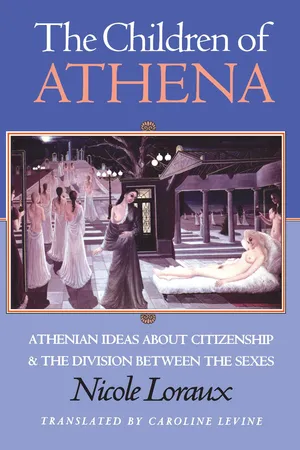
According to one myth, the first Athenian citizen was born from the earth after the sperm of a rejected lover, the god Hephaistos, dripped off the virgin goddess Athena's leg and onto fertile soil. Henceforth Athenian citizens could claim to be truly indigenous to their city and to have divine origins that bypassed maternity. In these essays, the renowned French Hellenist Nicole Loraux examines the implication of this and other Greek origin myths as she explores how Athenians in the fifth century forged and maintained a collective identity.
eBook - ePub
The Children of Athena
Athenian Ideas about Citizenship and the Division between the Sexes
- 296 pages
- English
- ePUB (mobile friendly)
- Available on iOS & Android
eBook - ePub
The Children of Athena
Athenian Ideas about Citizenship and the Division between the Sexes
About this book
Information
Publisher
Princeton University PressYear
2021Print ISBN
9780691037622
9780691032726
eBook ISBN
9780691236834
I
ATHENIANS AND WOMEN

1

Autochthony: An Athenian Topic
MYTH HAS A ROLE to play in the polis, whether the city is confronting itself or other poleis. It is a key element in the ideological warfare that pits cities against one another, or it is a foundation for symbolic representations of collective unity.1 Myth thus acquires a history. Mythologists may not like the idea, and neither may historians, but it is a history nevertheless—one that crosses paths with the political, social, and ideological history of the collective. Above all, myth acquires its place because it conducts a discourse in the city—for the city—as one of the inner voices of the political imaginary. Mythic schemes mold and legitimate the civic experience; they are always already there, but also always brought up to date. The polis makes use of them, but perhaps also yields to the persuasive voices of these ancient tales.
Thus, Athenian myths of autochthony provide an effective topos for more than one kind of civic discourse, whether used to legitimate the hegemony of Athens or to supply a timeless foundation for an Athenian ideology of citizenship.2 From the perspective of an official narcissism, there is, in effect, no citizen who is not an autochthon (auto-chthōn: born from the soil itself of the fatherland).3 Two versions coexist in the heart of the city: an unmediated autochthony, ascribed in the funeral oration to all Athenians collectively, and a derived one, inherited from the paradigmatic autochthony of their ancestor Erichthonios. Yet the versions agree in their declaration that the citizens of Athens root their origins in the Athenian earth because the earth produced the first Athenian citizen. This is clearly a discourse, first of all, for internal usage, since its entire aim is to proclaim the singularity of Athens and its andres, not to be confused with a myth of the origin of all humankind (anthrōpoi).4
The myth of Erichthonios (the miraculous child born from the earth, made fertile by Hephaistos's desire for the virgin Athena) thus offers the Athenians a certain language for speaking about the origin of their city—and for speaking about its name as well.
Erichthonios, or Erechtheus, is the eponymous hero; more precisely, from Homer to tragedy and from Herodotus to the Attidographers, he is the one who gives Athens its name.5 A strange eponym, to be sure, since the Athenians call themselves Erechtheids only in the language of poetry.6 Indeed, a strange eponym because Erechtheus does not give his own name to the city, but rather that of his protector, Athena (certainly a prestigious enough title). We will return to this subject. Let us note from the outset that there is another version of the story in which, in much more distant times, even more primordial than those of Erichthonios, it is the goddess herself who gives the city her own name as the result of a quarrel with Poseidon over possession of Attica.7 Yet it is important that another autochthonous figure plays a prominent part in this whole affair: Kekrops, "the first king of Athens," is the witness or the arbiter of this divine eris, the struggle that makes the city into the domain of Athena.
Kekrops, the first king; Erichthonios, the second king but the first Athenian. Kekrops reigns and establishes order in a land that is barely civilized; Erichthonios, as in Herodotus, exercises a power that is already political.8 Do we have a rivalry, then, between the two autochthons?9 Given the way in which the tradition insists on dividing the tasks between Kekrops and Erichthonios, it would be better to speak of a doubling of the story of origins—the origins of civilized order and the origins of political order. To account for this situation, must we embark on a mythic history of the first days of Athens? Such a project, I think, would not be unreasonable, for to a reader of myths who has a historical bent, it looks as though we have something like an evolution or a development over time: first Kekrops, then Erichthonios. But is this what the myth of autochthony meant to the city of Athens?
The historicist perspective certainly does not lack supporters among either the ancients or the moderns, and, from Herodotus to Jane Harrison, there have been historians to observe that Kekrops, the civilizing hero in whom man is still barely separable from beast—proven by his double form as a diphyēs, half-man, half-snake—can be, at most, the king of a region called Kekropia, and not the king of the Athenian polis.10 To be sure, in their zeal to write the primitive "history" of the gods and heroes of the primordial Acropolis (or even that of Athena's belated arrival on her rock), some modern scholars have taken great pleasure in charting this history of Athenian names.11 This was a favorite project of mythographers of the Hellenistic period, who, taking their lead from the historians, tried to push both the emergence of the city's name and the moment of its foundation ever further back in time.12 From this perspective, Erechtheus, or Erichthonios, is no more than an important link in a genealogical chain that leads from Kekrops right down to Theseus, from the primordial rival to the rival who is almost "historical," whose synoecism would finally and truly make Athens into a polis. But in telling a story of unification, synoecism lacks the same unifying power as the myth of autochthony, which posits an original unity of the polis. For the citizens of Athens, who live in the city or in rural demes,13 the "ingathering of demes" is only a historicolegendary event, which can be glorified or belittled, sometimes even opposed to autochthony, 14 but nothing essential is changed because this event does not happen within the same period as the foundation of the city: the goddess was installed on the Acropolis "well before synoecism."15 Indeed, she had been there forever, ever since Athens was Athens. One can indeed give ancient Attica the name Kekropia, as long as it is clear that this is only another name—even a borrowed one16—for the city of Athena and Erechtheus.17 In short, in contrast to this quasi history and its ever more numerous mediations, the myth of autochthony tells how Athens has been Athens since its origin.18
The time of Kekrops and that of Erichthonios are condensed into the arrested moment of a miraculous birth, the period of transition, when the only king on the barely civilized earth is a twofold creature, and when human time is that of the autochthonous child who will later found the Panathenaea. Numerous figural representations attest to this moment, depicting Kekrops in the central role of witness at the birth of Erichthonios; texts attest to it as well, by the frequent association of the two stories within a mythic complex, in which the birth of the first Athenian fits perfectly naturally into the primordial period of the distribution of timai among the gods—when Athens was given to Athena.19
Thus, autochthony supplies a mythic starting point (archē) for a history of the city that is not really very "historical." When, on a cup in Berlin, for instance, the Kodros Painter compresses four generations of Athenian kings into a timeless present, merging what came before and after in the assemblage of Kekrops, Erechtheus, and Aegeus around the infant Erichthonios,20 he hardly claims less than the official orator does in his funeral eulogy, when he establishes the roots of democracy in autochthonous origins,...
Table of contents
- Cover Page
- Title Page
- Copyright Page
- Contents
- List of Illustrations
- Foreword
- Introduction
- I. Athenians and Women
- Il. Reality, Fiction: Women of Athens
- Epilogue: Once Again, The Woman, The Virgin, Female Athenians
- Bibliography
- Index
Trusted by 375,005 students
Access to over 1.5 million titles for a fair monthly price.
Study more efficiently using our study tools.
Frequently asked questions
Yes, you can cancel anytime from the Subscription tab in your account settings on the Perlego website. Your subscription will stay active until the end of your current billing period. Learn how to cancel your subscription
No, books cannot be downloaded as external files, such as PDFs, for use outside of Perlego. However, you can download books within the Perlego app for offline reading on mobile or tablet. Learn how to download books offline
Perlego offers two plans: Essential and Complete
- Essential is ideal for learners and professionals who enjoy exploring a wide range of subjects. Access the Essential Library with 800,000+ trusted titles and best-sellers across business, personal growth, and the humanities. Includes unlimited reading time and Standard Read Aloud voice.
- Complete: Perfect for advanced learners and researchers needing full, unrestricted access. Unlock 1.5M+ books across hundreds of subjects, including academic and specialized titles. The Complete Plan also includes advanced features like Premium Read Aloud and Research Assistant.
We are an online textbook subscription service, where you can get access to an entire online library for less than the price of a single book per month. With over 1.5 million books across 990+ topics, we’ve got you covered! Learn about our mission
Look out for the read-aloud symbol on your next book to see if you can listen to it. The read-aloud tool reads text aloud for you, highlighting the text as it is being read. You can pause it, speed it up and slow it down. Learn more about Read Aloud
Yes! You can use the Perlego app on both iOS and Android devices to read anytime, anywhere — even offline. Perfect for commutes or when you’re on the go.
Please note we cannot support devices running on iOS 13 and Android 7 or earlier. Learn more about using the app
Please note we cannot support devices running on iOS 13 and Android 7 or earlier. Learn more about using the app
Yes, you can access The Children of Athena by Nicole Loraux, Caroline Levine in PDF and/or ePUB format, as well as other popular books in History & Greek Ancient History. We have over 1.5 million books available in our catalogue for you to explore.