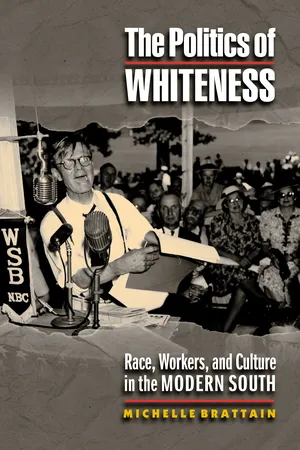
The Politics of Whiteness presents the first sustained analysis of white racial identity among workers in what was the South's largest industry--the textile industry--for much of the twentieth century. Grounding her work in a study of Rome, Georgia, and surrounding Floyd County from the Great Depression to the 1970s, Michelle Brattain paints a richly textured local portrait of how the varied social benefits of whiteness shaped the experience of textile millhands and, as a result, Southern politics. In doing so, she challenges traditional views of Southern politics as dominated by elites and marked by passivity among Southern workers. Brattain uncovers considerable white working-class political influence and activism for decades starting in the 1930s--which, by re-creating and defending Southern institutions grounded in the idea of racial difference, helped pave the way for resistance to the civil rights movement.
Structured chronologically, this book revises the current understanding, in the Southern working-class context, of paternalism, the New Deal, the 1934 General Textile Strike, the Second World War, and the Fair Employment Practices Commission. It addresses the vast influence of Eugene Talmadge and his son in twentieth-century Georgia politics, and the emergence of Republican influence in the South. Finally there came the moment when formerly explicit defenses of white supremacy were transformed into an intangible, but still powerful, politics of whiteness. The Politics of Whiteness will interest anyone concerned with the history of American politics, the labor movement, or race in America.
eBook - ePub
The Politics of Whiteness
Race, Workers, and Culture in the Modern South
- 320 pages
- English
- ePUB (mobile friendly)
- Available on iOS & Android
eBook - ePub
About this book
Information
Topic
StoriaSubtopic
Storia nordamericanaIndex
AFL-CIO: and civil rights, 225, 227; Georgia State Convention (1968), 261; and regional split over civil rights, 225, 227–29, 266–67, 270. See also Committee on Political Education
African Americans: and 1946 primary, 159; and adverse effects of urban renewal, 275; and association by whites with work, 35–36; and discrimination against by wartime manpower officials, 95, 96, 106, 109–11; and frustration over persistence of inequality, 273–77; and labor shortage during World War II, 109–11; and NAACP voter registration campaign, 156–57; occupations of, 36, 48, 56; population of, in Rome, 15; and textile industry, 35–36, 37, 55–56, 92, 96, 109; as union members, 140, 228–29; wages of, 26
Alabama Mills Corporation, 166
Anchor Duck Mill and Village, 32, 45, 49, 53, 58, 62, 63, 90, 92, 97, 112, 136; and 1933 strike, 64–65; and 1934 strike, 67, 69, 77; organization of workers 126, 128–29; sale of, 166; stretch-out in, 62, 63, 70. See also Anchor Rome Mills, Local 787
Anchor Rome Mills, 210, 264; and 1948 strike, 170–182, 191, 196; and management’s campaign against union, 166–170. See also Anchor Duck Mills, Local 787
Aragon, GA, 71, 226
Arnall, Ellis, 103–104, 108, 154, 250; as segregationist, 105; and three Governor controversy, 160–61
Atlanta Constitution, 30, 37
Atlanta Journal, 178, 197
Atlanta World, 104
Bachman, Robert, 168, 175
Baldanzi, George, 124, 146, 194, 196, 198, 199, 208, 215
Barkan, Solomon, 227
Bartley, Numan, 160
Battey, George MacGruder, 20, 26, 31, 35–36
Bell Aircraft, 89, 116
Berry College: anti-integration views of students, 244
Berryton Mills, 67
boosterism, 9, 18, 30–35, 44, 58–59, 82, 83–84, 163, 186, 209, 219; and 1948 strikes, 171–72, 195; alleg...
Table of contents
- Cover Page
- Title Page
- Copyright Page
- Dedication
- Contents
- Acknowledgments
- List of Abbreviations
- Introduction
- Prologue The Politics of Whiteness
- One: Boosterism, Whiteness, and Paternalism in the New South: The Creation of Wage Work
- Two: “Labor’s Best Friend”: Talmadge, Paternalism, and the 1934 Strike
- Three: “So-Called Fair Employment”: World War II and Whiteness
- Four: “Still a White Man’s Georgia”: PAC, Operation Dixie, and the Resurgence of Talmadgism
- Five: “Some Romans Have Red Faces”: The 1948 Strikes
- Six: Making Friends and Enemies: Political Action in Postwar Georgia
- Seven: The “So-Called ‘Civil Rights’ Bill” and the Republicanization of Rome
- Epilogue
- Bibliography
- Index
Trusted by 375,005 students
Access to over 1.5 million titles for a fair monthly price.
Study more efficiently using our study tools.
Frequently asked questions
Yes, you can cancel anytime from the Subscription tab in your account settings on the Perlego website. Your subscription will stay active until the end of your current billing period. Learn how to cancel your subscription
No, books cannot be downloaded as external files, such as PDFs, for use outside of Perlego. However, you can download books within the Perlego app for offline reading on mobile or tablet. Learn how to download books offline
Perlego offers two plans: Essential and Complete
- Essential is ideal for learners and professionals who enjoy exploring a wide range of subjects. Access the Essential Library with 800,000+ trusted titles and best-sellers across business, personal growth, and the humanities. Includes unlimited reading time and Standard Read Aloud voice.
- Complete: Perfect for advanced learners and researchers needing full, unrestricted access. Unlock 1.5M+ books across hundreds of subjects, including academic and specialized titles. The Complete Plan also includes advanced features like Premium Read Aloud and Research Assistant.
We are an online textbook subscription service, where you can get access to an entire online library for less than the price of a single book per month. With over 1.5 million books across 990+ topics, we’ve got you covered! Learn about our mission
Look out for the read-aloud symbol on your next book to see if you can listen to it. The read-aloud tool reads text aloud for you, highlighting the text as it is being read. You can pause it, speed it up and slow it down. Learn more about Read Aloud
Yes! You can use the Perlego app on both iOS and Android devices to read anytime, anywhere — even offline. Perfect for commutes or when you’re on the go.
Please note we cannot support devices running on iOS 13 and Android 7 or earlier. Learn more about using the app
Please note we cannot support devices running on iOS 13 and Android 7 or earlier. Learn more about using the app
Yes, you can access The Politics of Whiteness by Michelle Brattain in PDF and/or ePUB format, as well as other popular books in Storia & Storia nordamericana. We have over 1.5 million books available in our catalogue for you to explore.