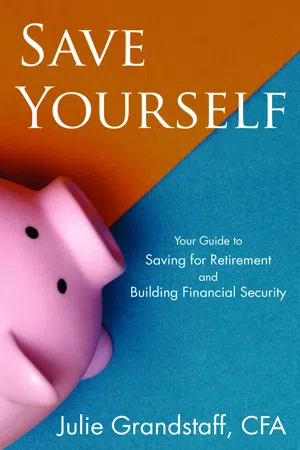
eBook - ePub
Save Yourself
Your Guide to Saving for Retirement and Building Financial Security
- English
- ePUB (mobile friendly)
- Available on iOS & Android
eBook - ePub
Information
Topic
Desarrollo personalSubtopic
Finanzas personalesPart 1
Chapter 1
The Rise and Fall of Retirement
Each of us has a vision for retirement. We have a specific idea about how we want to live that is unique to us, and we have this vision where we have the time and money to do what we want for many years without working for pay. That ideal is based on lifestyles largely funded by employer-provided pension plans.
But pensions barely exist any longer. Instead our employers are offering us retirement savings plans that have several advantages, but they’re lacking the guaranteed income provided by a traditional pension. We must figure out how to support ourselves for potentially decades on our own savings and investments.
It is becoming increasingly clear that we haven’t adapted well to the shift from pensions to savings plans. Despite the loss of this safety net, Americans are saving less than ever. The Employee Benefit Research Institute estimates that more than four in ten of us won’t be able to pay for our basic needs let alone fund the idyllic retirement we’ve come to expect. How did we get here?
What the Heck Is Retirement?
Retirement wasn’t always a thing. It wasn’t until the 1950s that enough companies offered pension benefits to create an expectation for a few years of leisure after a life of work. Before that, most people simply worked until they couldn’t and then relied on their families or communities for support.
Prior to the turn of the twentieth century, most families lived off the land and took care of each other. It was a hard life that took its toll on the very young and the very old. But you could grow or hunt for the food that you needed, and land was cheap. Money was less important than fertile soil and good weather.
As you grew older, you simply continued to work the land. At some point your eldest son might take over the farm and much of the hard work. But you stayed on and did what work you could, from light farm duties to helping to raise the grandkids.
As the American population migrated to the cities, money became more important. With no land to produce food, the only way to make a living was to work for pay. Work was manual and physically difficult in the early years of the twentieth century. You needed a strong back and stamina to survive a day in a factory job. As you got older, it was just harder to do the work, but you still had to work to live. Maybe you took a job that was less physically demanding for less money, but you still worked.
This was a problem for employers who needed more strong, young workers and fewer old ones. In fact, William Osler, a leading thinker and prominent physician of the day, believed, as did others, that after age sixty, people were pretty much useless in terms of being productive members of the workforce.4
One new idea for getting older workers out of the workplace was to provide them with enough pay that they could survive without a job. At the end of the 1800s, the first pension plans were born. They gave you a monthly benefit based on your pay and came to be known as defined benefit pension plans.
Railroads were among the first to offer pension plans, followed by universities. Public utilities weren’t far behind, and by the 1920s retirement benefits had spread to other industries, such as banking and insurance. Larger cities offered pension plans to city workers, police, and firefighters.5 But it would take a while before they provided much financial security.
A study by the New York Commission on Aging published in 1930 found that 44 percent of people in New York over the age of sixty-five were self-supporting, primarily through work, and more than half were dependent on family and friends.6 Statistics varied in different communities, but if you weren’t working, you were relying on your relatives and your community.
Securing the Seniors
The Great Depression, which lasted from 1929 to 1939, was devastating for many and more so for the elderly. While the unemployment rate for the under-sixty-five set was just over 25 percent, for those over the age of sixty-five, eight in ten were out of work. Many of those who had pensions lost them when businesses collapsed.7 With more of the elderly unable to support themselves, pressure to provide some form of government support was growing.
Other countries, primarily in Europe, had already put public retirement systems in place, beginning with Germany in 1889. In the United States, Franklin Delano Roosevelt initiated the Social Security Act, which was passed in 1935.8 The Social Security system was considered one of the crowning government achievements of the century.
The implementation of Social Security sparked an explosion in the creation of private pension plans. The Committee on Economic Security, which developed the Social Security Act, stated that reaching a retirement income level near 50 percent of a worker’s previous average earnings was “socially desirable.”9
This became a benchmark for pension benefits. With the advent of Social Security, it became less costly for companies to offer pensions that, together with Social Security, met the 50 percent earnings replacement goal.
By 1950, 25 percent of the private workforce was covered by a pension plan.10 Add to that government employees covered by pensions, and a substantial part of the workforce could look forward to an income after they stopped working.
Combined with Social Security, the promise of a pension benefit made a secure retirement—where you didn’t have to work or live with your kids—possible. Best of all, you didn’t have to even think about it beyond sticking with your job long enough to collect.
The wave of pension creations continued through the 1970s. The combination of Social Security and pension plan benefits vastly improved the economic security of the elderly. By the mid-1970s, the poverty rate among the elderly had dropped to just 15 percent, half of what it was fifteen years prior.11
The Beginning of the End of Pension Plans
It was the golden age of pension plans, and it was coming to an end. Regulations and a new government focus on revenue lost to tax-exempt retirement plans chipped away at the foundations of the defined benefit system. They ultimately led to the decline of company-funded pensions.
The First Blow
The first blow was regulatory. The Employee Retirement Income Security Act (ERISA) was enacted in 1974. While the law made great strides in ensuring that pension coverage was fair and equitable and benefits would actually be paid, it inadvertently created an incentive for companies to move away from defined benefit plans.
The law limited the amount of pension benefits that could be paid out. Higher-paid employees, mostly executives, could not have the same income replacement ratio from the pension as lower-paid employees with these caps.
So companies began providing supplemental defined contribution plans to help higher-paid employees make up for the cap on their pension benefits. Defined contribution plans only promise the return of the contributions and whatever investment return they earn instead of a monthly guaranteed payment in retirement, as is the case with defined benefit plans.
In the late 1970s, the government also created section 401(k) of the tax code, which allowed workers to voluntarily contribute a part of their salary pretax to employer-sponsored savings or profit sharing plans. 401(k) plans were a lower-cost and seemingly reasonable alternative to traditional defined benefit plans. They proved to be wildly popular, and growth in 401(k) plans and other defined contribution plans ballooned.12
The Second Blow
In the early 1980s, new accounting rules came out requiring plan sponsors to fund pensions as they were earned instead of funding the full projected benefit across a worker’s career. That meant contributions for younger workers would be lower than if companies simply funded the retirement equally every year. As workers got closer to retirement, contributions would be higher.
Then in 1987, in an attempt to shore up tax revenue without increasing tax rates, Congress adopted new rules designed to limit the tax sheltering offered by pension plans. The rules reduced the amount of pension funding that could be deducted for tax purposes to less than what was necessary to fully fund the pension obligations.
The result of the new accounting and tax rules combined was a virtual requirement to substantially underfund pension benefits early in a worker’s career. This was great for employers as long as their employees were young. The problem came when a large proportion of workers approached retirement age. Then the cost of providing the benefit would explode.13
The Final Blow
The final blow came when the tech bubble burst and stock markets declined from 2000 to 2002. Previously the growing level of pension underfunding had been hidden. Gains in the investment markets in the late 1980s and through the 1990s caused pensions to look flush. That allowed businesses to reduce contribution rates and still maintain a fully funded status per the regulatory requirements.
But the stock market decline revealed the cracks in the system. Over this three-year period, the Dow Jones Industrial Average lost more than 38 percent of its value. At the same time, those workers who had been in the early stages of their careers in the mid-1980s were far closer to retirement and collecting their pension benefits at this point. That meant the costs to fund their retirements grew rapidly.
The combination of weak investment markets and increased funding costs for older employees resulted in big gaps in overall pension funding and large increases in funding expenses for most pension plans. Defined benefit plans began dropping like flies. By 2010, only 14 percent of the private-sector workforce was covered by a defined benefit pension plan, down from a peak of 45 percent.14
Not only are corporate pensions now disappearing, but state and local government pensions are in dire straits as well. On average, municipal pensions are underfunded by 26 percent, and of the fifty largest US cities, twenty won’t be able to pay their pension obligations by 2025.15 Pension benefits are being reduced for those newer to government jobs.
We Should Have Seen It Coming:The Demise of Social Security
Now we...
Table of contents
- Title Page
- Copyright
- Dedication
- Contents
- Acknowledgments
- Introduction
- Part 1
- Part 2
- Part 3
- Endnotes
- Bibliography
- About the Author
Trusted by 375,005 students
Access to over 1.5 million titles for a fair monthly price.
Study more efficiently using our study tools.
Frequently asked questions
Yes, you can cancel anytime from the Subscription tab in your account settings on the Perlego website. Your subscription will stay active until the end of your current billing period. Learn how to cancel your subscription
No, books cannot be downloaded as external files, such as PDFs, for use outside of Perlego. However, you can download books within the Perlego app for offline reading on mobile or tablet. Learn how to download books offline
Perlego offers two plans: Essential and Complete
- Essential is ideal for learners and professionals who enjoy exploring a wide range of subjects. Access the Essential Library with 800,000+ trusted titles and best-sellers across business, personal growth, and the humanities. Includes unlimited reading time and Standard Read Aloud voice.
- Complete: Perfect for advanced learners and researchers needing full, unrestricted access. Unlock 1.5M+ books across hundreds of subjects, including academic and specialized titles. The Complete Plan also includes advanced features like Premium Read Aloud and Research Assistant.
We are an online textbook subscription service, where you can get access to an entire online library for less than the price of a single book per month. With over 1.5 million books across 990+ topics, we’ve got you covered! Learn about our mission
Look out for the read-aloud symbol on your next book to see if you can listen to it. The read-aloud tool reads text aloud for you, highlighting the text as it is being read. You can pause it, speed it up and slow it down. Learn more about Read Aloud
Yes! You can use the Perlego app on both iOS and Android devices to read anytime, anywhere — even offline. Perfect for commutes or when you’re on the go.
Please note we cannot support devices running on iOS 13 and Android 7 or earlier. Learn more about using the app
Please note we cannot support devices running on iOS 13 and Android 7 or earlier. Learn more about using the app
Yes, you can access Save Yourself by Julie Grandstaff in PDF and/or ePUB format, as well as other popular books in Desarrollo personal & Finanzas personales. We have over 1.5 million books available in our catalogue for you to explore.