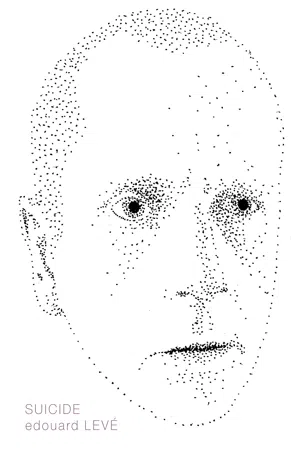
One Saturday in the month of August, you leave your home wearing your tennis gear, accompanied by your wife. In the middle of the garden you point out to her that you’ve forgotten your racket in the house. You go back to look for it, but instead of making your way toward the cupboard in the entryway where you normally keep it, you head down into the basement. Your wife doesn’t notice this. She stays outside. The weather is fine. She’s making the most of the sun. A few moments later she hears a gunshot. She rushes into the house, cries out your name, notices that the door to the stairway leading to the basement is open, goes down, and finds you there. You’ve put a bullet in your head with the rifle you had carefully prepared. On the table, you left a comic book open to a double-page spread. In the heat of the moment, your wife leans on the table; the book falls closed before she understands that this was your final message.
I have never gone into this house. Yet I know the garden, the ground floor, and the basement. I’ve replayed the scene hundreds of times, always in the same settings, those I imagined upon first hearing the account of your suicide. The house is on a street, it has a roof and a rear façade. Though none of that is real. There’s the garden where you go out into the sunlight for the last time and where your wife waits for you. There is the façade she runs toward when she hears the gunshot. There is the entryway where you keep your racket, there’s the door to the basement and the stairway. Finally there’s the basement where your body lies. It is intact. From what I’ve been told, your skull hasn’t exploded. You’re like a young tennis player resting on the lawn after a match. You could be sleeping. You are twenty-five years old. You now know more about death than I do.
Your wife screams. No one is there to hear her, aside from you. The two of you are alone in the house. In tears, she throws herself on you and beats your chest out of love and rage. She takes you in her arms and speaks to you. She sobs and falls against you. Her hands slide over the cold, damp basement floor. Her fingers scrape the ground. She stays for fifteen minutes and feels your body go cold. The telephone brings her out of her torpor. She finds the strength to get up. It’s the person with whom you had a tennis date.
“Hello, what’s going on? I’m waiting for you.”
“He’s dead. Dead,” she responds.
The scene stops there. Who removed the body? The firemen? The police? Since murder can be disguised as suicide, did a forensic pathologist do an autopsy? Was there an inquest? Who decided that it was a suicide and not a crime? Did they question your wife? Were they sensitive or were they suspicious when talking to her? Did she have the pain of being a suspect added to the pain of your disappearance?
I haven’t seen your wife since. I hardly knew her. I met her four or five times. When the two of you got married, you and I stopped seeing each other. I see her face again now. It has remained unchanged for twenty years. I’ve retained a fixed image of her from the last time I saw her. Memory, like photographs, freezes recollections.
You spent your life in three houses. When your mother was pregnant with you, your parents lived in a small apartment. Your father didn’t want his children to grow up cramped. He used to say “my children,” although he only had the one at that point. With your mother, he visited a partially dilapidated château belonging to a retired colonel of the Légion who had never moved in because he deemed the place to be in too great a state of disrepair for it to be habitable. Your father, director of a public works contracting firm, didn’t seem put off by the scale of the repairs. Your mother liked the grounds. They moved in, in April. You were born in a clinic on Christmas day. A servant kept three fires going in the château at all times: one in the kitchen, one in the living room, and one in your parents’ bedroom, where you slept during the first two years of your life. When your brother was born, repairs had still not progressed. You lived in precarious luxury for three more years, until the birth of your sister. It was after your parents had decided to look for a more comfortable place that your father announced to your mother that he was leaving her. She found a house that was smaller and less beautiful than the château, but warmer and more welcoming. There you had your second bedroom, which you occupied until leaving to live with your wife at twenty-one years of age. The little house you shared with her contained your third bedroom. It was your last.
The first time I saw you, you were in your bedroom. You were seventeen years old. You were living in your mother’s house, on the first floor, between your brother’s and your sister’s bedrooms. You rarely left your room. The door was locked, even when you were inside. Your brother and your sister have no memory of ever entering it. If they had something to tell you, they would speak through the door. No one came in to clean up; you did it yourself. I don’t know why you came to open the door for me when I knocked. You didn’t ask who it was. What made you guess it was me? My manner of approach, of making the floorboards creak? Your shutters were closed. The room was bathed in a soft red light. You were listening to “I Talk to the Wind” by King Crimson, and you were smoking. It made me think of a nightclub. It was broad daylight outside.
Your wife only remembered later that before falling from the table, the comic book you had left there was open. Your father bought dozens of copies, which he gave to everyone. He came to know the text and the images of this book by heart; this was not at all like him, but he ended up identifying with the comic. He is looking for the page, and on the page for the sentence, that you had chosen. He keeps a record of his reflections in a file, which is always on his desk and on which is written “Suicide Hypotheses.” If you open the cupboard to the left of his desk, you’ll find ten identical folders filled with handwritten pages bearing the same label. He cites the captions of the comic book as if they were prophecies.
Since you seldom spoke, you were rarely wrong. You seldom spoke because you seldom went out. If you did go out, you listened and watched. Now, since you no longer speak, you will always be right. In truth, you do still speak: through those, like me, who bring you back to life and interrogate you. We hear your responses and admire their wisdom. If the facts turn out to contradict your counsel, we blame ourselves for having misinterpreted you. Yours are the truths, ours are the errors.
You remain alive insofar as those who have known you outlive you. You will die with the last of them. Unless some of them have made you live on in words, in the memory of their children. For how many generations will you live on like this, as a character from a story?
You went to a concert in Paris. At the end of the first set the singer cut open a vein and sprayed his blood over the first few rows, tracing out circular arcs with his arms. Your brown leather jacket got a few drops on it, which drops then got lost in its general color when they dried. After the concert, you went with the friends who were with you to a café, the name of which you forgot. You spoke to strangers for hours. Afterward you walked the streets in search of other cafés, but they were closed. You stretched out on the park benches of a square near the Gare Saint-Lazare, and you remarked on the shape of the clouds. At six o’clock you had breakfast. At seven you took the first train home. When, the next day, your friends repeated to you the words you had spoken to strangers in the café, you remembered nothing of them. It was as though someone else inside you had spoken. You recognized neither your words, nor your thoughts, but you liked them better than you would have if you had remembered saying them. Often all it took was for someone else to speak your own words back to you for you to like them. You would note down those sayings of yours that were repeated back to you. You were the author of this text twice over.
Your life was a hypothesis. Those who die old are made of the past. Thinking of them, one thinks of what they have done. Thinking of you, one thinks of what you could have become. You were, and you will remain, made up of possibilities.
Your suicide was the most important thing you ever said, but you’ll never be able to enjoy the fruits of this labor.
Given that I am speaking to you, are you dead?
If you were still alive, would we be friends? I was more attached to other boys. But time has seen me drift apart from them without my even noticing. All that would be needed to renew the bond would be a telephone call, but none of us are willing to risk the disillusionment of a reunion. Your silence has become a form of eloquence. But they, who can still speak, remain silent. I no longer think of them, those with whom I was formerly so close. But you, who used to be so far-off, distant, mysterious, now seem quite close to me. When I am in doubt, I solicit your advice. Your responses satisfy me better than those the others could give me. You accompany me faithfully wherever I may be. It is they who have disappeared. You are the present.
You are a book that speaks to me whenever I need it. Your death has written your life.
You don’t make me sad, but solemn. You impair my incurable frivolity. Whenever I am too spontaneous and self-centered, and, for some reason or other, your face appears to me, I realize again the importance of the people around me. I see things from a perspective I’m rarely able to achieve. I take advantage on your behalf of things you can no longer experience. Dead, you make me more alive.
You were five years old, and you still couldn’t manage to slip on a sweater. Although two years your junior, your brother showed you how it’s done. Your father belittled you by suggesting, mockingly, that you try to live up to your little brother’s example, and in the end declared you incapable of it. Your brother, who admired you just as much as he did your father, was caught between two authorities. Not wanting to hurt anyone, he didn’t brag about your father’s praise. His modesty completed your humiliation.
You lie alone in a stone tomb upon which your first and last names are engraved in gold lettering. Below can be read the date of your birth and that of your death, separated by twenty-five years.
When I hear of a suicide, I think of you again. Yet, when I hear that someone died of cancer, I don’t think of my grandfather and grandmother, who also died of it. They share cancer with millions of others. You, however, own suicide.
A ruin is an accidental aesthetic object. If it becomes beautiful, this was certainly not the intention. A ruin is not constructed or maintained. The tendency of a ruin is to crumble down into a heap. The most beautiful parts remain standing despite their wear and tear. The memory of you is what stays up, your body what subsides. Your ghost remains upright in my memory, while your skeleton is decomposing in the earth.
You were glad to be born on the twenty-fifth of December: “All the people celebrating don’t realize that it’s my party too. Being forgotten spares me the trouble of having to shine.”
A man once said “I love you” to you. It wasn’t me. I didn’t feel that way about you while you were alive, but today I can say the same thing, though it wouldn’t be the sort of love formerly declared to you. My words come too late. They would not have changed your decision, but they would have changed the way I remember. To love someone from the moment of his death: is that friendship?
I have only one photograph of you. I took it on your birthday. You were at our place. My mother had baked a cake. I had prepared my camera in advance to avoid your having to act out the scene several times for the photo.
I took the photo without flash while you were blowing out the candles. The image is blurred. It’s in black and white. Your cheeks are hollow from blowing, your lips pursed to expel the air. I had composed the shot around you; no one else can be seen. You were wearing a thick woolen sweater. Life rushes from your lungs to put out the flames. You look happy.
Having died young, you will never be old.
Your grandfather used to speak even less than you did. He would smile in silence when passing by with his fishing rod, walking along the line of trees in order to take the path that led along the riverbank that demarcated the boundary of the park and which was where he was going to spend the afternoon. One day, when I was doing stunts on the branches above the water, my watch fell in. Years later, in the run of a dry summer, the river being low, your grandfather found it. I wound it up again. It started. You’d been dead for two years.
A woman who was a friend of yours, whose father-in-law ran a big hotel, got you a summer job. You were a porter and a housekeeper. I had some difficulty imagining you in a bellhop’s uniform, with antique cloak and a red and black cap. Cleaning the rooms, you found some strange objects. One day, in the night-table drawer of a man whom you had identified as “the banker,” you discovered a collection of homosexual pornographic magazines, still wrapped in plastic, and a never-used dildo. You showed them to me. You had left the magazines unopened. Were these discovered again after your death? What did people make of their presence in your home?
You often spoke to me about Ruin of the Garnieri. Its author, Prospero Miti, didn’t use to reread his printed works; he would only look at the proofs. One day, as an exception, he did reread one of them, and he realized that the order of the chapters did not correspond to what he had written. Since he liked the book this way, he didn’t ask for future editions to be corrected. You came across this anecdote after having read the book. You never tired of rereading it to try and discover the original order.
You used to take the elevator to go down, but not to go up.
You used to believe that with age you would become less unhappy, because you then would have reasons to be sad. When you were still young, your suffering was inconsolable because you believed it to be unfounded.
Your suicide was scandalously beautiful.
One day, in winter, you set out across the countryside alone on horseback. It was four o’clock. Night fell when you were sti...