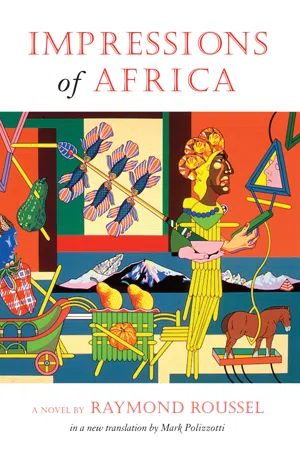
In a mythical African land, some shipwrecked and uniquely talented passengers stage a grand gala to entertain themselves and their captor, the great chieftain Talou. In performance after bizarre performance—starring, among others, a zither-playing worm, a marksman who can peel an egg at fifty yards, a railway car that rolls on calves' lungs, and fabulous machines that paint, weave, and compose music—Raymond Roussel demonstrates why it is that André Breton termed him "the greatest mesmerizer of modern times." But even more remarkable than the mind-bending events Roussel details—as well as their outlandish, touching, or tawdry backstories—is the principle behind the novel's genesis, a complex system of puns and double-entendres that anticipated (and helped inspire) such movements as Surrealism and Oulipo. Newly translated and with an introduction by Mark Polizzotti, this edition of Impressions of Africa vividly restores the humor, linguistic legerdemain, and conceptual wonder of Raymond Roussel's magnum opus.
- 280 pages
- English
- ePUB (mobile friendly)
- Available on iOS & Android
eBook - ePub
Impressions of Africa
About this book
Information
I
AT AROUND FOUR P.M. that June 25th, everything seemed ready for the coronation of Talou VII, Emperor of Ponukele and King of Drelchkaff.
Though the sun had passed its zenith, the heat remained stifling in that region of equatorial Africa, and we all sweltered in the sultry atmosphere that no breeze came to relieve.
Before me stretched vast Trophy Square, located in the very heart of Ejur, the imposing capital formed by countless huts and lapped by the Atlantic Ocean, whose distant roar I could hear to my left.
The perfect quadrangle of the esplanade was bordered on each side by a row of venerable sycamores. From spears planted deep into the bark of each trunk dangled severed heads, banners, and ornaments of every kind, which Talou VII or his ancestors had amassed there upon returning from many a victorious campaign.
To my right, before the midpoint of the row of trees, a red stage stood like a giant puppet theater; its pediment bore the words “The Incomparables Club” in silver letters forming three lines, around which broad golden strokes radiated like sun’s rays.
On the visible stage, a table and chair appeared to be set for a lecturer. Several unframed portraits were pinned to the backdrop, underscored by an explanatory label that read “The Electors of Brandenburg.”
Closer to me, in line with the red theater, rose a large wooden pedestal on which Nair, a young Negro of barely twenty, was standing doubled over, absorbed in an engrossing task. To his right, two stakes, each planted at a corner of the pedestal, were joined at their uppermost tips by a long, supple thread that sagged under the weight of three objects hanging in a row, displayed like fairground prizes. The first item was none other than a bowler hat, the black crown of which bore the word “PINCHED” written in dirty white capitals; then came a dark gray suede glove turned palm outward and decorated with a “C” lightly traced in chalk; and last hung a light sheet of parchment covered in obscure hieroglyphs, its header boasting a rather crude sketch of five caricatures made plainly ridiculous by their poses and exaggerated features.
Imprisoned on his pedestal, Nair’s right foot was collared by a noose of thick rope firmly anchored to the solid platform; like a living statue, he performed a series of slow, regular movements while rapidly murmuring a string of words he’d committed to memory. In front of him, placed on a specially shaped stand, a fragile pyramid fashioned from three joined pieces of bark captured his full attention; the base, turned toward him and slightly raised, served as his weaving loom. Within reach, on an annex to the base, was a supply of fruit husks covered on the outside by a grayish vegetal substance much like the cocoon of a larva about to transform into a chrysalis. By pinching a fragment of these delicate envelopes with two fingers and slowly pulling back his hand, the youth created a flexible bond, reminiscent of the gossamer threads that stretch across the woods in springtime. These imperceptible strands helped him weave a subtle and complex embroidery, for his two hands worked with unparalleled agility, crossing, knotting, intermingling the fairylike ligatures into graceful patterns. The phrases he tonelessly recited served to regulate his perilous and precise maneuvers, for the smallest slip could have caused the whole structure irreparable damage. If not for the aid of a certain formula memorized word for word, Nair could never have reached his goal.
Lower down, to the right, other toppled pyramids at the edge of the pedestal—their tips facing away from the viewer—allowed one to appreciate the effect of these labors, once completed; each upright base was indicated by almost nonexistent tissue, more ephemeral than a spider’s web. In each, a red flower held by its stem irresistibly drew the viewer’s gaze through the imperceptible veil of the ethereal weave.
Not far from the Incomparables’ stage, to the actor’s right, two stakes set four to five feet apart supported a moving apparatus. A long pivot extended from the nearer of the two, around which a scroll of yellowed parchment was compressed into a thick roll; solidly nailed to the farther stake, a square board laid as a platform served as base for a vertical cylinder slowly made to revolve by clockwork.
The yellowish scroll, unspooling tautly over the entire length of the intervening gap, wrapped around the cylinder, which, turning on its axis, ceaselessly pulled it toward the other side, gradually depleting the pivot that was forced to spin along with it.
The parchment showed groups of savage warriors, rendered in broad strokes, parading by in highly varied poses. One cohort seemed to be in mad pursuit of the fleeing foe; another, crouching behind an embankment, awaited its moment to burst forth; here, two equally matched phalanxes engaged in fierce hand-to-hand combat; there, fresh troops surged bravely forward with grand gestures toward a distant melee. The continual procession offered endless surprises, owing to the infinite number of effects obtained.
Opposite, at the far end of the esplanade, rose a kind of altar preceded by several steps covered with a thick carpet. From a distance, a coat of white paint veined with bluish lines gave the whole the appearance of marble.
On the Communion table, represented by a long board placed halfway up the structure and covered with a cloth, one could see a rectangle of parchment dotted with hieroglyphics standing near a heavy cruet full of oil. Next to this, a large sheet of stiff luxurious paper bore the title, “Reigning House of Ponukele-Drelchkaff,” written scrupulously in Gothic letters. Beneath this heading, a round portrait, a kind of delicately colored miniature, depicted two young Spanish girls aged thirteen or fourteen, coiffed in the national mantilla—twin sisters, judging by their perfect resemblance. At first glance, the image seemed part and parcel of the document; but upon closer inspection, one noticed a wide band of transparent muslin, glued onto both the circumference of the painted disk and the surface of the durable vellum, that melded the two objects seamlessly, though they were in fact separate. To the left of the dual effigy, the name “SUANN” paraded in large capitals; beneath it, a genealogical chart comprising two distinct branches, descended from the two lovely Iberians who formed the apex, occupied the rest of the sheet. One of these lineages ended with the word “Extinction,” in letters almost as large as the title, clearly meant to catch the eye; by contrast, the other, stretching a bit lower than its neighbor, seemed to defy the future with the absence of any concluding sign.
Near the altar, to the right, a giant palm tree flourished, its admirable breadth attesting to its great age; a handwritten sign affixed to the trunk offered this commemorative phrase: “Restoration of the Emperor Talou IV to the throne of his forefathers.” Off to one side and sheltered by the palms, a stake planted in the ground supported a soft-boiled egg on the square ledge of its upper tip.
To the left, at an equal distance from the altar, a tall plant, but old and pitiful, made a sorry complement to the resplendent palm; this was a rubber tree, its sap run dry and in a state of near rot. A litter of branches placed in its shade supported the recumbent corpse of the Negro king Yaour IX, classically costumed as Gretchen from Faust in a pink woolen dress with alms purse and thick blonde wig, its long yellow plaits, thrown over his shoulders, reaching almost to his legs.
To my left, backed against the row of sycamores and facing the red theater, a stone-colored edifice looked like a miniature version of the Paris Stock Exchange.
Between this structure and the northwest corner of the esplanade stood a row of life-size statues.
The first showed a man mortally wounded by a spear plunged into his breast. Instinctively, his two hands clutched at the shaft; his body arched back on the verge of collapse as his legs buckled under the weight. The statue was black and at first appeared to be all of a piece; but gradually one’s eye discovered a multitude of furrows running in all directions, forming clusters of parallel striations. In reality, the work was composed entirely of numerous whalebone corset stays cut and molded as the contours dictated. Flathead nails, their tips evidently bent beneath the surface, jointed these supple strips together so artfully that not the slightest gap remained between them. The face, its nose, lips, eyebrows, and eye sockets faithfully reproduced by minutely arranged little sections, bore a finely rendered expression of pain and anguish. The shaft of the weapon buried in the dying man’s heart suggested some great difficulty overcome, thanks to the elegant handle that showed two or three stays cut into small rings. The muscular body, clenched arms, and nervous, crooked legs all seemed to tremble or suffer, due to the striking, flawless curves imposed on the invariable dark-colored strips.
The statue’s feet rested on a simple vehicle, its low platform and four wheels composed of other black, ingeniously combined whalebone stays. Two narrow rails, made from some raw, reddish, gelatinous substance, which was none other than calves’ lungs, ran along a dark wooden surface and, by their form if not their color, created the precise illusion of a section of railroad track. It was onto these tracks that the four immobile wheels fit, without crushing them.
The surface supporting the tracks formed the top of a jet black wooden plinth, the front of which bore a white inscription with these words: “The Death of the Helot Saridakis.” Below it, also in milky letters, one saw this phrase, half-Greek and half-French, accompanied by a slim bracket:
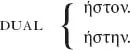
Next to the helot, the bust of a thinker with knit brow wore an expression of intense and fruitful meditation. On the stand one could read the name:
IMMANUEL KANT
After this came a group of sculptures depicting a thrilling scene. A cavalry officer with the face of a thug seemed to be interrogating a nun flattened against the door of her convent. Behind them, in bas-relief, other men-at-arms mounted on fierce steeds awaited orders from their chief. On the base, in chiseled letters, the title The Nun Perpetua’s Lie was followed by the question, “Is this where the fugitives are hiding?”
Farther on, a curious recreation, accompanied by the explanatory caption, “The Regent Bowing before Louis XV,” showed Philippe d’Orléans paying his respects to the ten-year-old child king, who maintained a pose full of natural, unconscious majesty.
Unlike the helot, the bust and these two complex groupings were made of what looked like terracotta.
Calm and vigilant, Norbert Montalescot strolled among his works, watching especially over the helot, whose fragility made a careless jostle from some passerby a matter of special concern.
Past the final statue stood a small cabin with no doors, its four walls, of equal width, made of heavy black cloth that in all likeli-hood left the interior completely dark. The gently sloped roof was strangely composed of book pages, yellowed by time and trimmed into tiles; the text, fairly large and exclusively in English, was faded or completely erased, but the visible headers of certain pages still bore the clearly printed title The Fair Maid of Perth. The middle of the roof contained a hermetically sealed skylight, made not of glass but of similar pages, also discolored by wear and age. This delicate tiling no doubt filtered a diffuse, yellowish light, soft and restful.
A kind of chord, suggesting the timbre of brass instruments but much fainter, escaped at regular intervals from inside the cabin, like musical breaths.
Just opposite Nair, a tombstone, in perfect alignment with the Stock Exchange, supported various elements of a Zouave’s uniform. A rifle and cartridge pouches lay alongside these military effects, which to all appearances served as a pious memento of the departed.
Rising vertically behind the funerary slab, a panel draped in black fabric offered a series of twelve watercolors, arranged in threes over four even, symmetrically stacked rows. Given the similarity of the characters depicted, the suite of paintings seemed to relate some continuous dramatic narrative. Above each image one could read, like a title, several words traced with a brush.
On the first sheet, a noncommissioned officer and a flamboyantly attired blonde were camped in the back of a luxuriously appointed victoria; the words “Flora and Lieutenant Lécurou” summarily designated the couple.
Then came “The Performance of Daedalus,” represented by a wide stage on which a figure in a Greek toga appeared to be singing lustily; in the front row of a box, one again found the lieutenant sitting beside Flora, who was training her opera glasses on the performer.
In “The Consultation,” an old crone wearing an ample sleeveless cloak drew Flora’s attention to a celestial planisphere pinned to the wall, and leveled an authoritative finger at the constellation Cancer.
“The Secret Correspondence,” inaugurating a second row of images, showed the woman in the cloak offering Flora one of those special grilles composed of a single sheet of cardboard with strange holes punched out, which are used in deciphering cryptograms.
“The Signal” took as its décor a nearly empty sidewalk café, at the front of which a tanned Zouave, sitting alone, indicated to the waiter a large bell tolling atop a neighboring church; below it, one could read this brief dialogue: “Waiter, what is that ringing?” “That’s the Benediction.” “In that case, bring me a harlequin.”
“The Lieutenant’s Jealousy” showed a barracks courtyard in which Lécurou, raising four fingers of his right hand, seemed to be furiously upbraiding the Zouave from the preceding image; the scene was accompanied by this blunt phrase in military slang: “Four days in the cooler!”
At the head of the third row, “The Bravo’s Rebellion” introduced into the plot a very blond Zouave who, refusing to execute one of Lécurou’s orders, answered with the single word “No!” inscribed under the watercolor.
“The Convict’s Execution,” underscored by the command “Aim!” depicted a firing squad that, at the lieutenant’s orders, trained its rifles at the heart of the golden-haired Zouave.
In “The Usurious Loan,” the crone in the cloak reappeared to hand Flora several banknotes; sitting at a desk, the latter seemed to be signing some kind of IOU.
The final row commenced with “The Police Raid the Gambling Den.” This time, one saw a wide balcony and Flora hurling herself into the void, while through the open window, around a large gaming table, gamblers recoiled in horror at the unexpected arrival of several black-suited men.
The penultimate tableau, titled “The Morgue,” showed a frontal view of a woman’s corpse lying on a slab behind a pane of glass; plainly visible in the background, a silver chain sagged beneath the weight of a precious watch.
Finally, “The Fatal Blow” ended the series with a nocturnal landscape; in the half-light, one made out the tanned Zouave slapping Lieutenant Lécurou, while in the distance, standing out against a thicket of ship’s masts, a placard lit by a bright lantern bore the three words, “Port of Bougie.”
At my back, a dark rectangular structure of meager dimensions stood as a complement to the altar, a light grill with narrow bars of black-painted wood forming its façade. Four native detainees, two men and two women, paced quietly inside this exiguous prison. Above the grill, red letters spelled the word “Jail.”
Next to me, the sizable group of passengers from the Lynceus stood waiting for the promised parade to begin.
II
SOON THE SHUFFLE of footsteps could be heard. All eyes turned to the left, and from the southwest corner of the esplanade we saw ...
Table of contents
- Cover
- Other Works by Raymond Roussel in English Translation
- Title Page
- Copyright
- Contents
- Introduction: A Child’s Garden of Eccentricities
- Chapter I
- Chapter II
- Chapter III
- Chapter IV
- Chapter V
- Chapter VI
- Chapter VII
- Chapter VIII
- Chapter IX
- Chapter X
- Chapter XI
- Chapter XII
- Chapter XIII
- Chapter XIV
- Chapter XV
- Chapter XVI
- Chapter XVII
- Chapter XVIII
- Chapter XIX
- Chapter XX
- Chapter XXI
- Chapter XXII
- Chapter XXIII
- Chapter XXIV
- Chapter XXV
- Chapter XXVI
- About the Authors
Trusted by 375,005 students
Access to over 1.5 million titles for a fair monthly price.
Study more efficiently using our study tools.
Frequently asked questions
Yes, you can cancel anytime from the Subscription tab in your account settings on the Perlego website. Your subscription will stay active until the end of your current billing period. Learn how to cancel your subscription
No, books cannot be downloaded as external files, such as PDFs, for use outside of Perlego. However, you can download books within the Perlego app for offline reading on mobile or tablet. Learn how to download books offline
Perlego offers two plans: Essential and Complete
- Essential is ideal for learners and professionals who enjoy exploring a wide range of subjects. Access the Essential Library with 800,000+ trusted titles and best-sellers across business, personal growth, and the humanities. Includes unlimited reading time and Standard Read Aloud voice.
- Complete: Perfect for advanced learners and researchers needing full, unrestricted access. Unlock 1.5M+ books across hundreds of subjects, including academic and specialized titles. The Complete Plan also includes advanced features like Premium Read Aloud and Research Assistant.
We are an online textbook subscription service, where you can get access to an entire online library for less than the price of a single book per month. With over 1.5 million books across 990+ topics, we’ve got you covered! Learn about our mission
Look out for the read-aloud symbol on your next book to see if you can listen to it. The read-aloud tool reads text aloud for you, highlighting the text as it is being read. You can pause it, speed it up and slow it down. Learn more about Read Aloud
Yes! You can use the Perlego app on both iOS and Android devices to read anytime, anywhere — even offline. Perfect for commutes or when you’re on the go.
Please note we cannot support devices running on iOS 13 and Android 7 or earlier. Learn more about using the app
Please note we cannot support devices running on iOS 13 and Android 7 or earlier. Learn more about using the app
Yes, you can access Impressions of Africa by Raymond Roussel, Mark Polizzotti in PDF and/or ePUB format, as well as other popular books in Literature & Literature General. We have over 1.5 million books available in our catalogue for you to explore.